01 october 2026, Martine Bontjes
The studio of... Wolfgang Ganter and Ria Wank
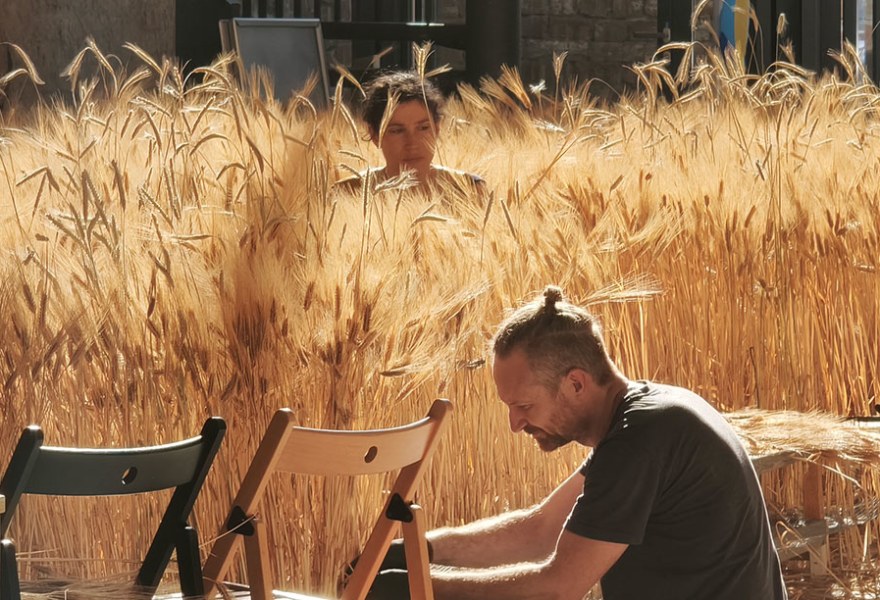
During the first lockdowns of the Covid pandemic, Wolfgang Ganter and Ria Wank decided to visit each other in his studios. That visit turned out to be a permanent one. They have left Berlin for Brandenburg, where they recently purchased a former transformer station that they are currently converting into a space with fifteen studios. Their aim is to create a place where visual artists can work and meet, and to continue the sense of community they had built at Berlin’s Uferhallen.
This spirit of exchange is also reflected in their own work. Ganter and Wank create the ideal conditions for biological and chemical processes to unfold, without fully determining their outcome. Wank guides the growth of plants and root systems, while Ganter works with bacteria and chemical reactions. In ‘Morphogenesis’, their two practices come together. The exhibition is on view at Frank Taal Galerie until 17 October.
You moved from Berlin to Brandenburg. How did you end up there?
In Brandenburg we bought a former transformer station. Well, it was more like a ruin when we got it and we are still fixing it. In the end it will be 15 studios and one flat. The flat and two studios will be for us and the rest will hopefully be an artist community. We try to keep it in the field of visual arts, so that synergy effects can be beneficial for everyone. Ideally similar to the community in Uferhallen Berlin.
The Uferhallen used to be the main central workshop for the Berlin public transport system. About 20 years ago it was converted into artist studios. With growing gentrification it got more uncomfortable, unsafe and expensive. That's basically the reason why we got the place outside of the city. We recently decided to give up Berlin for good and just visit it from time to time.
 Ria Wank, Dürer's Auge, 2025, Frank Taal Galerie
Why did you want to create a space for other artists as well?
Simply because it is always good to have a community around you. Being with friends, talking about art and helping each other is quite important. We've been spoilt for quite some time in Uferhallen and it would be nice to continue with that also here in Brandenburg an der Havel.
When did you meet for the first time? And how did you decide to work together?
Before we knew each other, we knew each other's work. So we decided to do a studio visit. It was Corona time. The first lockdowns had just happened but we still met at my studio. We talked about everything except for our work and pretty soon it was clear that this visit would be permanent. We moved together right away but it took a while until we started the duo exhibitions.
Your practice brings together biological and chemical forces. Do these two have something in common?
Growth and self-organization have been continuous factors in both of our works.
 Wolfgang Ganter, Untitled (Flambement Avec Point De Contact), 2026
Frank Taal Galerie
Wolfgang Ganter, Untitled (Flambement Avec Point De Contact), 2026
Frank Taal GalerieWolfgang, do you have to take any special precautions when working with the bacteria? Or are they harmless?
Years ago, after infecting myself a couple of times, I had to take precautions and started collaborating with scientists. So I could finally learn how to work more controlled and sterile. I also stopped randomly growing bacteria out of everything and concentrated more on soil bacteria. Most of them are harmless.
For some of your works, you use images of paintings. Which museums did you visit to photograph the works used in your current exhibition? And did the museums have any concerns about you photographing their paintings for this purpose?
Well, the museums that had concerns simply didn't give me permission to photograph. Luckily, most of the time I can convince the museums to give me access. For the show at Frank Taal two pieces were photographed in the Gemäldegalerie in Berlin and The Glorification of the Virgin by Geertgen tot Sint Jans is from the Boijmans Van Beuningen collection in Rotterdam. This one I found in an analogue art-historical archive that I acquired.
 Wolfgang Ganter, The Glorification of the Virgin, Geertgen tot Sint Jans, 2018, Frank Taal Galerie
Ria, I understand you follow the growth processes of plants. To what extent are you able to influence or direct their growth?
When you understand what the plant likes best, controlling the root growth is not too difficult. It takes quite some time to understand that. Water flow, oxygen, temperature, and light must be perfectly balanced to ensure healthy growth. If the plant is happy, the roots are happy too... and then so am I.
Your work explores the idea of ‘forced coincidence’: consciously creating the conditions for chance to occur. But chance is actually something beyond our control, right? To what extent does the outcome still come as a surprise to you?
Personally, I don’t like to call it coincidence, as it is difficult to create image compositions purely by accident. When you repeat a technique over and over again, you soon get a very good sense of exactly what needs to be done to achieve the intended result. Coincidence is more like a color—but I am the one guiding the brush.
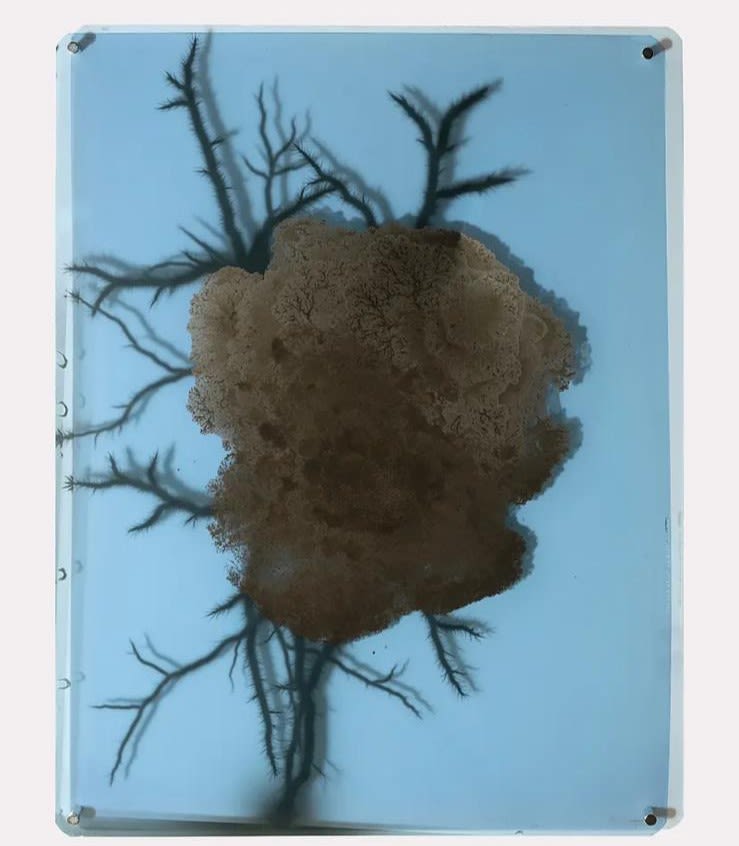 Ria Wank, Pyroclastic x-rays, 2023, Frank Taal Galerie
Some of your images develop over the course of several months, which can seem like a rather long and potentially frustrating process. How do you deal with that uncertainty and waiting?
Waiting is an essential part of my work and always tests my patience. Yet, through my photography, I have learned that perseverance pays off and most of the time it is not very good to stop a process in advance. My work is always accompanied by anticipation and the constant joy of watching something grow, seeing how something tiny is brought to life and develops into something bigger. Of course, things don’t always work out immediately, but that is part of the experience; it allows me to learn and perfect the process.
Are you currently working on a new project together, alongside the renovation of your shared space?
It looks like our exhibition in the Johanniskirche in Brandenburg an der Havel could move to another location. We are currently working on that.
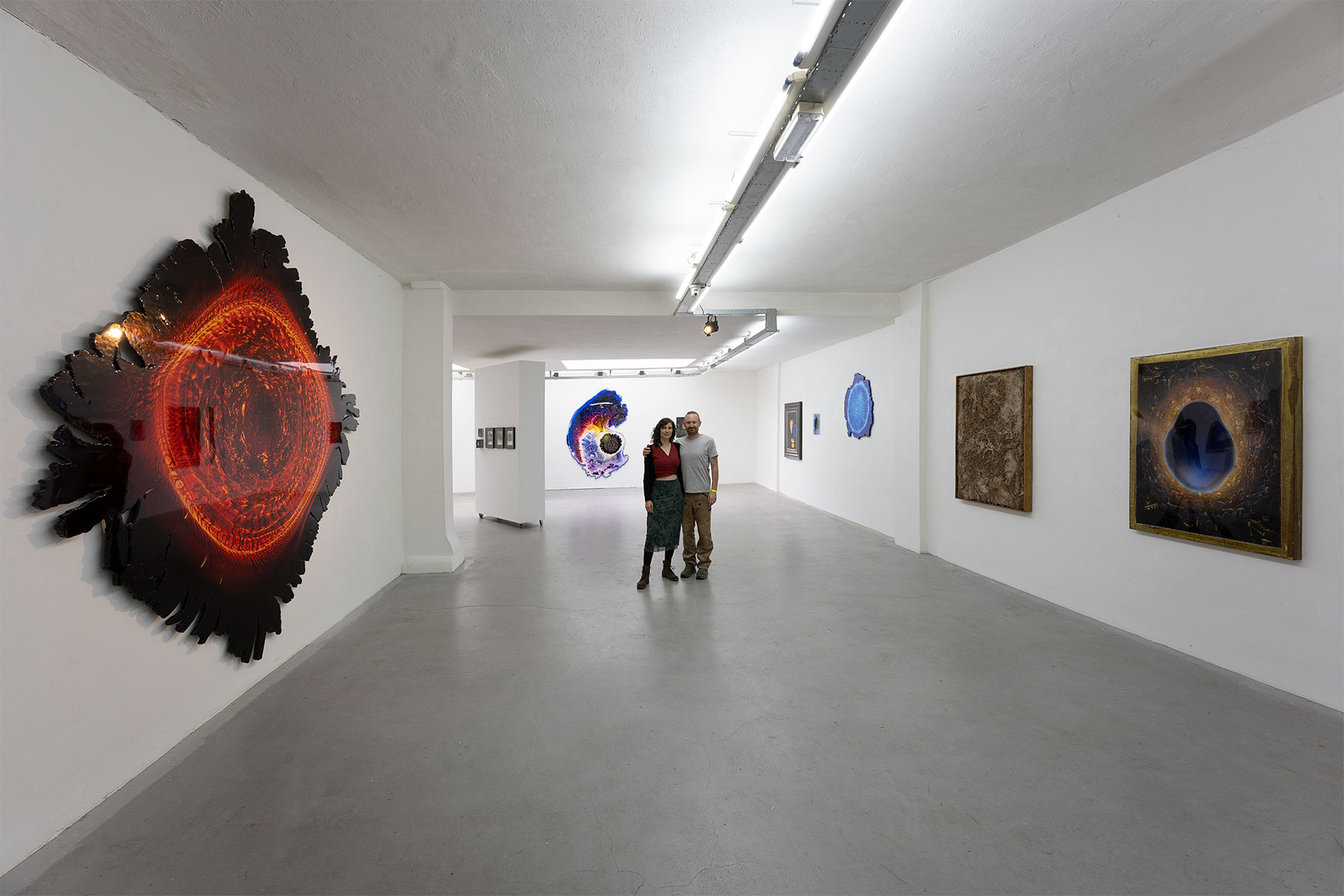 Ria Wank & Wolfgang Ganter, Morphogenesis, Frank Taal Galerie