12 june 2026, Martine Bontjes
The studio of... Jan Theun van Rees
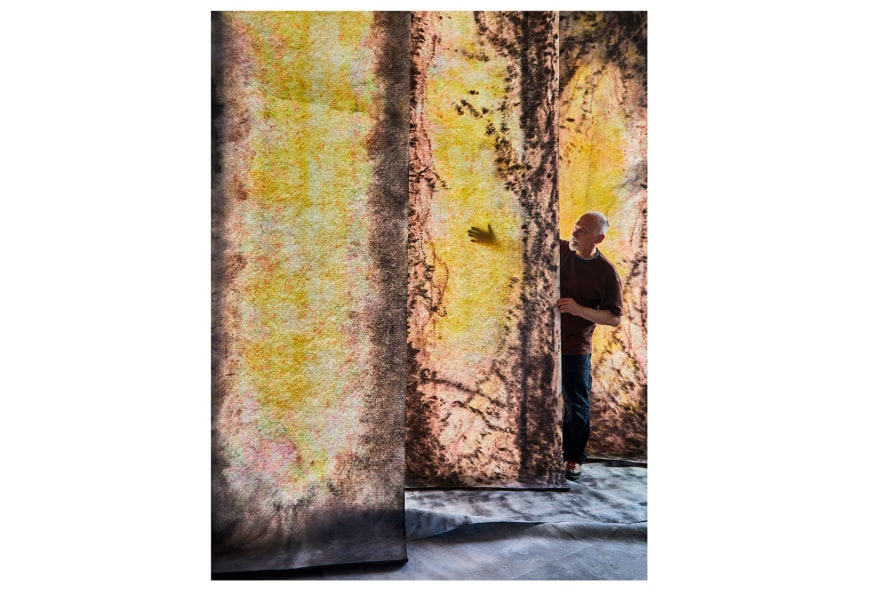
For many years, Jan Theun van Rees photographed stripped spaces in museums and theatres such as the Rijksmuseum and Carré. He documented places that normally remain unseen for the public. His fascination with hidden spaces never disappeared, but existing locations no longer offered what he was looking for. As a result, he began constructing spaces of his own. Nowadays, Van Rees creates his own rooms, passageways and long corridors in which light plays the leading role. His work is currently on view in the group exhibition 'What Holds' at Root Gallery.
Van Rees presents new works including Wild Space, Het licht om de Hoek and Licht Omloop. Together with artists Madelon Uljee, Sophie de Vos and Francisca Snel, he explores what resists being fully captured: a memory, a space or a form. Bringing together photography, wall sculptures and glass objects, the exhibition examines the boundary between what is perceived and what is constructed. 'What Holds' remains on view until 11 July.
You are fascinated by the way light enters and shapes a space. What is the light like in your own studio? Can you describe the place?
The studio is simply the place where I edit and print my photographs. Then again, it is also where I keep my art books, so it serves as a place for contemplation as well. Whenever I photograph a space on location, that space temporarily becomes the studio too.
 Jan Theun van Rees, Het licht om de Hoek, 2026, Root Gallery
What is the first thing you do when you enter your studio?
With making coffee. I start very slowly, as if I first need to arrive. The same happens when I am photographing on location. I spend a long time wandering around and lingering before I finally pick up the camera.
Do you ever receive visitors there, or does this space remain private?
In the end, I work best when I am completely on my own, detached from my social surroundings, as happens during artist residencies. I love looking at art and enjoy discussing it with others, exchanging ideas and experiences. Yet that can sometimes be counterproductive because it distracts from my own work. It is something I occasionally struggle with. Last winter, I spent six weeks without making a single appointment and worked on my photographs without interruption. It worked remarkably well and I would like to do that more often. Self-imposed isolation is like travelling without leaving.
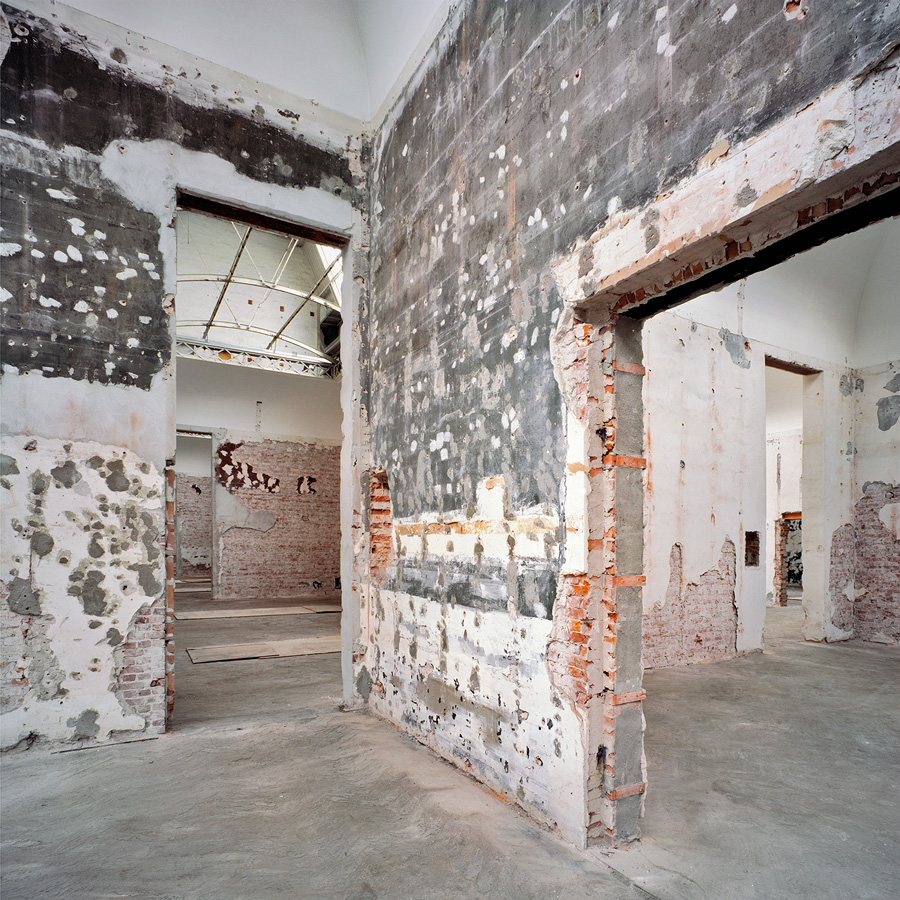 Jan Theun van Rees, Erezaal Stedelijk Museum
For a long time, you photographed what you call "unsightly spaces". What characterises such a place?
These are spaces that are invisible and functionless, such as a crawl space beneath a building. My aim was to photograph them with great care so that the image would become a monument to spaces we usually overlook.
I mainly searched for these hidden spaces in museums and theatres. By presenting these photographs in the public domain, they reveal that reality as we perceive it does not end at the wall. Sometimes an unknown world lies just on the other side of a single partition.
What attracts you to spaces that are in transition?
When everything has been stripped inside a building, the space can be experienced in its purest form, naked and – in my eyes – vulnerable. During renovation, the focus is always on what is to come, on the future. The future is projected onto the walls, while the building itself waits helplessly for what lies ahead. The space as it exists in that moment is not truly seen. In that sense, stripped spaces are closely related to hidden spaces. Two books have been published on these subjects: One Wall Away, Chicago's Hidden Spaces (2007) and Verborgen stad: culturele instellingen op de schop 2003–2012 (2013).
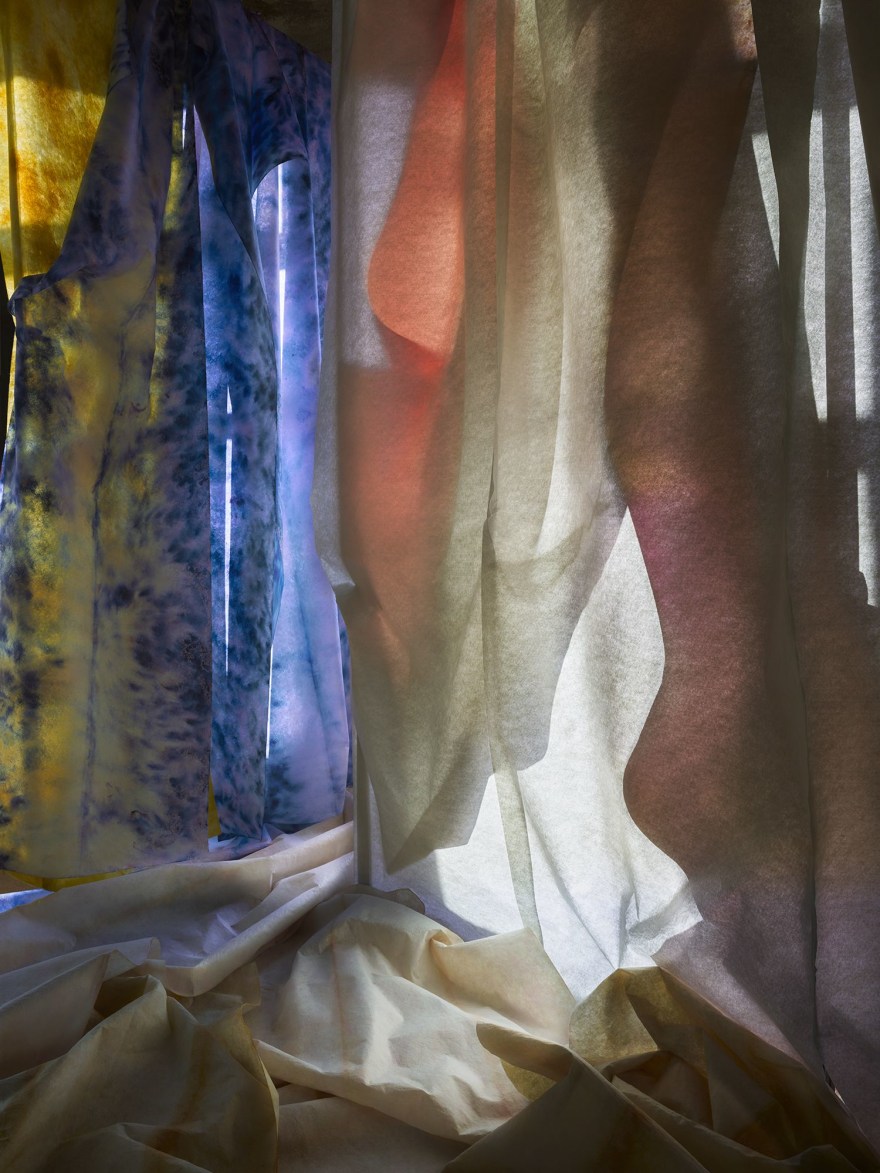 Jan Theun van Rees, Wild Space, 2026, Root Gallery
Over the past several years, you have been building your own spaces. How did that come about?
It was a long process. With hidden and stripped spaces, the significance of the location is important: Het Scheepvaartmuseum, Carré, het Stedelijk Museum and so on. Everyone has a picture in mind of those places. About ten years ago, I felt I had reached the end of that path. The projects were complete and I no longer felt any sense of surprise while photographing. It was time to move in a different direction. When photographing spaces, the interaction between inside and outside gradually became central. The way light enters a space is absolutely decisive. I experiment constantly, for example with camera obscuras, until a desire emerges for a space I cannot fully describe. It is not a concrete place but rather a sensation, an emotion. Yet I do not know where to find a space that corresponds to that feeling. At that point, I decide to build it myself. It is a very slow process. I have no real plan and I am not particularly handy. Gradually, a corridor appears that I can actually walk through and when I take a photograph, the image finally matches the ethereal atmosphere I had imagined.
How does that differ from photographing existing spaces?
I still photograph spaces on location, always searching for striking situations in which architecture and incoming light interact. Through photography, I absorb the space into myself. It is a process of internalisation, moving from the outside inward. Building spaces is an intuitive process in which previous impressions and vague memories help shape the form of the space. You could say it is a process that moves from the inside outward. The interaction between inside and outside therefore also applies to the creative process itself. The spaces I build have no actual location. They are, in effect, a SET. A photograph of a space with a particular quality of light is always situated somewhere and is therefore a SITE. SET and SITE are two sides of the same coin. They complement one another.
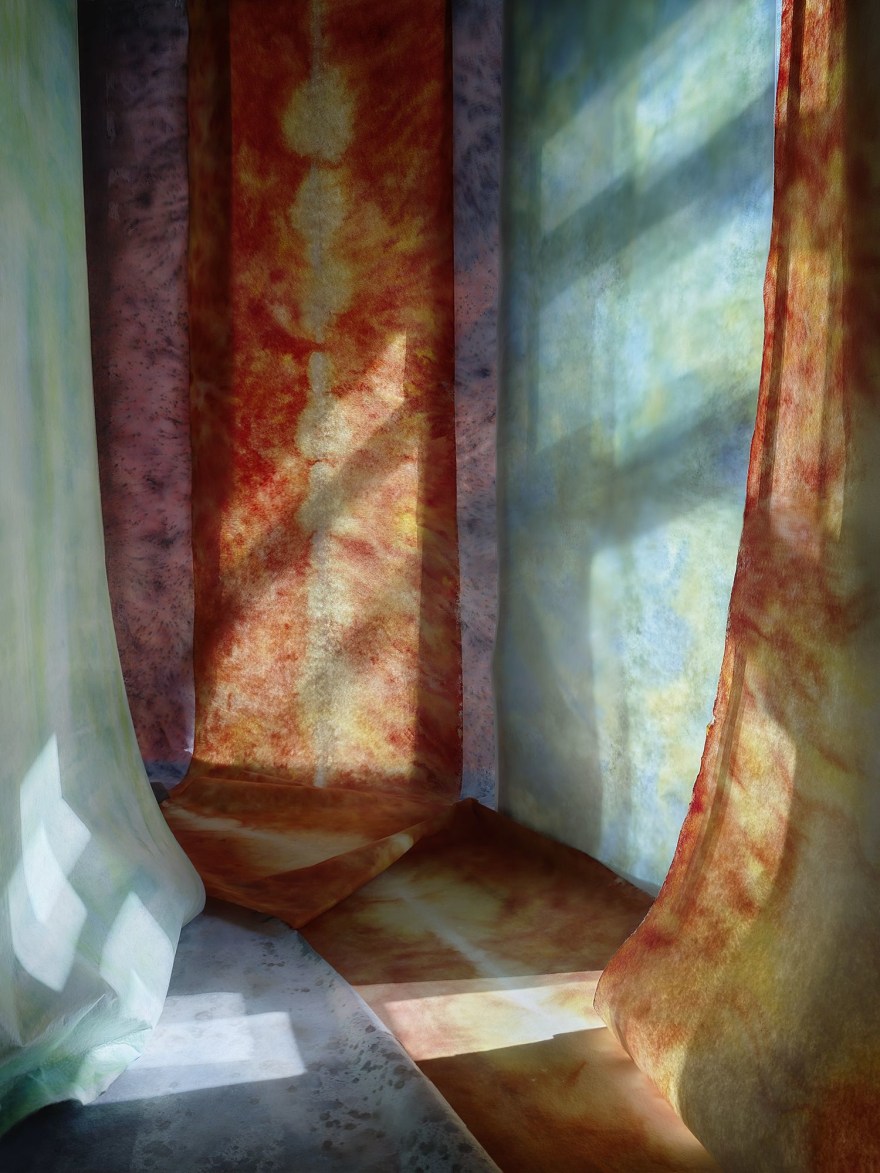 Jan Theun van Rees, Licht Omloop, 2026, Root Gallery
In what kind of studio do you build these SETS?
Initially, I build them in a completely darkened studio. To create the desired lighting effects, I use many different lamps and colour filters. Over time, I found it increasingly difficult to work in the dark. Whenever possible, I now prefer to work in a space with a glass roof. The spaces I build are made from long strips of industrial textile onto which I apply colour. This immediately introduces a connection to painting. An additional surprise is that the shadow of the roof structure is projected onto the SET, creating a relationship with the location itself.
Do you wait for the perfect picture, or do you document every stage of the process?
The building process is always slow. Only once a space is completely finished do I take a photograph. In a sense, the photograph is merely a document of that space. While building, I take many working photographs with my phone. When I scroll through them, I sometimes realise that certain images already contain everything I am looking for. Perhaps I have been too focused on the final result and failed to see that the image was already there. Eventually, I found a way to accelerate the process by increasing its intensity.
I now begin with a simple spatial setup and immediately examine the interaction between the arrangement, the incoming light and the position of the camera. As the sun moves, I adjust the installation and choose a new viewpoint. During a single session, I may make hundreds of photographs. Afterwards, they all have to be reviewed to determine whether an actual image exists among them. That takes a great deal of time as well.
 Jan Theun van Rees, Dag en nacht, 2025, Root Gallery
How did you choose the light for your work Het licht om de hoek?
The diagonal shadows come from a window that remains outside the frame. The back wall stands almost parallel to the incoming light, which first strikes the front surface and shortly afterwards passes through the fabric from behind. In my photographs, spaces usually contain a passage leading to another space, and Het licht om de hoek is no exception. Apparently, that is important to me. You can continue. There is a way forward.
Are you currently working on a new project, or are there future plans that excite you?
Once I have completed Painted Room, I want to intensify the dialogue between SET and SITE in a different way. I already know how I will proceed, but I can't reveal anything further just yet.
 Jan Theun van Rees, Cactus, 2026, Root Gallery