13 february 2026, Yves Joris
Melody of the Elusive: Danielle van Zadelhoff at Ysebaert Gallery
Why Danielle van Zadelhoff leaves the image open
On Melody of the Elusive, shadow, conversations with models and the beginning of a permanent collaboration with Ysebaert Gallery
Just before the opening, the gallery is still a hub of activity. Glasses are being arranged, voices are finding their place, music is playing somewhere that is not yet meant for the public. We are not sitting opposite each other at a table, but standing among the works. And that feels right. The images are present before they are viewed. In that in-between moment—between preparation and anticipation—photographer Danielle van Zadelhoff takes the time to answer my questions.
Dit is geen tentoonstelling die mikt op snelheid of onmiddellijke consumptie. Ze vraagt nabijheid. Stilte. Vertraging. De gebedsnoten van Berger laten zich niet op afstand lezen. Ze moeten worden geopend, letterlijk en figuurlijk. Wat zich binnenin ontvouwt, zijn geen verhalende scènes, maar geconcentreerde momenten uit onze recente geschiedenis. Beelden die zich hebben vastgezet in het geheugen en daar weigeren te verdwijnen.
Why the title Melody of the Elusive?
To me, the title is both highly tangible and not at all. A melody suggests coherence, rhythm, something you can follow. But the elusive slips away again. I find that combination intriguing. The title actually developed from the last video I made, which is also shown here. I like to embed something intangible in my work, something that makes you start to dream.
Yet the word melody also suggests a certain orchestration. How does that relate to your working method?
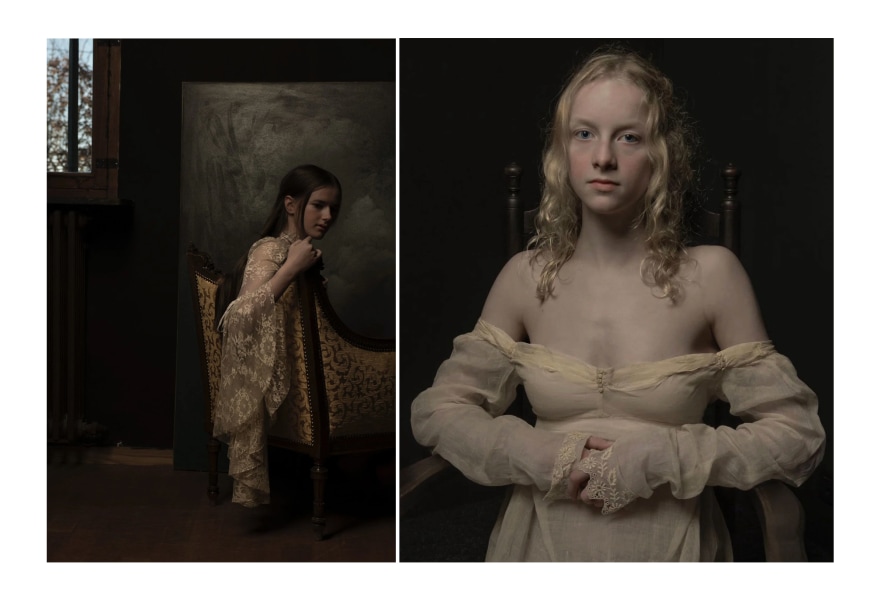
Many people think my work is highly directed, very controlled. That is precisely what I do not want. A model arrives and I try to discover a shared emotion. That happens through conversation, sometimes simply by having coffee together. Those moments are just as, if not more, important as the moment when the camera appears. It’s anything but automatic. You can never fully understand another person; you only have a perception of them. What I try to do is sense where a shared point of connection is found. That is my empathy, my imagination, and I project that onto the image. At the same time, I always leave it open to interpretation. I do not like to pin everything down.
Is photography perhaps also a limiting medium in that sense?
Absolutely, photography is limiting. When you draw, you can go anywhere. With photography, you are bound to your subject. And I am a dreamer, so I try to bring together the past, the unconscious and the conscious by working with light and shadow. My images are not illustrations of thoughts, but carriers of a state of mind. In this way, I embed something that is not literally visible.

Danielle van Zadelhoff, Commedia dell'arte N°21, 2026, Gallery Ysebaert
Sometimes the work feels very spontaneous, yet strongly composed. How does that tension arise?
I never have a fixed image in mind beforehand. I like to compare it to a costume drama. You can become so absorbed in the story that you forget it is about costumes. That is what I hope for with my photographs as well: that you see more than just the ‘performance’. That you believe in it. That the image does not present itself as a construction, but as a natural moment. And that only works if the model does not have to do what I say. We stand there together. We create something together.
I have lots of clothes, attributes, objects. Together with the model—including children—we look at what we are going to make. What do you find important? We talk at length. Then something emerges that we both want to express. Only after that do I look at colour and composition. I might say that something blue is still needed in the image. Then we search together for blue nail polish or a blue object. That is how the image grows. Not as execution, but as discovery.
Was it different with the series about clowns?
Yes, that series was for the opera, so it had to be Commedia dell’arte. I had a lot of clown costumes, but again, the models were allowed to choose for themselves. Together we looked for something that suited them, so that you truly believe it. That credibility is crucial: as soon as the acting becomes visible, the image falls apart.
How did the Commedia dell’arte series come about?
I had a major exhibition at a museum in Romania. It was so immense that it completely blocked me afterward. There were two enormous rooms, specially designed for my work. It overwhelmed me. I thought, do I now have to create number 601 to fill the space? That is something you should not have to expect of yourself as an artist. The scale, the monumentality, was paralysing rather than liberating.
After that, I started working in black and white, returning entirely to the essence. Then a request came from Munich. Meanwhile, the political context also began to play a role, with the American elections. I followed them closely. Not out of political preference, but because of the aggressive communication, the fear, the power of the strongest. It affected me. I love people, I care about protection. I had to do something with that.
I do not like clowns, which is precisely why it was a threshold for me. I wanted to create clowns who are shocked, sad, thoughtful. My feelings are in those figures. Children who cry, girls who do not know what they feel. It is about powerlessness. Do we still have influence? Are we not the clowns ourselves? It is not a political pamphlet, but an invitation to reflect. A question that lingers, without imposing an answer.

Danielle van Zadelhoff, Le temps qui passe 5, 2024, Gallery Ysebaert
You later returned to black and white again. Why?
You later returned to black and white again. Why? After Romania, colour was too much. I wanted to strip everything away. I also began drawing to rediscover myself. It is easy to elaborate on something you are good at, but much harder to examine where you stand, where you want to go, what you want to say. Black and white was not a stylistic choice, but a necessary pause.
Shadow plays a major role in your work. Is this personal?
I was coming out of a difficult period. I could only allow light in where I wanted it. Very bright images did not match my feelings. In shadow, you have to look closely. Nothing is immediately divulged. I love that idea. Shadow slows down and compels attention.
Your work does not seem truly situated anywhere; it could be anywhere.
There may be a Dutch influence. I grew up in a family that loved art, with a large library. My parents had an international company and there were lots of foreigners visiting our home. I was a dreamy child, read a lot, did not like school very much. I think you then build a kind of inner library, only with images rather than words. Those images stay with you and are universal, without a real location.
What was an important moment in your career?
I received a wonderful compliment from the well-known photographer Frank Horvat, who sadly passed away in 2020. At Paris Photo, he sent his granddaughter to see me. I was invited to Le Petit Palais, where a film about his life was shown in a family setting. That was an enormous honour. Not a grand public moment, but a quiet affirmation that stays with you.
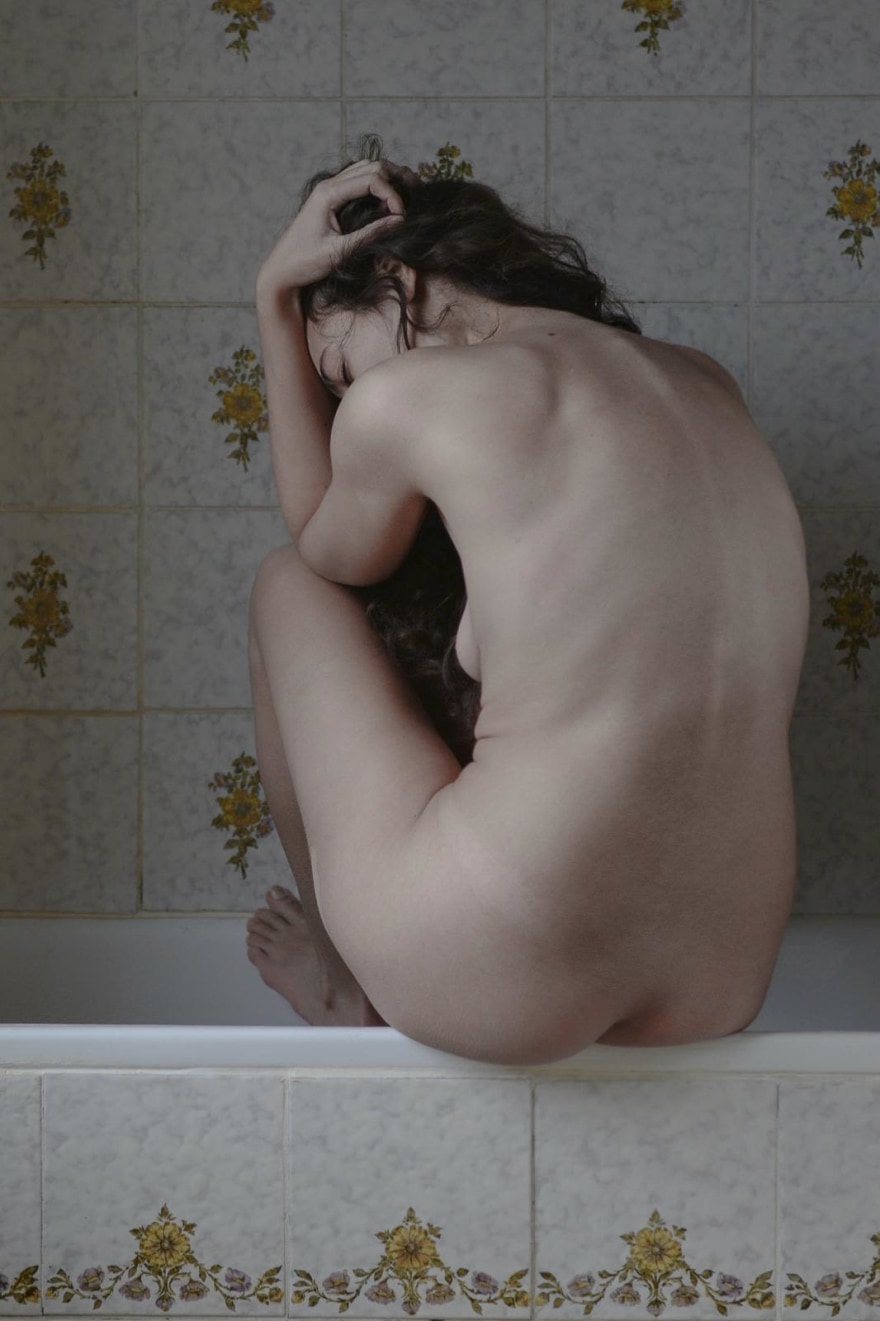
Danielle van Zadelhoff, The Bathroom, 2023, Gallery Ysebaert
In this exhibition, we also find reliquary boxes containing your photographic images. How do they relate to your more traditional photography?
That project was called This Is My Church. It was about the body as a temple. We no longer go to church, but we are all preoccupied with our bodies. To me, beauty is not in perfection, but in imperfection, in the personal, in what has not been smoothed over.
Your work touches on religion without being religious.
I come from a family with different religions—Jewish, Protestant, Catholic. That shaped me. Faith fascinates me; I find such surrender admirable. I cannot do it myself, but I admire it in others. That fascination lingers, without claiming symbolism.
Where do you hope to be in ten years?
I was forced to slow down for a while because of my health. I hope I can stay healthy. That I can keep working, enjoy a glass of wine. Everything that is happening now feels like a gift.
When the doors open shortly and the murmur fills the space, the images remain undisturbed on the walls. They ask for no explanation, no context, no sequence. They are there, as they came into being: from conversations, from attention, from shared moments that cannot be reconstructed.
Melody of the Elusive is not an attempt to hold on to something, but to leave space – for doubt, for silence, for what does not immediately want to be named. That this exhibition simultaneously marks the beginning of a permanent collaboration between Danielle van Zadelhoff and the gallery underscores that attitude: not an endpoint, but an open trajectory in which looking, working and presenting may continue to evolve. That is what makes this exhibition not without obligation, but precisely clear. Those who look, participate. Nothing more is asked.
