30 january 2026, Yves Joris
An exhibition that fits inside an envelope at Settantotto Gallery
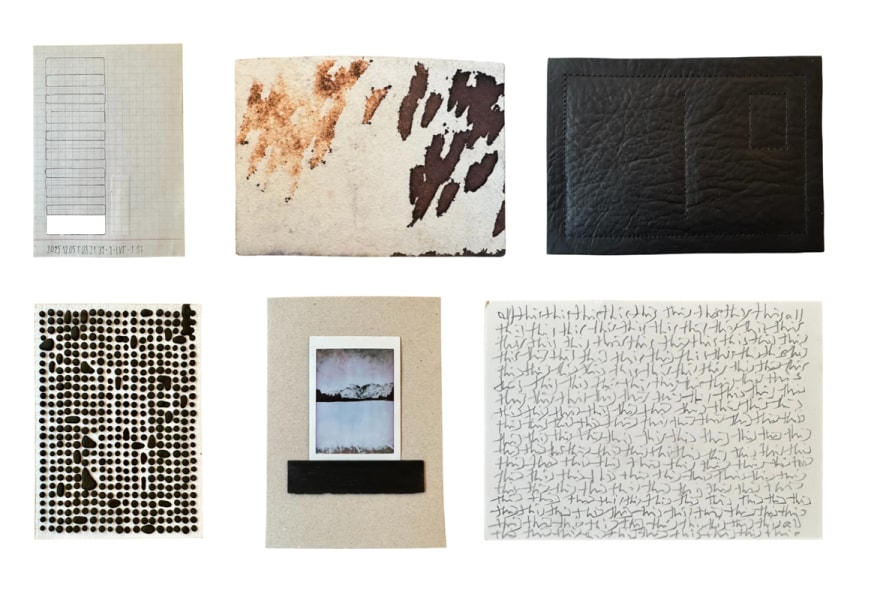
It sounds almost like a passing comment: an exhibition that fits inside an envelope. Not a slogan, not a metaphor, simply a fact. A postcard has an A6 format and therefore also an envelope, in which something can be sent, be in transit and arrive. The exhibition A6 at Settantotto departs from the notion that art does not necessarily have to occupy exhibition space in order to be present.
The premise is clear and without any frills. Gallery owner Thijs Dely asked 12 artists to create a work in DIN A6 format and send it to the gallery by post. No courier, no intermediate steps. What arrived is shown. Visitors have the opportunity to purchase another work from the series, a similar work or an edition. This is then sent to the new owner. The visitor therefore does not buy an object that is already fixed, but remains in a state of artistic suspense until the work is delivered to their home.

Wim Nival koesteren van ..., 2025, Settantotto Art Gallery
105 × 148 mm
These dimensions might be found on a technical data sheet or an order form. They sound administrative, neutral, unpoetic. But that is precisely what makes them unique.
This format promises nothing. It claims no wall, no silence, no attention. It fits in a hand, in a jacket pocket, between two books. The small scale sets something in motion, not only for the artists, but also for the viewer. After all, when you stand in front of an A6 work, you do not immediately think in terms of monumentality, investment or representation. You look more closely — literally. Without first planning, without measuring.

Capucine Vandebrouck, II Cercles, 2025, Settantotto Art Gallery
An idea born from looking
The concept of A6 did not originate from a theoretical desire for minimalism, but from a practical observation. In earlier exhibitions, Thijs noticed how mail art stimulates the imagination. There is something inherently enigmatic in the idea of buying a work that is still on its way, that will only fully reveal itself at home on the kitchen table. A bit of suspense, a bit of chance: as if you are ordering art with the promise that it may remain secret for a little while longer.
There is also a sober logic to the project. The A6 format makes it possible to bring together the artists represented by the gallery in a single space without it becoming a mere accumulation. Everyone works within the same framework, yet no one disappears into it. And there is the additional advantage that the work does not need to be transported. It arrives on its own accord — from studios by regular mail. No crates, no lorries, no logistical choreography.
Looking without planning ahead
Anyone who regularly visits exhibitions is familiar with the moment when looking starts to involve practical considerations. You stand in front of a work that moves you, but before that feeling can settle, the question arises as to where it would hang, whether it would fit, whether it might be too large.
With A6, that reflex disappears automatically. The work fits into life as it is. It does not need to dominate a room. It can be discreetly present, which is precisely what makes it so effective. It asks for nothing except attention.
Big and small as rhythm
As you walk through the gallery, you notice that A6 does not confine itself to that one format. In the other spaces, larger work by the same artists is displayed. Not as an explanation, but as an extension. The small work is not a preliminary study, the larger one not a final point. They exist side by side, without hierarchy. The one requires proximity, the other distance. Together they form a rhythm. The small work concentrates, while the larger allows the space to breathe. The scale changes, the thinking does not. The handwriting remains recognisable.
This is not an exploration of formats, but a consistent way of working that adapts to the space without losing itself.

e.v., untitled, 2026, Settantotto Art Gallery
Mail, paper and arrival
A letter is something with a start and a finish. You cannot endlessly rewrite it. You seal the envelope and send it off. After that, it is on its way, beyond your control. That simple gesture has taken on an unusual quality nowadays.
The work in A6 follows the same trajectory. Each work travels as an object, not as an artwork. They are sorted, stacked and delivered by mail. One even arrived at the gallery slightly damaged. They bear traces of movement. When they arrive, it does not happen silently. There is a sound in the letterbox. A brief interruption of the day. You take the work in your hands and immediately see that it has travelled.
Mail art as an attitude
In that sense, A6 does not stand apart from a longer tradition. The project aligns seamlessly with mail art, an artistic practice that, since the 1960s, has regarded the act of sending itself as an artistic gesture. Not only the object matters, but also the journey, the delay, the chance.
With that history in mind, René Heyvaert is an important reference. In his work, envelopes, postmarks and dispatch are not packaging, but content. Mail becomes a carrier of meaning.
That way of thinking was also visible in an earlier exhibition organised by Settantotto around Heyvaert’s work. It once again made clear that mail art is not a closed chapter, but a mode of thought: art may circulate, may be in transit, may even get lost without losing its value.

Tom McGlynn, NOT EXACTLY, 2025, Settantotto Art Gallery
Deliberately small
Twelve artists are taking part in A6 — Marlise Breye, Bert De Geyter, Henk Delabie, herman de vries, Carmine Iacolare, Sam Lock, Tom McGlynn, Wim Nival, Klaus Staudt, E.V., Capucine Vandebrouck and Leen Van Tichelen — each with his or her own practice, brought together by format and that act of sending.
A6 does not argue in favour of small work. It shows what happens when scale is not an ambition, but a deliberate choice. When sending is not a side issue, but part of a philosophy. When arrival is not a formality, but a moment.
It is — literally and figuratively — an exhibition that fits inside an envelope. And lingers precisely because of that.
