27 january 2026, Yves Joris
Silenced language: between not saying anything and having already said everything
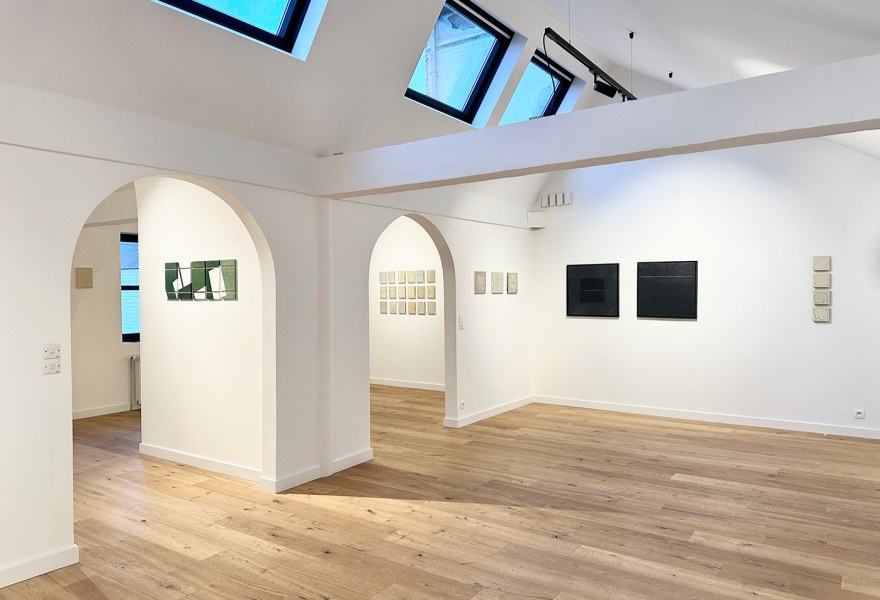
I am on my way to Vlierzele, to the TaLe Art Gallery. The car follows a route I now know well: ribbon development, open fields, winter light that does not warm yet softens. On the passenger seat lies the text by curator Christine Adam. I am not reading it for the first time, but am reading it more slowly than before. After all, there are lots of traffic lights on Flemish roads and for some reason, they turn red more often on Sundays than on other days.
The wonderful title of this exhibition, Silenced Language, has no linguistic meaning in this context, but refers to the visual language used by the four artists. It is a language that evokes, that is suggestive and meditative. In the search for the essence, for the timeless, the stillness, the artists eliminate the superfluous. Everything becomes calm and restraint, while the viewer is encouraged to pay attention and to feel the intensity reflected by the artwork.- Christine Adam
Some sentences call for a rereading, others for contradiction. Silenced Language, she writes, has no linguistic meaning here, but refers to the visual language used by the artists. A language that evokes, that is suggestive and meditative.
I’m reminded of a sentence by Herman de Coninck, persistent and clear: “Silence is the difference between not saying anything and having already said everything.”
It is not a comforting sentence. It suggests that silence is not emptiness, but saturation. Not absence, but excess. And precisely for that reason, silence is not an innocent state, but a choice that entails risk. And that is precisely what fuels my doubt about Adam’s words. Is stillness sometimes not a form of complacent silence? When is it the result of having nothing to say and when of thinking something through until there is nothing left to add?
Words under pressure
The door of the TaLe Art Gallery closes softly behind me. No music, no murmur. The space is clear, controlled, but not cold. I decide to stop carrying Adam’s words with me as a guide and instead to put them to the test here, among the works of art. Not to refute them, but to see how far they hold when images assume the act of speaking.
She speaks of eliminating the superfluous, of calm and restraint. But calm is not a self-evident end point. Calm can also be the result of a conflict that remains visible, even when silent. “Everything becomes calm,” she writes. I look around and think: no, everything becomes attention. And attention is never neutral, never optional, never comfortable.
The silence here is not décor. It is a condition that is imposed. Only afterwards does it become an agreement between the work and the viewer. The artworks demand time. They resist a quick glance. It is precisely here that Adam’s text overlaps De Coninck’s thought: silence arises not when there is nothing left to say, but when speech has reached its limit.

Bernard Sercu, BEGINSEL, gemengde techniek, 12,5 x 67 cm, 2007, TaLe Art Gallery
Bernard Sercu: the wound as language
With Bernard Sercu, silence is not a point of departure, but a remainder. His work bears the traces of interventions: incisions, repetitions, damages that are anything but accidental. The materials—wood, paper, canvas—are not merely a carrier, but a conversation partner or, rather, an adversary.
Adam writes about stillness as a search for the timeless. With Sercu, I see above all time that has fixed itself into rhythm. Here, stillness is not an escape from time, but a way to hold onto it. Every incision recalls an action. According to his text, destruction evokes reconstruction. True, but reconstruction here does not mean repair in the classical sense. It is not healing, but reformulation.
The silence these works radiate is that of something that has already been spoken—through violence, through repetition, through discipline. De Coninck’s sentence fits seamlessly here: this is not saying nothing. This is saying everything, until speech itself becomes superfluous. The silence is not gentle, but heavy with memory. It holds the past fast, like an echo that does not fade.

Marnix Hoys, Sculptuur met shimenawa,(Atago Shrine,Fukuoka) en rode zijde, TaLe Art Gallery
Marnix Hoys: the silent body
With Marnix Hoys, silence takes on a physical form. Figures without eyes, without arms, sometimes without clear facial features. They stand. They carry. They are silent. The references to Japanese ceramic traditions are not a cultural signal, but a discipline. The body becomes the bearer of presence. Silence acquires weight.
Adam speaks of a suggestive, meditative visual language. Hoys’ sculptures are indeed suggestive, but rarely meditative in the serene sense of the word. This is not meditation as rest, but as confrontation. They are heavy, earthy, almost archaic. Their silence is not an invitation to relaxation, but to confrontation. What does it mean to be human when expression is reduced to a minimum?
This is silence that does not reconcile, but preserves. As De Coninck suggests, everything has already been said here, just not in words. The body is silent because it cannot do otherwise. And that is precisely what makes the work so loud.

Rebecca Dufoort, Lijnen MMXXI, 2021, TaLe Art Gallery
Rebecca Dufoort: the breath of looking
With Rebecca Dufoort, Adam’s text seems almost to settle in naturally. Her abstract-minimalist paintings evoke a sense of calmness and rhythm. They form a perfect balance. Planes and lines keep one another in check. Colour is not played out, but carefully dosed.
Yet here, too, silence is not equivalent to standstill. The combination of oil and matte acrylic creates subtle shifts in sheen. The light changes the work and the work changes the act of looking. You have to keep looking in order to preserve the silence. Here, ‘meditative’ does not become self-evident, but a continuous effort.
Dufoort writes about the tension between order and intuition. That tension is palpable. It prevents the work from becoming decorative. The silence here is fragile. One fleeting glance and it collapses.
This may be the most ‘meditative’ form of stillness in the exhibition, but also the most demanding. It requires discipline from the viewer. Silence becomes not a gift, but an agreement.

Anne De Maesschalck, Zonder titel nr 40, 2024, TaLe Art Gallery
Anne De Maesschalck: receding landscape
With Anne De Maesschalck, the landscape almost disappears entirely. What remains are forms, layers, balances that want to represent nothing, yet evoke something. Silence and calm are not a theme here, but an effect.
Adam writes about the search for the essence. De Maesschalck seems not to define that essence, but to allow it to emerge. Her forms exist alongside one another, sometimes logically, sometimes illogically connected. They refuse narrative, but offer space for dialogue.
The silence these works generate is perhaps the most open form of silence in the exhibition. It allows for personal interpretation, yet imposes nothing. This is not silence that leads, but that invites co-responsibility. It is a silence that does not say: look like this, but rather, stay a while and tell me what you see. Once again, De Coninck comes to mind: the work does not say nothing; it says everything that is necessary in order to then be able to fall silent.
Between Adam’s words and De Coninck’s silence
When I look at the exhibition again as a whole, I return to Adam’s text. She is right when she speaks of stillness, of eliminating the superfluous. But what this exhibition truly shows is that stillness is not a style, but an attitude. Not an end point, but a consequence.
The silence here is multifaceted: wounded with Sercu, embodied with Hoys, breathing with Dufoort, inviting with De Maesschalck. It is never empty. It is always the result of choices, interventions, omissions that carry meaning.
“Silence is the difference between not saying anything and having already said everything.”This exhibition resolutely chooses the latter. Not without risk, not without friction, but with the confidence that images can speak until speaking becomes superfluous. And in a time that constantly demands explanation and a fast ace, that may very well be the most radical form of language.
