Connexion
S'inscrire
FR
Mirco Marchelli 1963
Vit à Ovada, Italy. Travaille dans Ovada, Italy.
Représenté par:
Hilde Vandaele Gallery
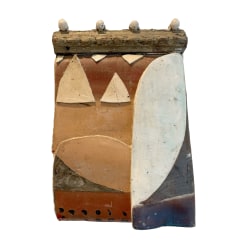
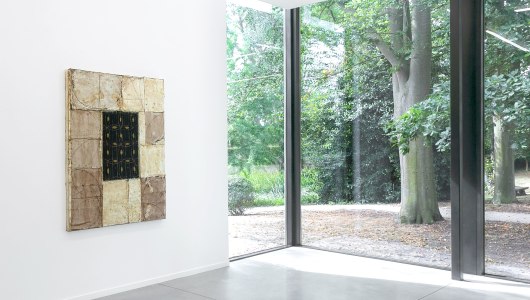
He goes about sniffing out old items of furniture and utensils in the flea markets and second-hand shops. He takes them and puts them away. “As the farmers say, that could come in handy one day,” he says. Or he works with them right away, transforming them into something else, creating new objects and presences. Every one of them brings its past with it; every one of them has a story to tell. “Every work I produce has a story behind it. Everything must have a story behind it, and everything is made of stuff that I find and recreate.” To which he gives enchanted, fairy-tale-like names with meanings like “Many good things”, “Reasons for happiness”, “Playful artwork”, “A mute scene for low clouds”, “Toys”, “Playing statues”, or “Echo of flowers”. But Mirco Marchelli is not a romantic young man absent-mindedly playing around with these toys, nor is he a prop master: he’s a rigorous artist, who began his career in music but is capable of a poetic openness, of what I would call a respect for time – musical and historical – and of a sense of the past that fertilises the present and (we hope) the future, “a projection back in time in order to move forward”, as he said on another occasion, describing his sense of time. Features and qualities that suggest the profile of an uncommon sort of artist.
Faithful, in a certain sense, to the teachings of twentieth-century art, but adopted with a suave lightness, Marchelli works with ready-made objects, or objets trouvé. Not to declare them works of art tout court, with an authorial gesture, nor to give them new life on the basis of a logic we might describe as “circular art”, and not even because these objects offer the carefree freedom of having been left behind by chance, and by chance having attracted someone’s eye, the pietas of the act of the person who picked them up, but because these objects have a story of their own: they are something. Almost someone, if expressing it this way were not overdoing it. And it is here that bricolage, in the most resolved sense of the visionary experimentation characteristic of the twentieth century, finds its most complete expression, putting together different materials, ideas and images...
— Adriana Polveron
Faithful, in a certain sense, to the teachings of twentieth-century art, but adopted with a suave lightness, Marchelli works with ready-made objects, or objets trouvé. Not to declare them works of art tout court, with an authorial gesture, nor to give them new life on the basis of a logic we might describe as “circular art”, and not even because these objects offer the carefree freedom of having been left behind by chance, and by chance having attracted someone’s eye, the pietas of the act of the person who picked them up, but because these objects have a story of their own: they are something. Almost someone, if expressing it this way were not overdoing it. And it is here that bricolage, in the most resolved sense of the visionary experimentation characteristic of the twentieth century, finds its most complete expression, putting together different materials, ideas and images...
— Adriana Polveron
Oeuvres d'art
Articles
Médias
Points forts
Recommandations
Collections
Expositions
Position sur le marché
CV



Abonnement gratuit au magazine
Articles, interviews, spectacles et événements. Livré dans votre boîte aux lettres chaque semaine.