Connexion
S'inscrire
FR
client
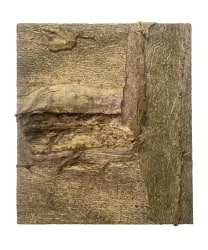
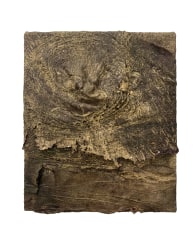
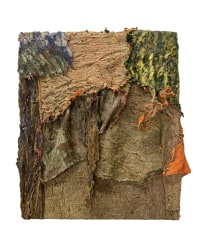
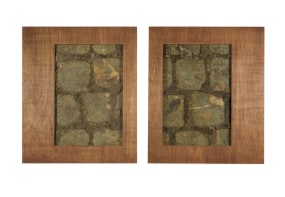
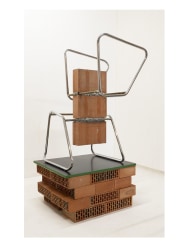
In the artwork of Luc Vandervelde Lux, nothing seems to be lost. While in his earlier career the focus was on figurative, photo-realistic paintings, more recently, materials themselves have become the core of his artistic practice. This shift has come from seeking a foothold in times where everything changes quickly, and also from the desire for a reappraisal of materials. He has devised a way to weave a multitude of patterns and textures together to tell a new story.
No material escapes the eye of the artist: carpets, fabrics, plastic, felt, jute, rubber, knitwear, metal or wooden frames, remnants of roofing, tape or moving blankets are processed in his visual universe. It is a multi-layered world where found objects are freely brought together to relate to each other in a new harmony. While some materials are bought or collected, others are found on the street or on the way to the studio. Everything can be important and what someone else might throw away, finds a place in luc’s works. Everything, every interaction, is a potential material to work with.
What ultimately ends up in a work, he decides intuitively and on a purely visual basis. He unravels the structures of the discarded materials by dismantling them and in doing and making, in building or connecting the different layers, he manifests himself consciously: recycled remnants are converted into aesthetic compositions.
The experimental process remains visible: each part shows a fragment of a memento, an anonymous presence of stories or histories. Own memories are intertwined with unknown lives, personal experiences with universal dimensions.They look like archaeological layers that are sometimes palpable but inaccessible, or just open and exposed. Without making moral propositions, every transformed work becomes an object of reflection that represents certain values, and invites us to position ourselves in relation to these values.
Another beauty unfolds.
Everything changes. Nothing perishes. (Ovid)
Text: Els Wuyts, December 2019
No material escapes the eye of the artist: carpets, fabrics, plastic, felt, jute, rubber, knitwear, metal or wooden frames, remnants of roofing, tape or moving blankets are processed in his visual universe. It is a multi-layered world where found objects are freely brought together to relate to each other in a new harmony. While some materials are bought or collected, others are found on the street or on the way to the studio. Everything can be important and what someone else might throw away, finds a place in luc’s works. Everything, every interaction, is a potential material to work with.
What ultimately ends up in a work, he decides intuitively and on a purely visual basis. He unravels the structures of the discarded materials by dismantling them and in doing and making, in building or connecting the different layers, he manifests himself consciously: recycled remnants are converted into aesthetic compositions.
The experimental process remains visible: each part shows a fragment of a memento, an anonymous presence of stories or histories. Own memories are intertwined with unknown lives, personal experiences with universal dimensions.They look like archaeological layers that are sometimes palpable but inaccessible, or just open and exposed. Without making moral propositions, every transformed work becomes an object of reflection that represents certain values, and invites us to position ourselves in relation to these values.
Another beauty unfolds.
Everything changes. Nothing perishes. (Ovid)
Text: Els Wuyts, December 2019
Oeuvres d'art
Articles
Médias
Points forts
Recommandations
Collections
Expositions
Position sur le marché
CV
Oeuvres de Luc Vandervelde Lux




Abonnement gratuit au magazine
Articles, interviews, spectacles et événements. Livré dans votre boîte aux lettres chaque semaine.