Connexion
S'inscrire
FR
client
When a body breathes its last breath, the soul crosses the mythical river Styx, accompanied by a ferryman. In classical imagery, this is Charon: an elderly man with a stern face, but in Steven Peters Caraballo's paintings, this figure appears in an unexpected guise. Not as a man, but as a young, fresh woman.
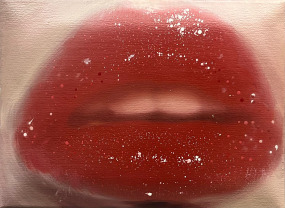
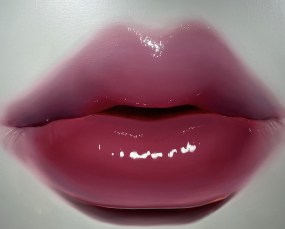
Whereas in the past the entire body was portrayed, Caraballo now focuses on a fragment of the body: the lips. A small detail can sometimes say more than a complete image, leaving room for the unspeakable. No eyes that look back, no voice that speaks. Only the lips: a place between silence and speech, between what is shown and what remains hidden.
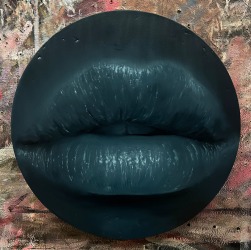
Each deceased person gets their own Charon; with each crossing, a new companion appears. The series shows mouths of Charons from Europe, Africa, and Asia, each full and sensual, with its own unique presence. Seductive and unattainable, this multitude makes Charon universal and inescapable: no one escapes her presence.
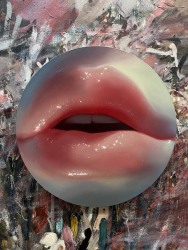
The paintings vary in intensity: sometimes the mouth is sharp and immediately present, sometimes it partially dissolves into a vague outline, as if it only fully forms in the eye of the viewer. This gives viewing a physical character: the mouth imposes itself on the gaze, leaves a shadow on the retina, and thus subtly changes perception itself.
By playing with the physical tensions of the canvas, the mouth sometimes emerges from the surface, like an apparition entering the space. What at first seemed to be a window transforms into an object: the paintings approach the viewer and force confrontation.
Repetition and variation turn the mouth into a ritual motif, a visual mantra. Each mouth is different, but always seductive and silent. This creates an endless series of Charons, each a companion who embodies the same paradox: closeness and distance, invitation and prohibition, promise and boundary.
Whereas in the past the entire body was portrayed, Caraballo now focuses on a fragment of the body: the lips. A small detail can sometimes say more than a complete image, leaving room for the unspeakable. No eyes that look back, no voice that speaks. Only the lips: a place between silence and speech, between what is shown and what remains hidden.
Each deceased person gets their own Charon; with each crossing, a new companion appears. The series shows mouths of Charons from Europe, Africa, and Asia, each full and sensual, with its own unique presence. Seductive and unattainable, this multitude makes Charon universal and inescapable: no one escapes her presence.
The paintings vary in intensity: sometimes the mouth is sharp and immediately present, sometimes it partially dissolves into a vague outline, as if it only fully forms in the eye of the viewer. This gives viewing a physical character: the mouth imposes itself on the gaze, leaves a shadow on the retina, and thus subtly changes perception itself.
By playing with the physical tensions of the canvas, the mouth sometimes emerges from the surface, like an apparition entering the space. What at first seemed to be a window transforms into an object: the paintings approach the viewer and force confrontation.
Repetition and variation turn the mouth into a ritual motif, a visual mantra. Each mouth is different, but always seductive and silent. This creates an endless series of Charons, each a companion who embodies the same paradox: closeness and distance, invitation and prohibition, promise and boundary.
Oeuvres d'art
Articles
Médias
Points forts
Recommandations
Collections
Expositions
Position sur le marché
CV




expositions


Abonnement gratuit au magazine
Articles, interviews, spectacles et événements. Livré dans votre boîte aux lettres chaque semaine.