Connexion
S'inscrire
FR
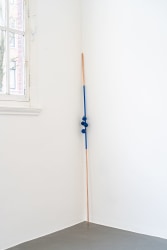
Fabiola Burgos Labra's artworks can be read as representations of, or moments in, a layered process-based practice. In them, she explores topics of gender, colonization, her own family history and our culturally determined relationship with materials. In search of different approaches to these materials and objects, she manages to create meaningful and sensitive sculptures and installations through simple gestures and fragile materials.
Burgos Labra's work subverts the dominant assumptions about the art object that shape the very framework of the art market. The friction with prevailing conceptions of completeness, permanence, object value and ownership is driven to its extreme in the context of the art fair.
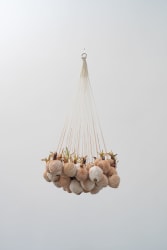
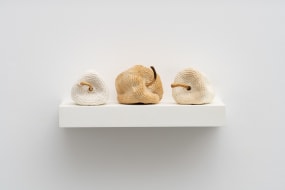
The series Mummies - mami, consisting of textile “wrapped” fruit and vegetable bodies, is emblematic of this. Cotton and wool thread are carefully crocheted around the produce, giving them a sculptural quality. However, the new guise of equilibrium is deceptive: life continues unabated. Where the soft fruit slowly “paints” the fabrics from within, in other cases life seeps out (cfr. Mummies - mami (Onion), 2024). The objects find themselves in a state of constant flux. They are inherently unstable and uncontrollable. Their slow but certain disintegration demands attention and care. Indifference is out of the question.
Where in some cases a final mummification, a stillness occurs, in others a fragrant dissolution follows: “Mummification is an act of conservation and care for life itself, with a recognition of human dependence on nature. Cotton is used to weave blankets and the decomposition of the living body is witnessed. The mummified objects tell a particular story, the cycle of life and death, and how to care for a “living sculpture.”” (Fabiola Burgos Labra)
Burgos Labra's work subverts the dominant assumptions about the art object that shape the very framework of the art market. The friction with prevailing conceptions of completeness, permanence, object value and ownership is driven to its extreme in the context of the art fair.
The series Mummies - mami, consisting of textile “wrapped” fruit and vegetable bodies, is emblematic of this. Cotton and wool thread are carefully crocheted around the produce, giving them a sculptural quality. However, the new guise of equilibrium is deceptive: life continues unabated. Where the soft fruit slowly “paints” the fabrics from within, in other cases life seeps out (cfr. Mummies - mami (Onion), 2024). The objects find themselves in a state of constant flux. They are inherently unstable and uncontrollable. Their slow but certain disintegration demands attention and care. Indifference is out of the question.
Where in some cases a final mummification, a stillness occurs, in others a fragrant dissolution follows: “Mummification is an act of conservation and care for life itself, with a recognition of human dependence on nature. Cotton is used to weave blankets and the decomposition of the living body is witnessed. The mummified objects tell a particular story, the cycle of life and death, and how to care for a “living sculpture.”” (Fabiola Burgos Labra)
Oeuvres d'art
Articles
Médias
Points forts
Recommandations
Collections
Expositions
Position sur le marché
CV
Oeuvres de Fabiola Burgos Labra



expositions


Abonnement gratuit au magazine
Articles, interviews, spectacles et événements. Livré dans votre boîte aux lettres chaque semaine.