10 may 2021, Manuela Klerkx
Warre Mulder | Between red and orange
What do you get if you have two Dutch parents and are born and raised in Belgium? Right, Warre Mulder: experiential expert in the field of similarities and differences between Belgians and Dutch. We touch on the subject when I tell him that I see a lot of "bravado" in his work. "That must be the Dutch influence," he says. And he may be right about that, because whoever you speak to, almost everyone thinks that overall Dutch are louder and bolder than the more modest and contemplative Belgians. He himself sometimes compares the Dutch mentality with football:
When it comes to football, the Dutch already behave like winners, they are almost there but not quite yet. As a result, they miss that last part that is necessary to become world champions.
And he might be right about that. But still, after a little more questioning, he admits that he supports the Dutch team and not the Red Devils, but you don't get this from me. In any case, the above differences and similarities lead to eclectic images about which art critic Christine Vuegen (HART Magazine) outlines very poignantly:
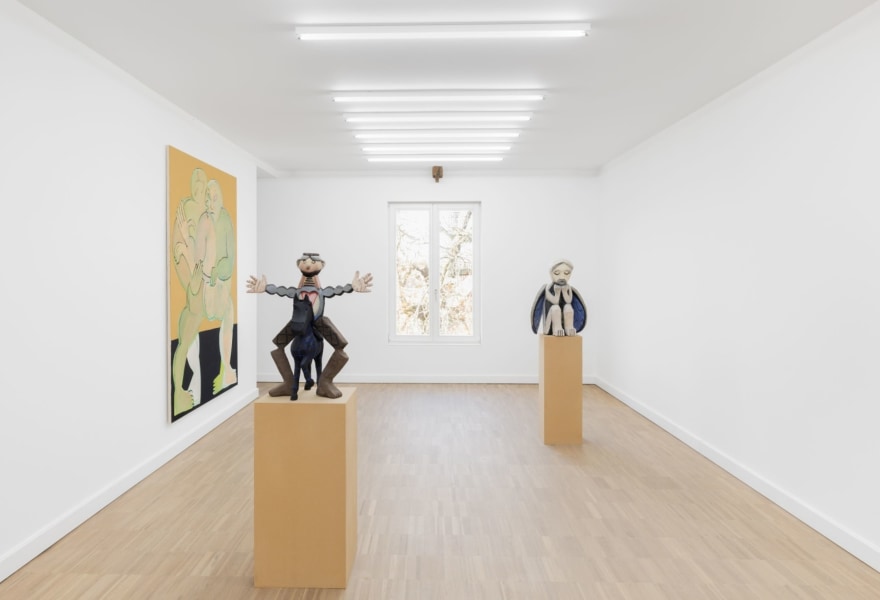
Walking tightly on the boundary lines between ardent and witty, genuinely inspired and grinning, spontaneous and planned, the artist conjures up hybrid sculptures: imaginative fable creatures, human images, animals, a plant or an object. They can be something like archetypes, ancestor images, guards or messengers, often cheerful and disturbing at the same time. Spirituality and humor, animism and play, associations and meanings tumble over each other in a personal visual language that can appeal to everyone.

Warre Mulder, I come with good intentions, 2020, Whitehouse Gallery.
In my opinion, the bravado in his work has to do with the way in which he thinks about history with its power structures, rituals and questionable practices. There is a lot of consideration - his Belgian side! - in the way in which he brings to life his enigmatic figures from past times. He himself says about this mish mash of cultures and influences:
I like sampling, not only in music, but also in art. I don't believe in the value of one local culture, but in traveling through space and time in which you get to know pieces of pure humanity in all kinds of ways. Nothing stands alone and by examining different periods and styles you recognize patterns and symbols that recur in different ways in all parts of the world, which together form humanity.
It logically follows that Warre is not so much interested in making inanimate objects, as in the creation of animated, iconic objects such as statues of saints or African-looking masks and statues that, in their robust, almost rudimentary appearance, are more reminiscent to Romanesque art (in which the human figures are static and stylized) than to Baroque (with an abundance of form and intensity of emotional expression). In his 2021 statue "King over Nature", for example, features a king leaning on two lions as if they were crutches. An image that directly evokes associations with the Sphinx of Giza, the largest sphinx in the world that has been resting for centuries in front of one of the three great pyramids in Giza, but also makes us aware of the human being who puts himself above nature, so also above the animals. A questionable victory on which the last word has not yet been said.
Animism can be found all over the world at all times. It is one of the primal human tendencies that I seek out in my art. The instinctive urge to see something alive in inanimate things is inherent in humans. As a child I experienced that very much by seeing toys as living things. Actually, that is the basis of what I do now. I want to get inspiration in my work, a dose of animism. I want the texture to evoke something tactile, I want the materials have a natural origin, and it has to be made by hand. It is a kind of purity I am looking for. It is really a quest for spirituality and animism. You are looking for it and you would like to believe in it, but you also cannot fully believe in it, which is when you start to put things into perspective. (Excerpt from an interview with Christine Vuegen)
Warre makes art In the same way that children play with toys, immersed in their own imagination and not starting from a specific concept but rather by seeing art as a game consisting of parts that enter into constantly changing alliances with each other, creating new characters and stories. Just like the Memphis group - a group of interior designers from the years 1981-1987, founded by the Italian designer Ettore Sottsass - his designs are characterized by the illogical combination of geometric shapes, bright colours and all kinds of patterns. Still, Warre’s works look much less slick because they are not industrially produced but by hand, which makes them look much more original. But they look tough or, as we say in the Netherlands: with balls.

Warre Mulder, De kennis van het lopende vuurtje, 2021, Whitehouse Gallery.
He is currently working on a new sculpture for Ballroom Project that consists of a group of people gathering around a fire and telling each other stories: a primal human activity that has existed since the invention of fire. Eyes are hidden in the flames, but he does not want to say more about it at the moment.
He is also working on another large statue, a triumphal arch from the Etruscan era, which initially served to purify the army after a battle by letting the soldiers walk underneath it one by one. Later, under the Romans, the triumphal arch - usually made of wood with ceramic elements - was adopted as a construction, but only the victor of the battle, the supreme boss of the army, was allowed to walk under the arch of honour. It was no longer about the purification of an entire army, but about celebrating the victory expressed in honouring only one man. The seed for our individualistic era was already being sown at that time. Perhaps. It is certain that the mixing of forms and styles, cultures and beliefs leads to powerful and meaningful sculptures such as those of this Dutch Belgian or Belgian Dutchman who is constantly travelling through time and space in search of animation.