29 september 2026, Martine Bontjes
The studio of... Louise te Poele
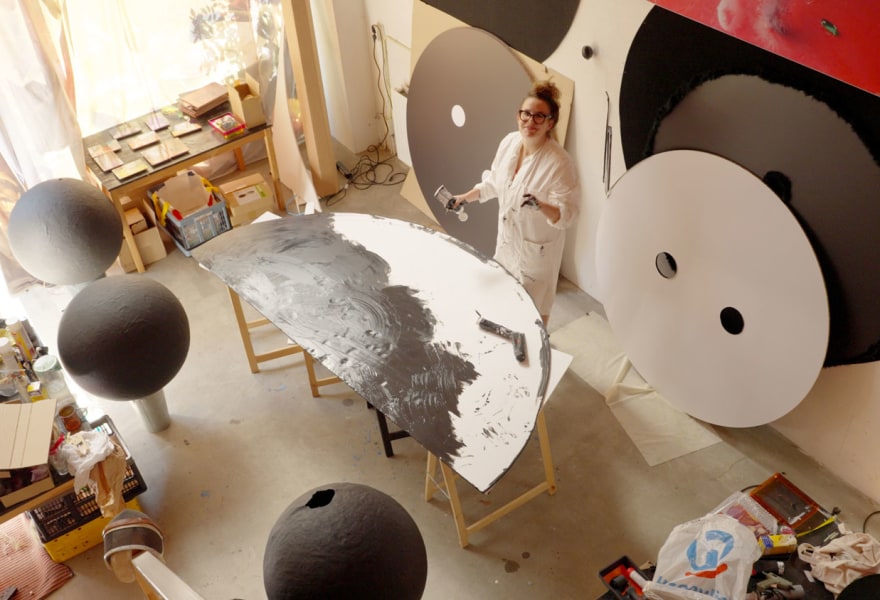
Louise te Poele recently moved into a new studio in Arnhem, nestled in greenery. Spread across three floors, she works on spatial installations, film and photography. Here she was able to reflect on her pregnancy, when the idea for her solo exhibition ‘My Voice Went Soft’ began to take shape. When she gave birth to her first child, she noticed that the machines in the hospital received more attention than she did. Even when the equipment proved not to be working properly, her voice remained unheard. Through balancing constructions made of feathers, flowers, eggs and other seemingly fragile elements, Te Poele explores what happens when your voice is given less and less space. At the same time, she reveals how much strength and love can reside in that soft voice. ‘My Voice Went Soft’ is on view at Art Gallery O-68 in Velp until 18 October.
Where is your studio and how would you describe this place? I imagine a colourful space. Is that right?
My studio is located in an old converted barn, surrounded by greenery and nestled among a tangle of motorways. The workshop is downstairs, where I make my still lifes and construct spatial works and props for my films. On the second floor there is another still life table, currently covered with glass spheres. I am combining new colours there for a new spatial work. My computer is also there, along with a wall covered in inspiration, newspaper clippings and images from projects that are either ongoing or have already taken place. There is a third floor as well, which I only use when I have filled up the other floors and have nowhere else to put things. I have only been here for a year. I recently thought: yes, this is already becoming a beautiful, colourful Louise world.
You don’t always work alone, as you also create participatory artworks. Do you easily welcome people into your studio, or do you prefer to keep your space private?
I actually prefer to keep my studio private: working hard in my own growing universe. The only person who came by just before the opening of ‘My Voice Went Soft’ was my gallerist, Anne Mie Emons of Art Gallery O-68. I really enjoyed that. She could see how everything was coming together and, with all the things lying around, I could tell her the story behind the work. I make my participatory projects on location. I pack up my entire studio, take it there and unpack it on site, where it usually develops into a wonderful installation made up of all the materials.
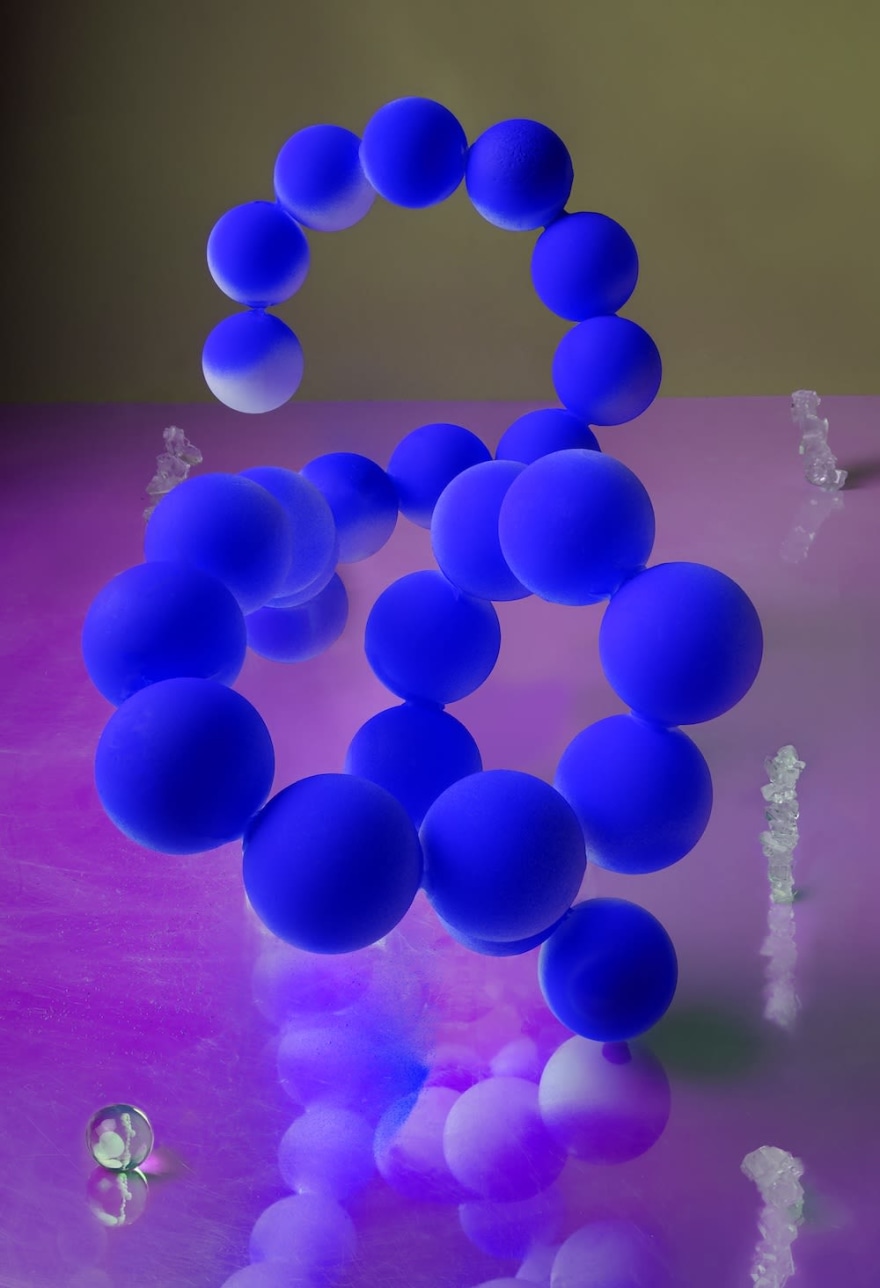 Louise te Poele, Blue Swan, 2026, O-68
If I were to spend a day with you in the studio, what kind of encounters and activities would I see and experience?
That could be completely different every day. You can choose which day you would like to join me. One memorable day was the final day of installing my artwork for King’s Day 2025 in Doetinchem: a bright pink gateway installation with still lifes on the walls that I had made especially for this occasion. Behind the gateway was a sea of flowers with dancers and classical musicians. My team consisted of friends and family. We had a kind of anthem, ‘Work It’ by Marie Davidson. It started playing again at five in the morning, we quickly finished the last things and then welcomed the Dutch royal family into our world. It was incredibly hard work and by the end everyone was completely stunned, thinking: wow, what just happened today?
On another day, you could come with me to the film studio, where I make the film that accompanies ‘My Voice Went Soft’. You would see my completely packed van arrive and my team waiting for me with a slight look of panic in their eyes: “Louise, what have you come up with now?!” I explain everything, everyone gets to work and I come up with a few final scenes on the spot. By the end of the day, we are exhausted but satisfied. I love film studios. That is when everything really comes alive for me.
If you had joined me last week, you would have seen the creation of a new spatial work: first a trip to the hardware store, where you find yourself wondering in the car park where that enormous piece of wood with the tiny woman is going to end up. Then the ear protection goes on and we start sawing. The work A Giant Folly Family will be on view at Kunstsmullen from 3 to 25 October in the forests of Heeze-Leende.
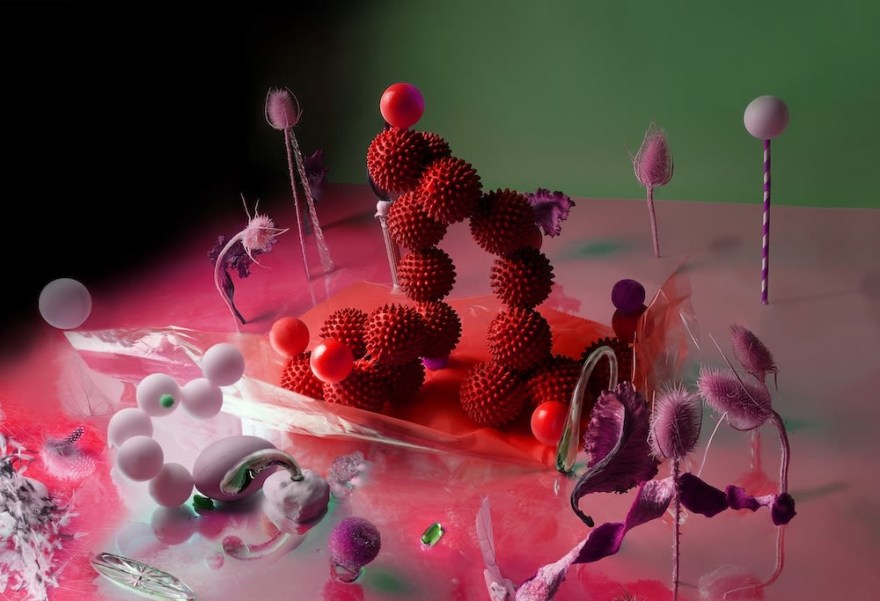 Louise te Poele, Could this be the moving soap dispenser, euh no., 2026, O-68
In ‘My Voice Went Soft’, you explore a voice that seems to have gradually faded into the background. How would you describe that voice?
For me, the voice in ‘My Voice Went Soft’ has several meanings. The voice that is pushed into the background has become as soft as modelling clay: you can easily knead it, put it away in a corner and make it disappear from hearing.
When did you first notice that this voice was becoming less present? And what voices took its place?
Sometimes I really feel that what I say gets through. The series began with a moment when that was not the case. When I was in hospital giving birth to my first child, they listened to the machines, not to me. It did not matter what I said. It almost felt as though I did not exist: my voice became soft and a strong computer language took over.
I see all kinds of different objects in your still lifes, such as feathers, fruit, eggs and flowers. What do these objects have in common?
They are alive, or they symbolise life. I love having life in my work. It creates a sense of urgency: I have to make it now, because otherwise it will be gone. I often begin a series with a flower still life. As the series progresses, the literal signs of life gradually disappear and are replaced by balancing constructions. The sense of vitality then lies in the balance: in a tiny feather that just manages to stay upright, or in a construction that makes you wonder: how can this possibly stay standing? It creates tension and can even feel dangerous, because the possibility of falling out of balance is so close.
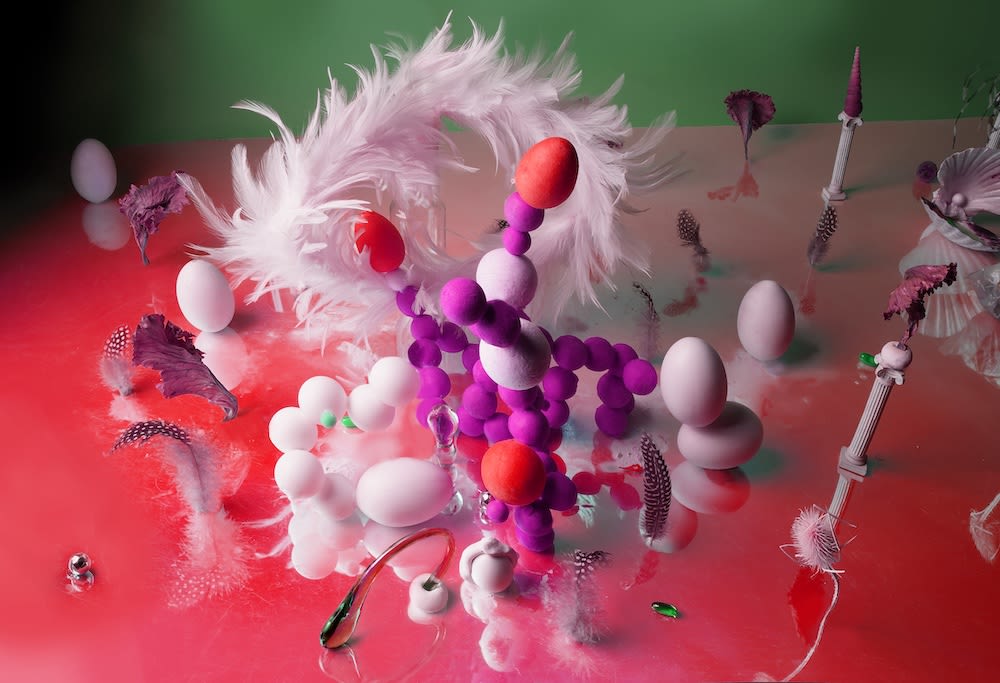 Louise te Poele, Look what I found on the surface of a dirty hospital tray, 2026, O-68
Did you actually find the objects for the work Look what I found on the surface of a dirty hospital tray on a dirty hospital tray?
No, my titles often contain several meanings. When I was coming up with the titles, I imagined the hospital room where we were staying, the room where the light never went out at night. I invented all kinds of stories about what might have happened there and played with those possibilities. The title refers to the fact that I try to make something out of anything, even dirt on a hospital tray. It also stands for the unexpected things that happen, things you had absolutely no idea were coming. It is about the sense of wonder that life can sometimes offer you.
Your still lifes are very carefully and aesthetically composed. What kind of coherence are you looking for exactly?
Perhaps I am looking for a new definition of beauty, but I have always found the word beauty a little difficult, because it carries the implication of a value judgement that excludes so much. At the same time, I try to see the beauty in almost everything. I am always looking for something I do not yet know, and that is what I start working with. First I search rather roughly, and gradually the refinement comes in.
The exhibition is an exuberant, colourful world. Do you associate colour with softness?
Yes, actually I do. Colour is never really taken seriously, even though it is incredible: COLOUR! And not soft colours, because I find those too safe. I love it when it really explodes.
What helps you keep listening to that soft voice?
In this case, I started making a lot of new work. It just poured out of me. I no longer had to compete with those machines. Here, I was the one speaking again. My advice is: keep going, keep making, try new things even when they are incredibly frightening. It always gives me a lot of energy.
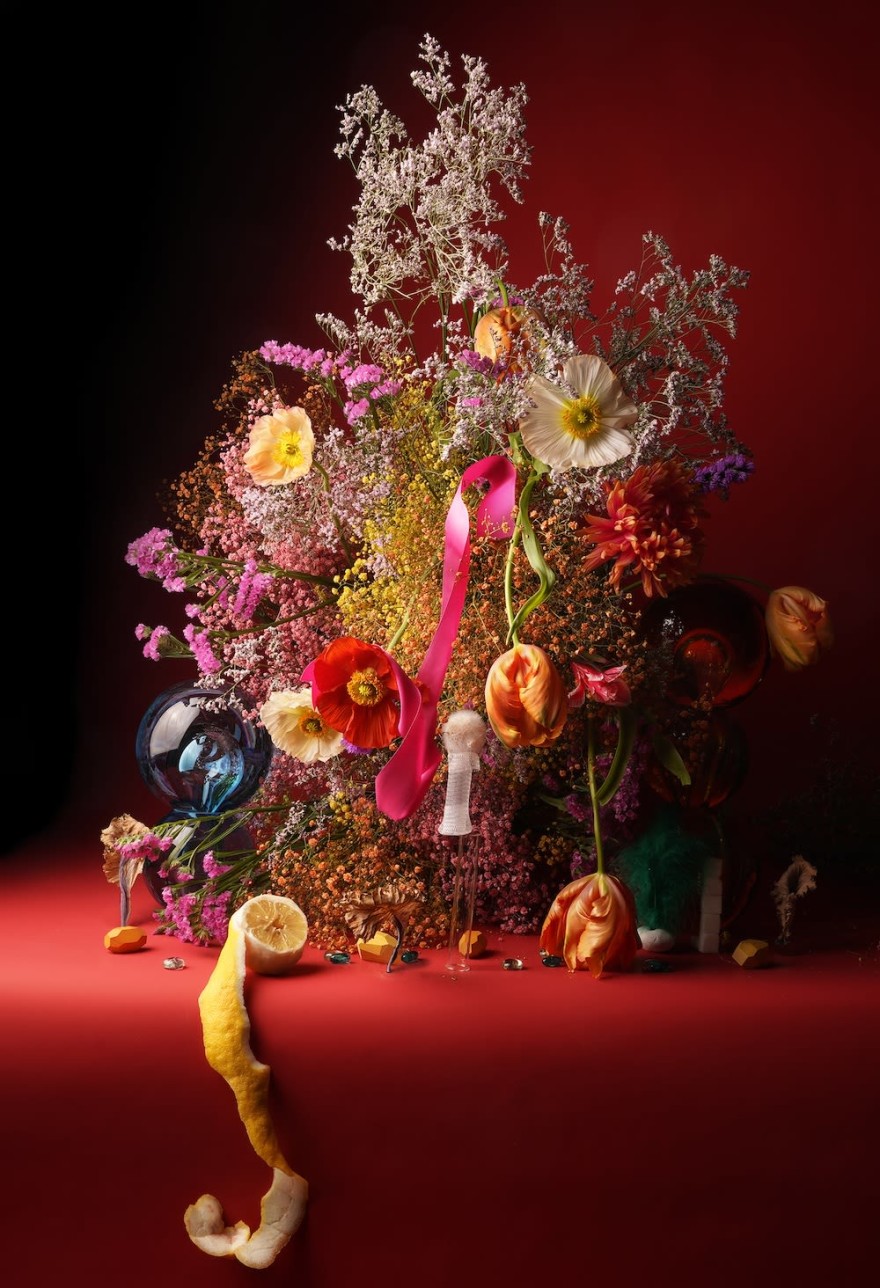 Louise te Poele, Flowers for Elbi, 2026, O-68
You are currently working on a participatory art project with female status holders. Why did you specifically want to work with this group?
I have always felt a kind of mission to bring people into contact with art for whom that is not necessarily a given. It started with my graduation project Farmers. During an earlier participatory project around the spatial artwork Concentric Spheres in Barlo, I noticed that the women found it more difficult to express themselves than the men. I thought: hey, perhaps I should do something specifically with these women. I am curious about their voices. That is why I initiated Raise Your Voice together with Niemanders. Niemanders creates music with the women in which their voices can be heard, while I create images together with them in which their voices become visible.
Are you already making plans for a follow-up project?
Yes! If everything goes well, I will be making several large spatial works on commission, with carte blanche in both cases. Now that ‘My Voice Went Soft’ is finished, my mind is slowly beginning to wonder: what comes next? Something is quietly brewing in the background. I will let you know when the time is right.
