18 september 2026, Yves Joris
Ce matin-là, the morning gives itself away: Christophe Malfliet & Jonas Callaert at Gallery Sofie Van den Bussche
As always, I am about to go looking for the story behind the work. Call it a healthy form of professional distortion. Who, what and why. Sofie corrects me immediately. No dialogue between subjects. A dialogue between colours. I close my notebook. A glass of wine is poured. A dialogue beckons.
There is no theme here that you can recount at a birthday party. No headline, no thesis. There is only the question of whether two styles can find one another without ever mimicking each other. That is less than a story and more than decoration. It also, I believe, aptly describes a good conversation.
 Christophe Malfliet, En route, 2026, Gallery Sofie Van den Bussche
En route, in silence
On the right, a car. White, outlined in black, half drawing, half tantrum. Underneath, handwritten: EN ROUTE. Christophe Malfliet paints like someone who talks because he cannot keep quiet. A bit of spray paint here, an application there, suddenly a scrap of embroidery among the paint, like a private joke. Pop art with a hangover.
Malfliet is an artist who turns up the volume. Figuration and abstraction collide within one and the same plane. A mountain appears, followed by an animal, then nothing recognisable, as if the image changed its mind halfway through. He works with whatever is at hand: paint, spray paint, a piece of fabric. Nothing is too insignificant to be used.
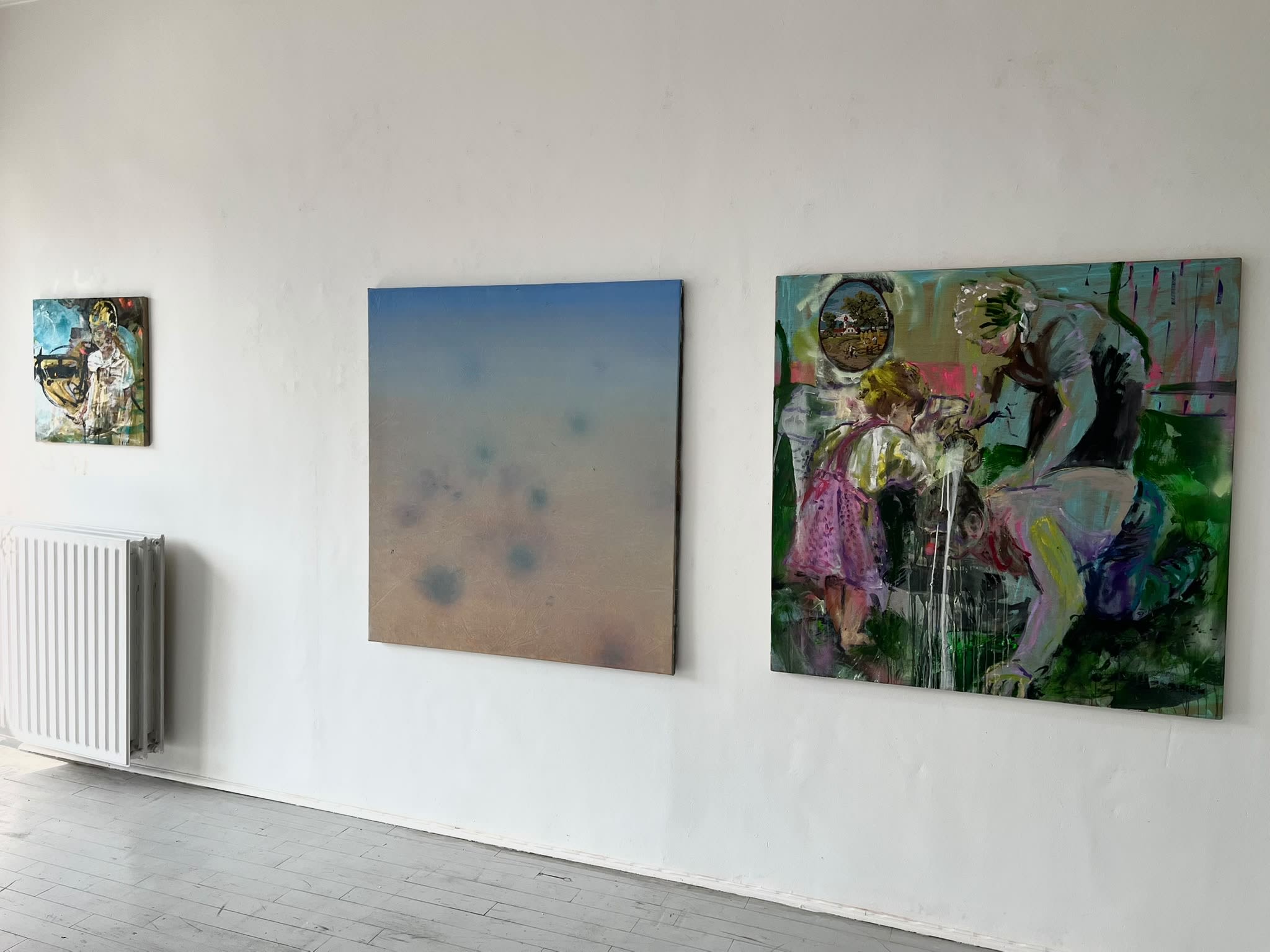
On the left, two canvases. Both a vertical progression from blue into something softer. One rough, scraped, a scar beneath a plaster. The other smooth, blue dissolving into haze. Almost like air. Jonas Callaert does not call it a landscape. Yet it is exactly that, only it has shed its representation. He travels, photographs, cuts, pastes and extracts a colour from the collage. Sometimes it is precisely the colour of the sky.
What remains is not a reproduction of a place, but its distillation. A mountain becomes a greyish blue shadow. Callaert does not paint places, but what a place leaves behind once you have (almost) forgotten it. That is a different kind of landscape art from the one we are used to: not a window onto the world, but its residue.
 Ce matin-là, Christophe Malfliet & Jonas Callaert, Gallery Sofie Van den Bussche
Demanding moments of stillness
Two men, 20 years apart. A friendship that began in a classroom whose address no one remembers. One loud, the other quiet.
Sofie thought Callaert’s work would listen to Malfliet. At a certain point, the opposite happened. Demanding moments of stillness without ever putting it quite that way. Not too much. Eventually, each artist was given his own zone in the space. Not to separate them, but to make them resonate more strongly together afterwards. There were still large works by Malfliet waiting in the basement. They remained there.
That is a subtle difference. The aim is not to place two artists opposite one another until one ‘wins’. Sometimes, you have to pull them apart precisely so that, afterwards, with a wall between them, they can resonate more forcefully. Like a conversation in which not everyone speaks at once. There are necessary silences. There are moments of stillness. And then there are those moments when everything falls into place, almost by accident, and you think: they could never have planned this.
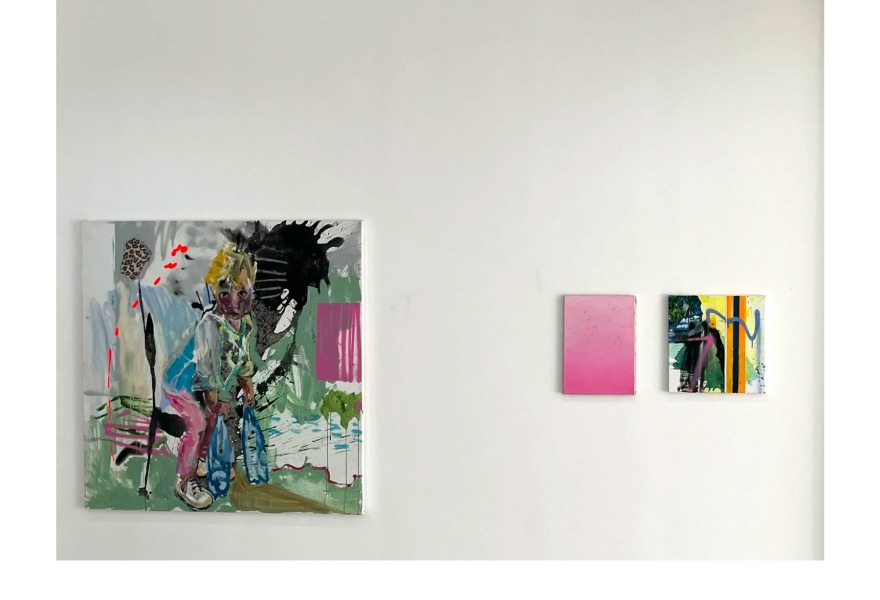
 Christophe Malfliet, La spruzzatore allegro, 2026, Gallery Sofie Van den Bussche
Exclamation mark and comma
On the left, a child who is not smiling. Blonde hair, a gaze too old for her little body, two plastic bags heavier than a child should have to carry. Around her: black scribbles like a storm, a leopard spot that has wandered in from another jungle, red drops falling without ever landing anywhere. Malfliet constructs a world that wants to say too much and therefore says everything at once. And yet it is precisely in the middle of this abundance that your eye catches on a magenta rectangle.
Almost a mistake. Almost too neat for this chaotic universe. A field of colour that initially seems to shut itself off from what is happening around it, but which, on closer inspection, turns out to be a passageway. Your gaze drifts further to the right and there you see Callaert’s panel: flat pink, soft lilac sliding towards something deeper. No child now, no bags, no black scribbles. As if that single rectangle had worked itself loose from Malfliet’s painting, crossed the wall and shed all its baggage along the way. The figurative remained behind with the child, while the colour journeyed on.
And colour turns out to not be merely a passing stranger. Blue is never far away in Malfliet’s work. It appears everywhere: sometimes at the centre, sometimes as a footnote, the colour that holds everything together like a bass guitar you only miss when it disappears. And it is precisely that blue that becomes the hinge towards Callaert, whose entire palette seems to have been distilled from the same register. The world disappears, the colour remains.
And so, almost unnoticed, the dialogue that carries this exhibition becomes apparent. Not between subjects, but between colours. Two artists who never agreed on colour and yet, somewhere between an escaped pink and a persistent blue, continually strike the same note. One lets colour collide, overlap and fan out. The other strips everything away until only the essence remains. With Malfliet, colour is an exclamation mark. With Callaert, a comma. And it is precisely between the two that the dialogue begins.
 Ce matin-là, Christophe Malfliet & Jonas Callaert, Gallery Sofie Van den Bussche
A portrait without a face
It is not the interplay of colours that stays with you, elegant though the explanation may be. It is the thought that an exhibition can be a portrait without a face. Malfliet dominant, expressive, virtuosic to the very edge of excess. Callaert timid, monochrome, a man who distils his travels into a single shade. Hang them side by side and you do not get a compromise, but a conversation in which no one raises their voice, yet everything is said.
Nobody knows how I really feel. Precisely what paintings are better at than people. They do not need to know. They need to show it. In blue, in pink, in a car painted en route by someone who never arrived and has no intention of doing so.
You might say that the exhibition presents two portraits disguised as a landscape and a car. Malfliet is the car: on the move, noisy, never standing still. Callaert is the horizon: something that can only be seen once you have gained enough distance. Both are as much portraits of friendship as of the individual. It is difficult to separate the two once you have seen the work hanging side by side.
What remains
I leave the exhibition feeling that I have seen a song rather than heard one. The blues are about pain you recognise without having to explain it. Here, it is about friendship. An underrated form of the same emotion. Two men, two artistic visions, one morning that lasted long enough to extract an entire exhibition from it.
 Ce matin-là, Christophe Malfliet & Jonas Callaert, Gallery Sofie Van den Bussche