20 august 2026, Flor Linckens
Denmark and Lucia Mrakovcic in Coppejans Gallery
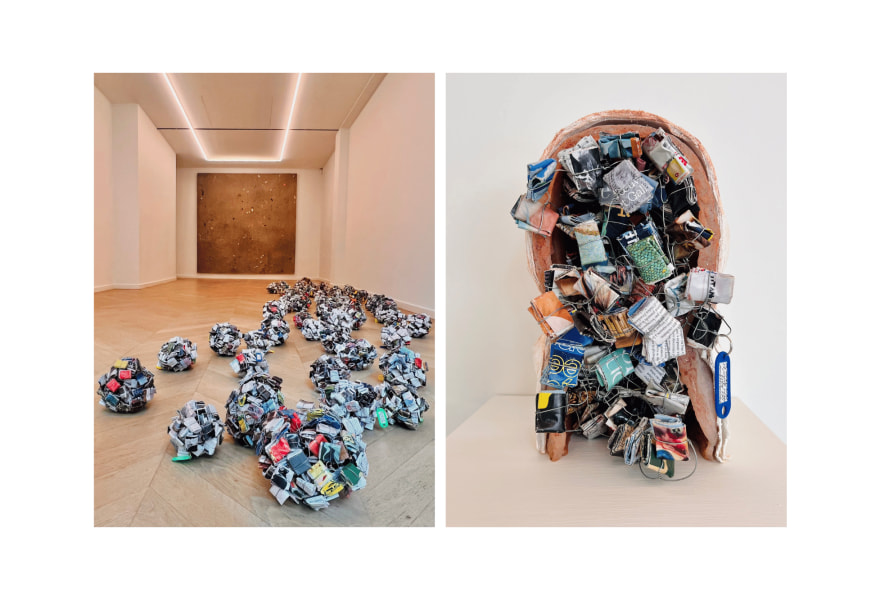
Until 6 September, Coppejans Gallery in Antwerp presents ‘Mind Trap’, a duo exhibition featuring work by Denmark and Lucia Mrakovcic. At first glance, their practices may seem to have little in common: Denmark has been working with books, newspapers and magazines for more than fifty years, while Mrakovcic takes the smallest and most ordinary remnants of her immediate surroundings as her starting point. Yet both artists seem to engage with a similar question: what do the things we collect, preserve or leave behind reveal about who we are? And what do these artists preserve of themselves in their work?
Denmark’s work grew out of an experience that may feel even more familiar today than it did when he first developed his practice in the early 1970s: the feeling of being overwhelmed by information and the impossibility of actually processing everything that surrounds us. The Belgian artist is known for the rebellious ways in which he ‘archives’ information. Denmark, a pseudonym of Marc Robbroeckx, was born in Wilrijk in 1950 and studied art history and archaeology at Ghent University. After completing his studies in 1972, he found himself overwhelmed by the sheer amount of information that had accumulated in his home. On the one hand, he felt a certain sense of powerlessness, as though this abundance of information was hindering, rather than helping him. At the same time, he realised that his own thinking could never keep pace with an ever-growing and uncontrollable accumulation of opinions, theories, ideologies and facts. He decided to reinvent himself as an ‘artist-archivist’.

This marked the beginning of a long-term project for which Denmark began destroying, reconstructing and transforming publications. They are given a second life, while effectively being stripped of their primary function: carrying knowledge. Denmark cuts into books and newspapers horizontally, burns and freezes publications, pulverises newspapers or places them in glass jars. He folds magazine pages using copper wire, makes sculptures from cut-up books compressed between two clamps and glues Mao Bibles between wooden slats. For one work from his "Dead Archive" series, he used every test paper produced over the course of a year at a single secondary school. In doing so, Denmark explores how knowledge is produced, disseminated and stored.
In the exhibition at Coppejans Gallery, we encounter a number of paper spheres scattered across the floor. For “L’essentiel”, Denmark used ninety art magazines, folding and binding them with stainless steel wire to create compact, spherical sculptures. The pages remain present, but their contents are no longer accessible. At the same time, there is something autobiographical about the work: these art magazines reflect the world in which the artist has immersed himself for decades. This becomes even more explicit in “Self-Portrait II”. For this work, Denmark made a cast of the back of his own head, which he subsequently filled with folded pages from two recent art magazines. Beneath a glass dome, his head is reduced to a physical repository for images and information, which is sometimes exactly what having a head feels like. This self-portrait reveals above all what occupies his mind.

In our current digital world, where the flow of information has exploded and fake news has become a persistent parasite, the questions Denmark raises have only become more relevant. At the same time, the artist uses his work to critically examine our wasteful, consumption-driven culture. This is also where his practice connects with that of the second artist in the exhibition. While Denmark has spent more than fifty years working with books, newspapers and magazines, Mrakovcic turns her attention to dust, threads, hairs, scraps of paper and other remnants that would ordinarily disappear as soon as we sweep the floor. Both artists collect, preserve and transform, but they do so from very different artistic sensibilities.
Lucia Mrakovcic was born in Antwerp in 1982. She studied sculpture at the Royal Academy of Fine Arts Antwerp, where she now also teaches. The work Mrakovcic presents at Coppejans Gallery is not a self-portrait, but it can be read as an indirect portrait of her presence, her daily activities and her studio practice. Over the course of approximately two years, she sewed down everything that had fallen onto the floor of her studio in the preceding years and remained there: threads, hairs, scraps of paper, particles of dust and other seemingly insignificant remnants. The result is an archive of attention, a portrait of what she considers worth preserving. Using a continuous thread, Mrakovcic connects these elements into an expansive network. The resulting work resembles a monumental abstract landscape, but seen up close, it becomes a detailed universe of tiny traces and chance occurrences.

This fascination with the fragile and easily overlooked runs like a thread through Mrakovcic’s multidisciplinary practice. When so much of what surrounds us is produced only to disappear again, she focuses precisely on what usually remains unseen or is often thrown away. She hopes to encourage us to spend more time with these objects, and look at them with greater care, the seemingly insignificant, allowing us to sense how many stories can be hidden in the smallest details. At the same time, she confronts us with the ways in which we produce, consume and assign value. In the context of Kunstenfestival Aardenburg, the artist said: “My hope for the future is that every now and then we can slow down a little, that we can have more time to observe and embrace the small, fragile things and the fragility of life, and to find a connection with the entire world, not only with nature, but also with people and everything that exists around us.”
Together, Denmark and Mrakovcic show that who we are is shaped not only by our memories and thoughts, but also by everything we read, preserve, touch and leave behind. Denmark focuses on the endless stream of images and information accumulating around us, while Mrakovcic draws attention to what risks getting lost in that context. Together, they show that archiving is not simply about preserving, but also about choosing what we consider worthy of our attention.
