17 august 2026, Flor Linckens
Last chance: getting lost in the world of Juliette Minchin
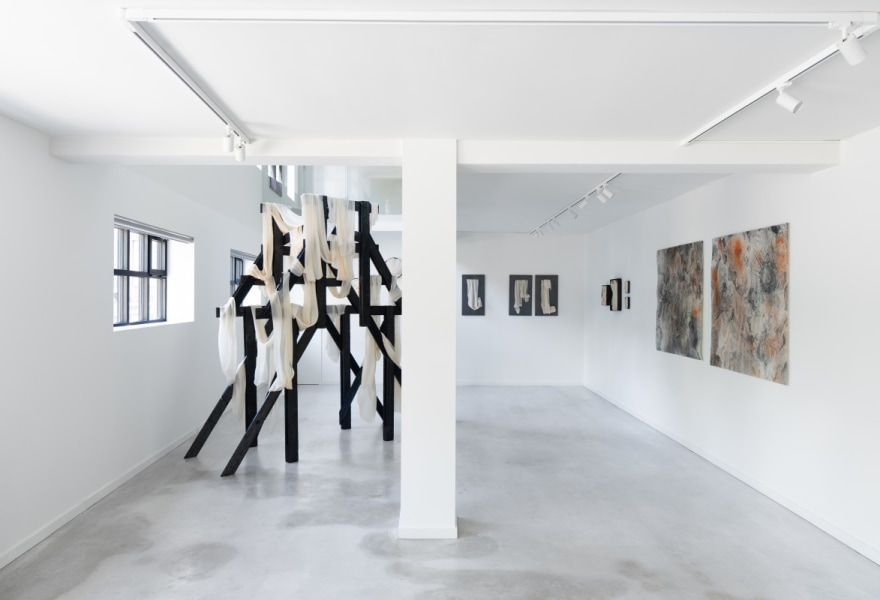
Until 29 August, ROOF-A in Rotterdam is presenting Juliette Minchin’s solo exhibition ‘REBURN’. For this presentation, the French artist has transformed the gallery’s entire ground floor into a monumental installation. Here, charred wood, wax, stone and metal come together to form a landscape that seems to be suspended somewhere between ruin, architecture in the making, and ritual space. On 29 August at 4 p.m., the gallery will host a festive finissage. During the event, Hendrik Driessen, former director of Museum De Pont, will join Minchin in conversation about her practice and the themes that shape her work. From 5 December onwards, the artist’s work will be on view in a solo exhibition at Centre Pompidou-Metz.
Juliette Minchin was born in 1992 in Clamart, just outside Paris. She studied scenography at the École Nationale Supérieure des Arts Décoratifs (ENSAD), followed by a degree at the Beaux-Arts de Paris. Her background remains clearly visible in her practice today. A scenographer considers all the elements that shape the way people experience a space: architecture, light, material, colour, objects, scent, sound, sightlines and the way visitors move through a space. Minchin’s exhibition at ROOF-A is therefore not so much a collection of individual objects, but rather a carefully orchestrated environment in which space, material and visitor become temporarily intertwined.
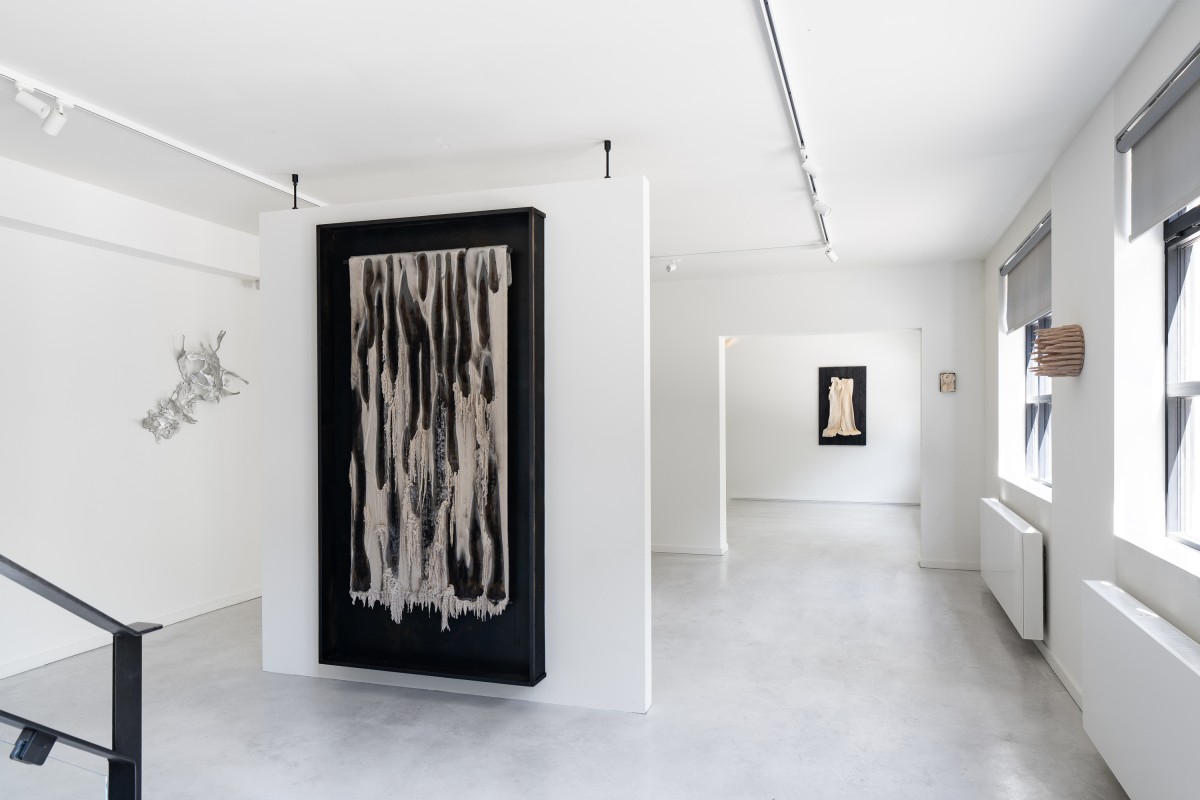
This becomes apparent the moment you enter ‘REBURN’. Fire serves as the exhibition’s point of departure, and your attention is immediately drawn to a series of charred wooden and metal structures that extend across the space, along the walls and from the ceiling. Yet fire functions here not only as a symbol of destruction but also of metamorphosis. The blackened surface of the wood bears the visible traces of burning, while simultaneously acting as a protective layer that paradoxically strengthens the material. This technique has in fact been used since the Paleolithic era to protect wooden structures.
Around and upon these constructions appear Minchin’s characteristic wax draperies, another material transformed by fire. At times they resemble textiles, at others skin or protective shrouds. Their meaning is never entirely fixed, and this ambiguity forms an essential part of the exhibition. At moments, it feels as though you are encountering the same work in different stages of its existence.
Minchin’s production process is intensely physical. Molten material must be shaped quickly, making chance and spontaneity unavoidable components of the work. According to the artist, this unpredictability reflects a form of uncertainty that we should also learn to embrace in everyday life. She frequently reuses the same wax, allowing older works to disappear into the melting pot before returning in a different form. In this way, matter becomes a vessel carrying memories of its previous incarnations.

Yet Minchin is interested not only in the practical qualities of wax, but also in its cultural and spiritual associations. In an interview with Wouter van den Eijkel for GalleryViewer the artist stated:
"Wax is the most plastic material in existence: it has the ability to be in many different states. It can be smooth, wrinkled, creased or cracked, hot and then cold, liquid, soft or solid. Wax continually goes from one state to another. (...) In spite of its fragility, wax has healing and protective properties. It is used in painting and furniture to resist wear and tear and in cooking to preserve food. It is therefore solid and durable. Fragile and eternal, I love it because it is a material that shows a strong ambivalence. It also has a mystical dimension in response to superstitions, which I find very inspiring. It is used in many funeral rites to accompany or protect the deceased [in death masks for instance, ed.]. It has a universal symbolic value: wax refers to the candle whose flame embodies hope and light in all cultures. It emanates a scent, familiar to all, reactivating a collective memory."
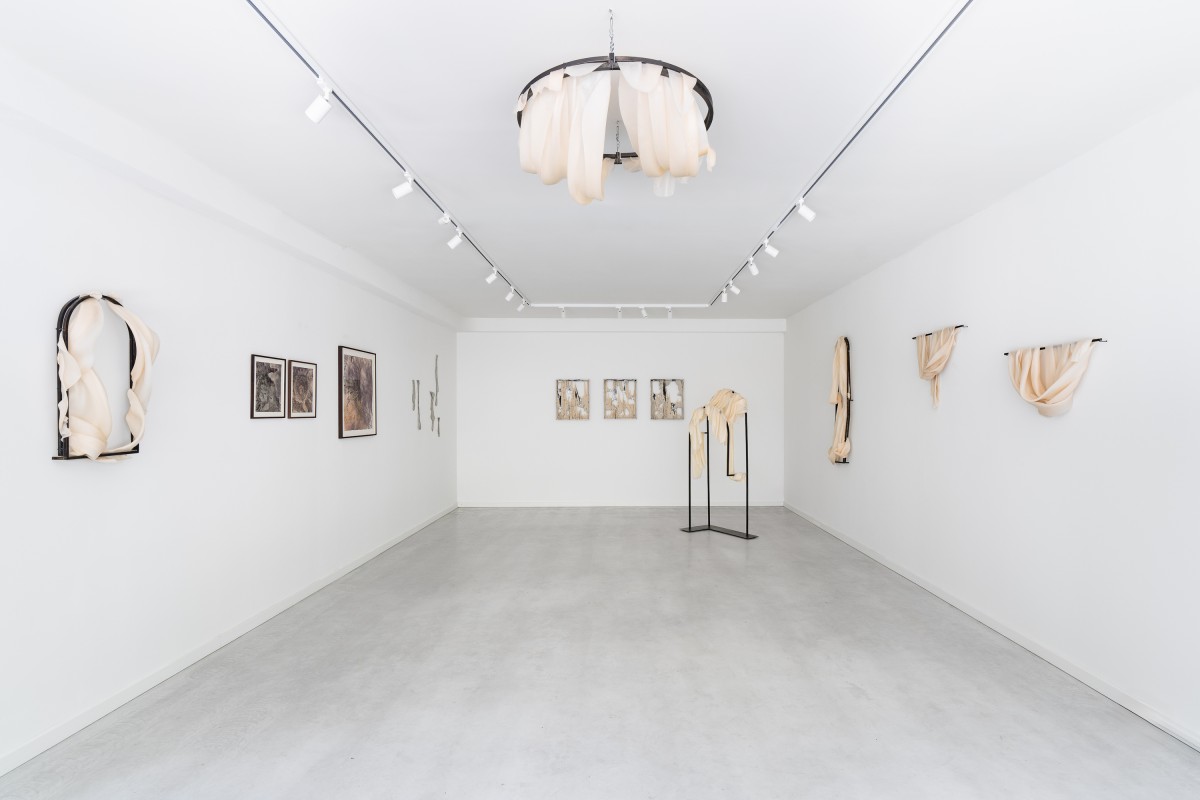
In addition to wax, Minchin works with materials such as wood, plaster, ceramics and metal. Her practice explores themes including cyclical time, disappearance and impermanence, as well as materials and sites in states of transition. This fascination helps explain her interest in construction sites, scaffolding, restoration projects and the remnants of buildings damaged by fire or decay. As Minchin explains: "I’ve always be fascinated by transformation in architecture: the skeleton walls at construction sites before they are covered with their ‘skin’, the large fabrics that protect historical monuments during restoration work, the remains of a building reduced to a carcass after a fire."
Minchin exhibited her work in remarkable locations, ranging from the thirteenth-century Abbaye de Beaulieu-en-Rouergue to the sixteenth-century Zeyrek Çinili Hamam in Istanbul, with its subterranean Byzantine cisterns. At Château La Coste, Minchin installed a monumental sculpture composed of stacked stone blocks at the highest point of the vineyard, creating a dialogue with both the surrounding landscape and a nearby ruin on the opposite hillside.
Minchin’s practice also engages with fields such as anthropology and themes including loss, recovery, degeneration, spirituality, mysticism, ritual and the way we describe meaning as a collective. Rather than focusing explicitly on religion, the artist is interested in the ways people across different cultures and historical periods have sought to make sense of loss, change, mortality and the unknown.

Minchin’s work was previously exhibited at the Monnaie de Paris, Museo Sant’Orsola in Florence, the Biennale BIS in Saint-Paul de Vence, a Selfridges window display in London and Palazzo Costantino in Palermo (in collaboration with the Institut Français). Her work is held in the collections of Château La Coste, Société Générale, the AkzoNobel Art Foundation, Collection Moët-Hennessy and the Musée d’Art Contemporain du Val-de-Marne. She received several distinctions, including ‘Mondes Nouveaux’, an initiative of the French Ministry of Culture.
