11 august 2026, Martine Bontjes
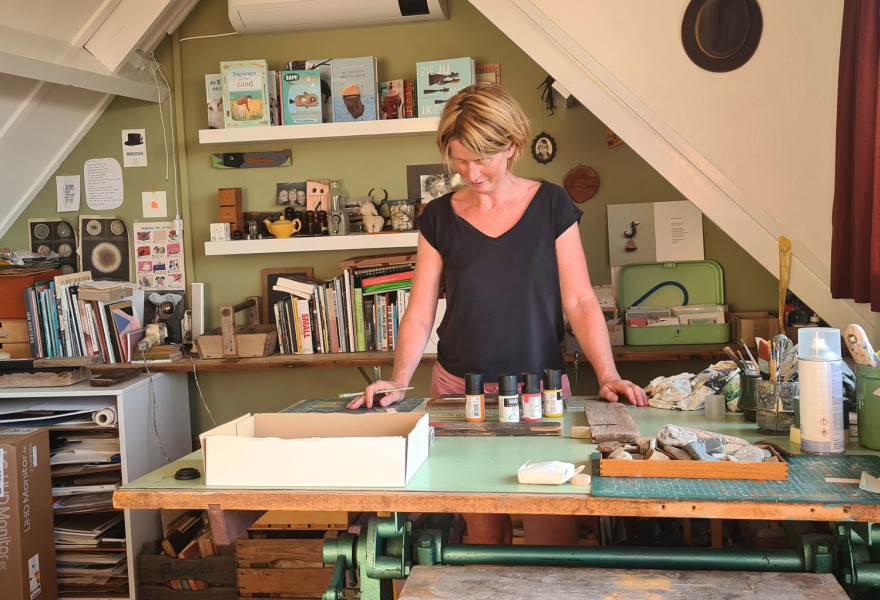
The studio of... Tineke Meirink
Meirink presents two series that each breathe new life into found materials in their own way. In Eigen Houtjes, she transforms pieces of wood into distinctive birds, giving them names such as 'De Vliegende Vlekfitis', 'De Verkouden Snip' and 'De Felle Donder'. In Trashures, she combines a variety of found objects on weathered wood to create graphic compositions.
Where is your studio and how would you describe this place?
My studio is on the top floor of my home in Garmerwolde, a small village just outside Groningen. It is not a large space, but it's a wonderful place to work and the light is beautiful. The studio has two sections. At the front is my desk with my computer, the tidy area for digital work. At the back is my worktable where I work by hand.
 Tineke Meirink, knikkerbolletje, 2026, Gallery Untitled
What kind of materials can be found in your studio?
Brushes, pencils, paint, chalk, markers, my computer, scanner, camera, collections of pieces of wood and old paper, found objects such as stones, beach finds, rusty objects, shards, dried plants, seeds and feathers. Lots of them. You'll often find me in the garage as well. That's where I keep my workbench, bandsaw and other woodworking tools.
Is there one particular tool you cannot work without?
I don't think so. I like working with whatever happens to be available, although I do really enjoy using Liquitex acrylic gouache.
You're an illustrator, writer and artist. You've illustrated more than 140 children's books. How do you ensure that every book develops its own atmosphere and visual language?
It happens quite naturally. Every manuscript or type of book, whether it's my own project or a commission, calls for a fresh approach. That's what makes it so enjoyable. Every time, you get to reinvent the wheel.
 Tineke Meirink, klusmus, 2026, Gallery Untitled
Your exhibition 'Alles is er al' is currently on view at Gallery Untitled. You created animal figures from pieces of wood and other everyday objects. Where did you find those materials?
Along rivers, on the beach, during walks, in thrift shops and in builders' skips. Sometimes people give me things as well, saying: "I'm sure you'll be able to do something with this."
Do you always turn them into animals, or do other figures emerge as well?
I also use those found objects as a surface for Trashures or as the starting point for an illustration. I photograph them, often in combination with other finds, and then add illustrated elements digitally. I actually made the bird series, Eigen Houtjes, especially for the exhibition at Gallery Untitled. It had been a while since I'd worked on them, but this exhibition made me rediscover the series completely. The audience has rediscovered them too. They have proved to be very popular and they're flying off the walls.
 Tineke Meirink, trashures P1.08, 2026, Gallery Untitled
Did this way of seeing start in your childhood? Can you remember when you first started recognising faces in everyday objects?
Absolutely. I vividly remember seeing all sorts of things in the knots of the wooden bed my father built for me.
Is that way of seeing always with you, or is it something you can switch on?
It's always there to some extent. Sometimes more than others. But I can consciously switch it on as well.
I read that you also enjoy giving names to these creatures. Do you have a favourite in the exhibition? How did come up with its name?
Yes, I love playing with language. But choosing a favourite from all sixty one birds I made for the exhibition... it is an impossible question. 'Felle Donder' is very dear to me because it's made from one of my father's old tools. Unlike names such as 'Vliegende Vlekfitis', 'Verkouden Snip' and 'Rare Kiet', it isn't derived from an existing bird name. Instead, it suits the bird because of its bright blue eyes and bold character. It's definitely not one to pick a fight with.
 Tineke Meirink, felle donder, 2026, Gallery Untitled
Alongside the animal figures, you're also presenting the Trashures series. They almost look like paintings on wood. Is that right?
That's true. The bird series, Eigen Houtjes, is still closely connected to my work as an illustrator. Trashures is less so. In that series, I bring together different objects from my collections on found pieces of wood, and sometimes on paper, adding simple graphic elements. In a way, each composition becomes a new collection in miniature.
Are there any materials you would like to work with in the future?
I usually don't look that far ahead. I work with whatever comes my way and inspires me at that moment. But I'd love to combine the found materials I already work with and precious materials such as bronze or gold leaf. I think that would create a wonderful and intriguing contrast.
What are you working on at the moment?
Thanks to a grant from the Dutch Foundation for Literature, I'll be spending the coming months working mainly on a new picture book by Erik van Os and Elle van Lieshout, although I can't say anything about it just yet. At the same time, I'm working on an educational language method and developing a new project with the author Mary Heylema. Eigen Houtjes and Trashures are ongoing projects as well, so they continue to evolve.
 Tineke Meirink, potloodventje, 2026, Gallery Untitled