28 july 2026, Flor Linckens
An intriguing dialogue between stone and cardboard in Art Gallery O-68
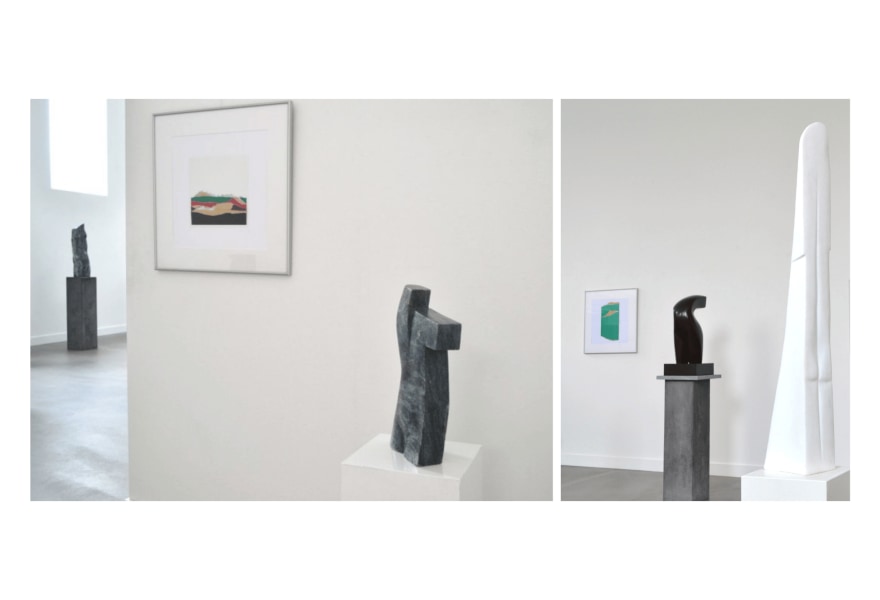
Last weekend, Art Gallery O-68 in Velp opened the duo exhibition 'Oerkracht en Geometrie' (‘Primal Force and Geometry’), bringing together the sculptures of Jan Pater and the collages of Edgar Knoop. Despite their distinctly different visual languages, the two artists share an important common ground: both reduce complex forms and experiences to their essence, asking remarkably similar questions in the process. Pater abstracts the human body, while Knoop explores the ways colour, rhythm and light shape our perception of space. The result is a compelling dialogue between two contrasting approaches to form. One is rooted in weight, volume and tactility, the other in light, depth and optical perception. Three-dimensional sculptures stand alongside flat compositions that evoke movement and spatial depth through remarkably economical means.
Jan Pater was born in Heerhugowaard in 1950. Before dedicating himself to sculpture some thirty years ago, he worked as a cabinetmaker, nurse and teacher. It is therefore hardly surprising that craftsmanship and the human form come together so naturally in his artistic practice. Anyone looking at his sculptures will immediately recognise the human torso, sometimes explicitly, sometimes in a more abstracted form. Pater is not really interested in anatomical perfection but rather in finding the most convincing and distilled expression of the human body. A slight twist of the hip, a subtle curve, a polished surface, a flowing line or a sharply cut edge can prove to be enough to suggest a human form.

The artist primarily works with materials such as marble, granite, onyx, gneiss, bronze and wood, continually exploring their individual qualities. At times he chooses pristine white Carrara marble, at others warm brown bronze, ash wood or striking blue sodalite. His working method is highly intuitive. Rather than producing clay models or detailed preparatory drawings, Pater works directly into the material, allowing the sculpture to emerge through carving and polishing. As a result, each work feels less conceived than discovered, as though its final form had always been waiting inside the block of stone. Yet every curve, every volume and every incision is carefully considered. The natural veins, textures and colour variations of the material also help shape the final result. Some sculptures appear so organic that they seem to grow directly from their pedestal.
For many years, Pater has worked at SEM Studio in Pietrasanta, Tuscany, where he continues to return annually. His work has been included in the collection of Beeldengalerij Het Depot in Wageningen and he has also created a sculpture for the Antoni van Leeuwenhoek Hospital in Amsterdam.

Edgar Knoop was born in Dortmund in 1936. He studied philosophy and art history at Ludwig Maximilian University of Munich before continuing his education at the Academy of Fine Arts Munich, where he later spent almost thirty years as a professor at the department of Experimental and Applied Color Theory. Today, he lives and works in Seeboden in Austria. His multidisciplinary practice encompasses sculpture, collage, photography, light objects and installations and broadly explores the relationship between colour, light, science and the (optimisation of) human perception. His work occupies a space between Concrete Art, Kinetic Art and Op Art and is characterised by mathematical structures, colour theory and optical effects. Throughout his career he frequently collaborated with scientific institutes.
This exhibition at Art Gallery O-68 offers a particularly strong overview of Knoop's long-running "Horizonte" series, which he started in 1995. These abstract collages are constructed from the simplest of materials: paper and corrugated cardboard with carefully torn edges. Because tearing can never be completely controlled, there's always an element of chance that Knoop deliberately embraces before carefully arranging each fragment into its final composition. Through these reliefs he creates a subtle sense of tension, movement and depth, while the corrugated surface catches and reflects light in constantly changing ways.

Visually, the "Horizonte" works evoke the landscapes that Knoop encountered during his many travels through North and South America, Asia and the Maghreb. The torn contours of the cardboard recall mountain ranges, cloud formations and coastlines without ever depicting a specific place. For Knoop, colour functions as an active material in its own right. He favours highly saturated, contrasting colours rarely encountered in nature, ranging from Kelly green and neon green to ochre yellow and fire-engine red. Despite this vibrant palette, the compositions possess a striking sense of calm, thanks in part to the recurring horizontal structure that anchors each work.
Edgar Knoop's work is part of the collections of the Belvedere Museum in Vienna, the Stadtmuseum München and Museum van Bommel van Dam in Venlo. His works can also be found in public spaces in cities including New York, Munich and Mainz.

