21 july 2026, Flor Linckens
Laurence Aëgerter: knowledge as a shared possession
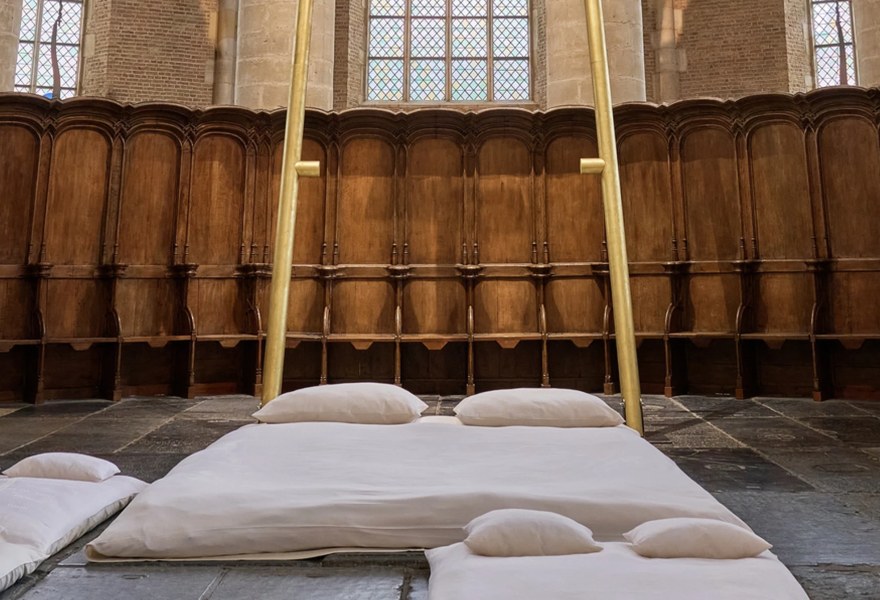
This summer, Laurence Aëgerter presents the monumental site-specific installation "Ode aan dagen van wijsheid" ("Ode to the Days of Wisdom") at the Grote Kerk Alkmaar. Created especially for this historic setting, the new work connects the church’s rich past with urgent questions about knowledge and memory, as well as the ways in which we acquire, interpret and assign meaning to information today. Aëgerter is represented by Bildhalle.
The installation is the result of extensive research into the historic early modern Librije of the Grote Kerk Alkmaar, the city's first public library. For centuries, it served as a centre for the exchange of knowledge, where several hundred books could be consulted by the literate community, with permission. Today, the collection is preserved at the Regional Archive of Alkmaar. Yet Aëgerter's focus quickly shifts from the history of the Librije to the present day. For the artist, the history serves as a starting point for reflecting on the value of knowledge itself. We live in an age in which information is abundant, literacy is widespread and technological developments grant us access to unprecedented quantities of information. Within this context, Aëgerter asks why this ever-growing body of knowledge does not automatically lead to greater wisdom, understanding, empathy or collective responsibility.
Aëgerter is known for inviting viewers to reflect on themes such as perception, memory and the complex, often elusive nature of images and "reality". Trained as both an art historian and a visual artist, she has developed a multidisciplinary practice encompassing photography, textile art, installations and community projects. Her layered body of work is rooted in an in-depth exploration of the transformative power of images and their ability to shift in meaning through time and context. She investigates how images are created, circulated and consumed. By reinterpreting historical imagery and forging new connections between past and present, she reveals how visual culture shapes our perception and encourages us to question ideas of authenticity. In doing so, Aëgerter explores the structures, "the archive", that shape our collective memory and, in turn, our identity. Drawing on her extensive knowledge of art history and iconography, she brings images and references from different cultures and historical periods into dialogue with one another.
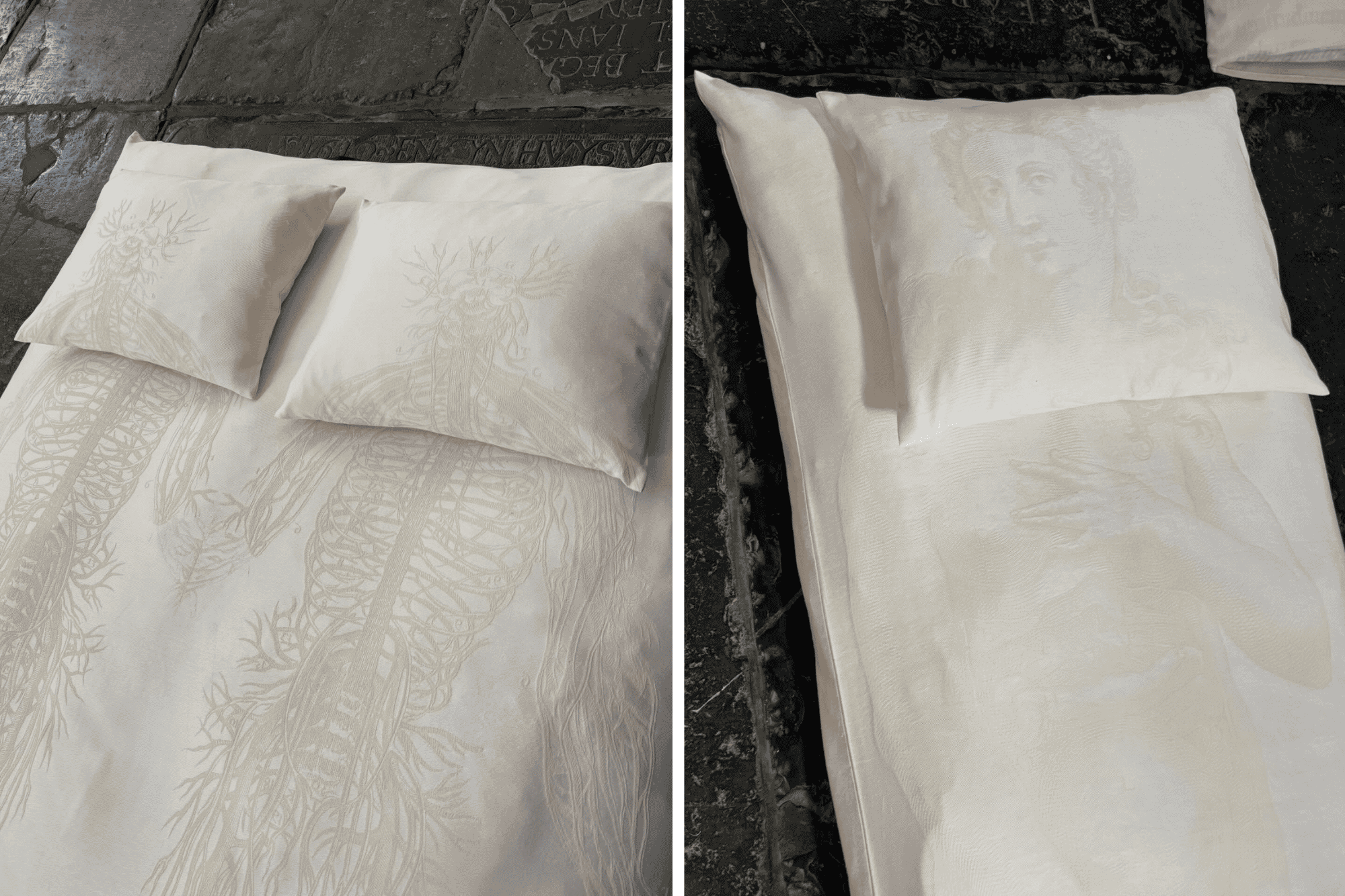
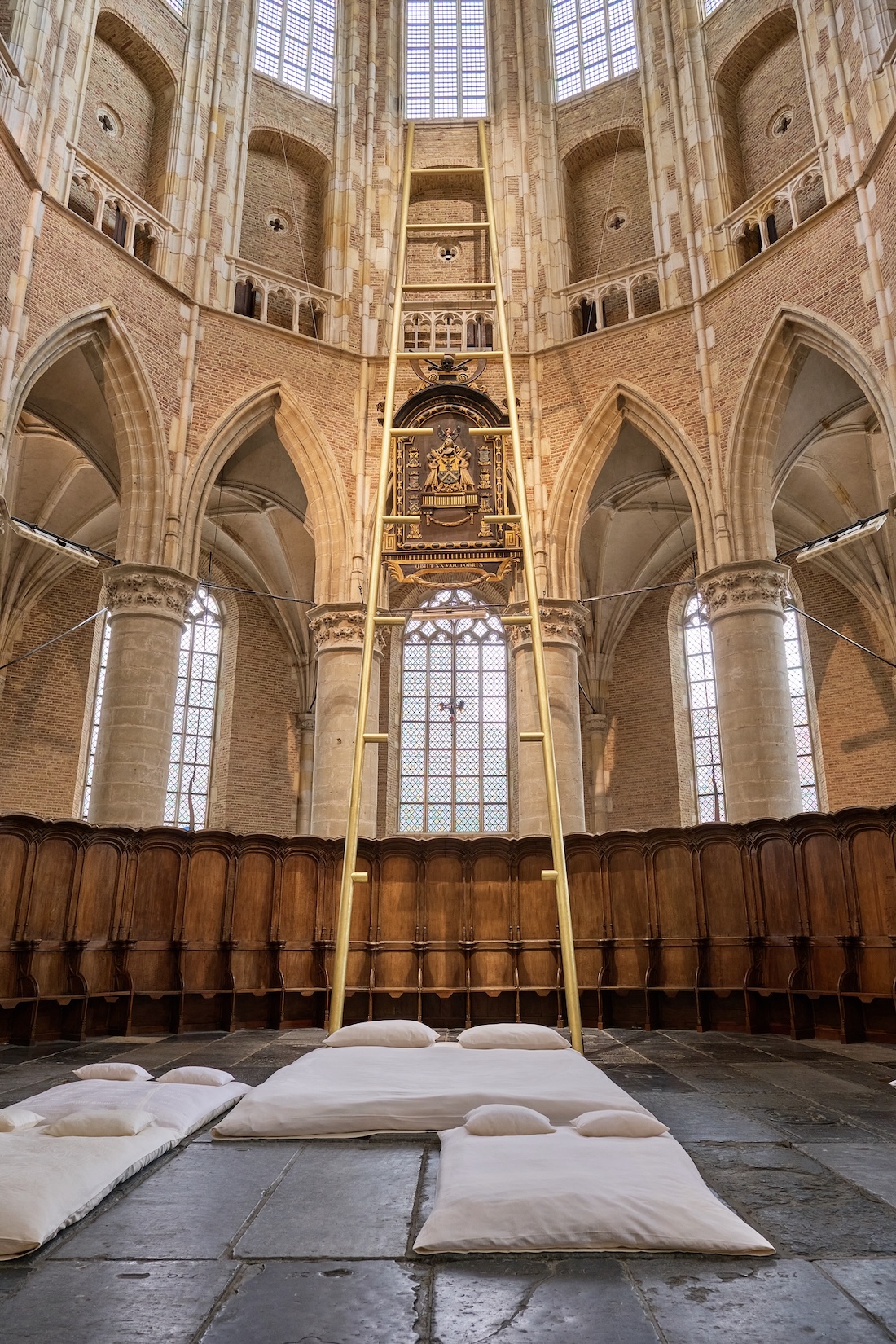
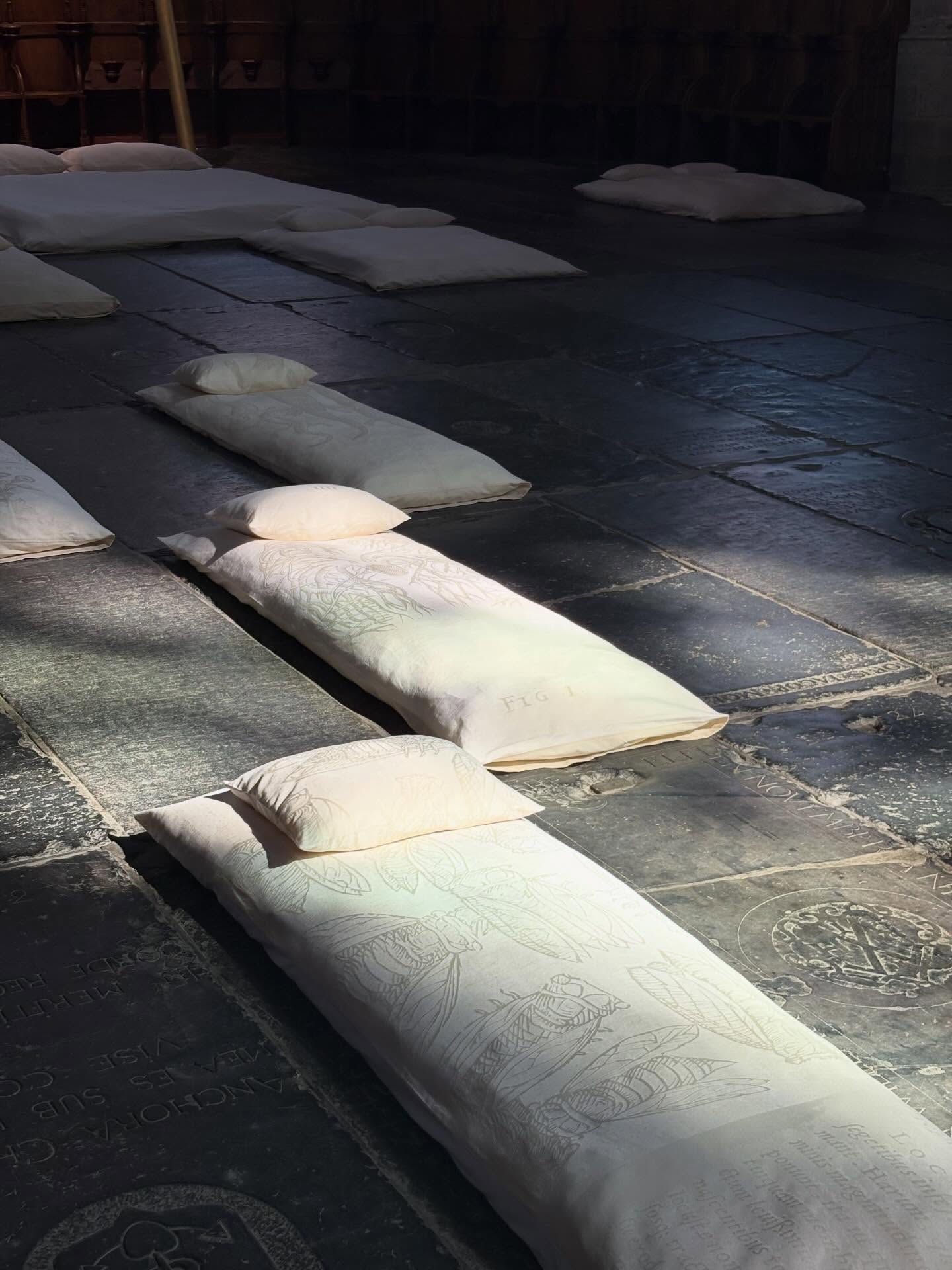
At the heart of the exhibition, inside the five-hundred-year-old Grote Kerk Alkmaar, lie twenty-one damask duvets and pillows, arranged across the centuries-old gravestone floor of the high choir. Originally, this was the part of the church where the clergy or monks performed their daily prayers and chants and where the high altar was typically located. The subtle motifs woven into the duvets and pillows are based on illustrations that Aëgerter found in the late medieval books from the former Librije. They depict anatomical studies, plants, animals, root systems and other organic forms. During her research, Aëgerter discovered striking visual correspondences between these historical illustrations. Thanks to the unique properties of damask, the woven images continuously appear and disappear depending on the changing light and the visitor's position, leaving the work in a constant state of transformation and demonstrating that perception is never entirely fixed.
The appropriation and transformation of existing images has long been a defining element of Aëgerter's practice. She regularly draws on visual material from encyclopaedias, archives, art reproductions and documentary photography, placing these sources within new, often poetic contexts that invite new ways of seeing. Historical reproductions are manipulated, fragmented or re-photographed. They are distorted, inverted, concealed or exposed to time, light, shadow or heat. Sometimes these interventions are subtle, involving shifts in colour or composition. At other times, they take the form of more radical physical transformations, often employing traditional craft techniques. In doing so, Aëgerter creates visual tensions in which the boundaries between original and interpretation dissolve and one reality gradually gives way to another. Her work explores the subjective ways in which we look, construct meaning and, in this case: absorb and interpret knowledge, how collective histories take shape and how the past continues to resonate in the present.
The installation also includes a gold-coloured eighteen-metre ladder, leaning against the rear wall of the choir. Because its lower rungs are largely missing, the ladder appears unfinished and unreachable: a metaphor for our enduring search for insight.
Laurence Aëgerter was born in Marseille in 1972, into a family of antique dealers. She currently divides her time between her hometown and Amsterdam. She studied art history at the Université d'Aix-en-Provence and the Vrije Universiteit Amsterdam, where she graduated cum laude with a thesis on trompe-l'œil in seventeenth-century Dutch painting. She subsequently studied at the Gerrit Rietveld Academie, where she further developed her research into image transformation. Her work has been exhibited at the Petit Palais in Paris, MAMAC in Nice, the Guggenheim Museum Bilbao, Les Rencontres de la Photographie in Arles, the Museum van de Geest, the Fries Museum, Jeu de Paume in Paris, FOMU Antwerp, the Frans Hals Museum and the Nederlands Fotomuseum. Her work is held in the collections of the Metropolitan Museum of Art in New York, the J. Paul Getty Museum in Los Angeles, the New York Public Library, Museum Voorlinden, MAMAC Nice and the Nederlands Fotomuseum.
