23 june 2026, Martine Bontjes
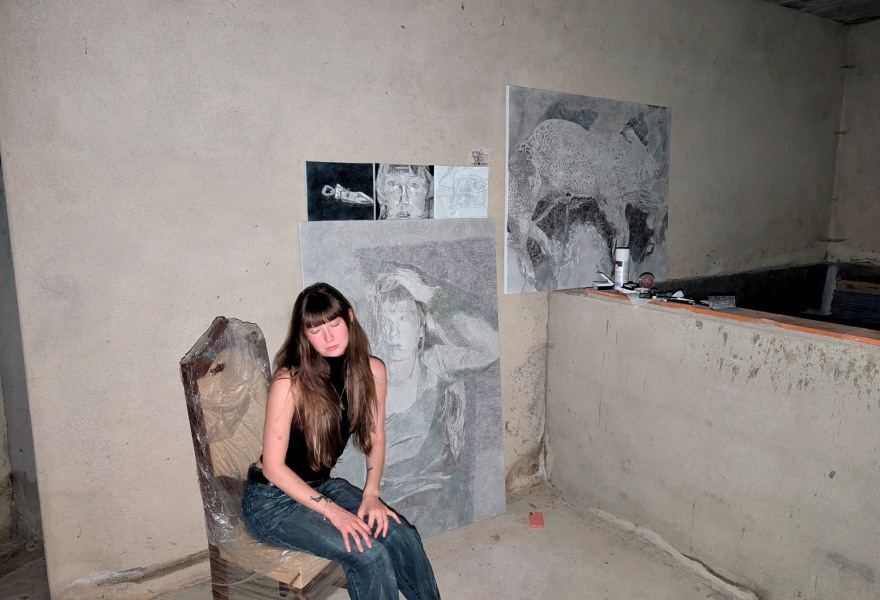
The studio of... Sofiia Dubyna
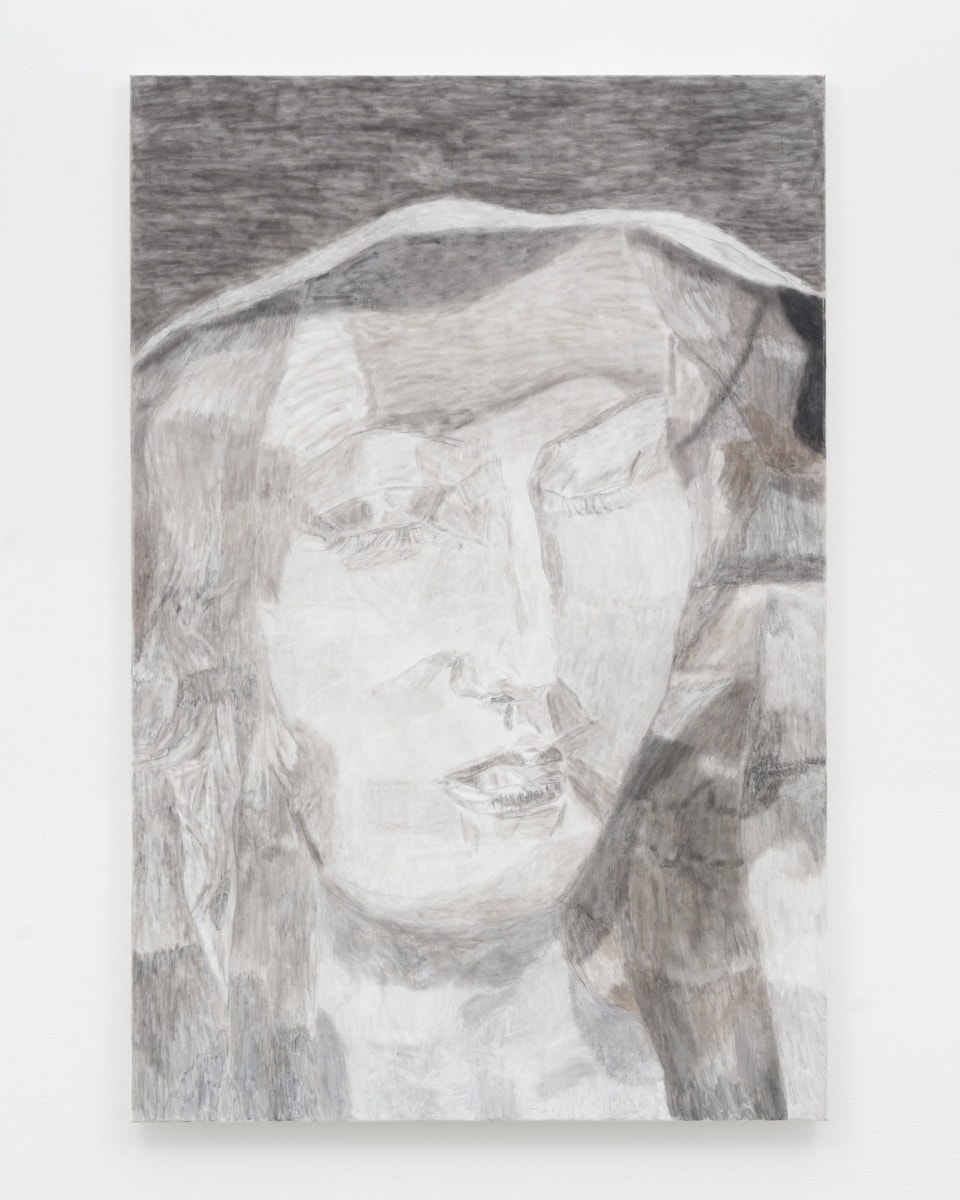
Sofiia Dubyna paints the people that surround her. While friends previously played a central role in her work, her new paintings and drawings turn their attention to her mother. The series was created after a period during which mother and daughter had lost touch. In sober black and white tones, Dubyna explores the complex dynamic between parents and children, which she believes differs fundamentally from friendship. Family relationships, she says, are less forgiving. She hoped the works might help repair her relationship with her mother, and they did. “I think she now knows that I need her too.” The exhibition ‘Duo’ remains on view at andriesse eyck galerie until 26 June.
Dubyna considers herself fortunate. Throughout her studies and the years that followed, friends and acquaintances have consistently helped her find places to work. She is currently based in the basement of a friend’s parents’ house in Portugal: a spacious concrete room that comes surprisingly close to her ideal studio. The emptier the space, the better. For Dubyna, emptiness is not an absence but a condition for creation.
Where is your studio and how would you describe this place?
My studio is currently in the enormous basement of a friend's parents' house, ridiculous and strange as that may sound. The place is huge and charming, at least to me, though comfortable dimensions are obviously the most important thing. Probably the funniest feature of the basement is the presence of a large basin for pressing grapes and making wine, as far as I understand. Apparently these were common in old Portuguese houses (God knows what it's actually called).
By some stroke of luck, studios were always provided by the universities where I studied, and when I moved somewhere temporarily I had to paint at home, which isn't always ideal. Luckily, I've been fortunate with the people I've met, so the offer to occupy someone's parents' basement arrived fairly quickly. If there's one thing I've always been lucky with, it's friends.
If you had your own studio one day, how would you imagine it?
I think that in my current situation this is the nicest studio I could possibly have, especially considering that it's free. I wouldn't dare call it a dream studio, but I genuinely like it there. I love empty concrete spaces. My dream studio would definitely look exactly like this, only it would belong to me, which is always nicer.
The emptier the space, the better. I can't stand mess in artists' studios. It drives me completely insane, even when I'm stepping into somebody else's workspace. I immediately want to tidy everything up so that emptiness and order can fill the room. That's exactly what my dream studio would be like, without a doubt.

Sofiia Dubyna, Mothers and Daughters, 2025, andriesse eyck galerie
You often work with unusual materials, such as makeup belonging to friends. Did you use your mother's makeup for this new series?
God forbid. My mother would have been extremely unhappy about such a use of her belongings. Besides, my friends often gave me makeup that didn't always fit the specific colours I needed, so I would end up having to go out and buy the right shades anyway, rather gloomily and with very little conceptual significance.
Have you ever worked with colour, or has your practice always been focused on black and white?
Actually, I've always worked in colour. But you get tired of it. You don't always have the desire or the energy to paint everything in what we would call "surprise-party colours." Besides, it seemed to me that anything connected to my mother should be monochrome. Not because everything is grey and miserable, but simply because she's a restrained person. Her clothes and her behaviour have always been like that, stripped of bright colour. As I've grown older, I've simply become more like her (at least I wish).
We're used to expressing ourselves only in our relationships with people close to us. In everyday life it's usually better to remain either rough (simply rude) or detached. So if I wanted to describe visually our relationship with the things around us, only this palette felt appropriate.
Sofiia Dubyna, Mothers and Daughters, 2025, andriesse eyck galerie
In your earlier work, your circle of friends often played a central role, whereas this new series focuses on your relationship with your mother. Is this the first time you have placed a family member at the centre of your work?
Yes, for the first time. I've always had a certain fear of depicting relatives, my mother in particular. In general she never really liked the way I painted girls, so it's hardly surprising that she wouldn't want to find herself among the people I scribbled into my works. And I didn't particularly want to paint her either. I didn't want to explain myself, or listen to her complaints afterwards, although I've always found the way she complains quite amusing.
I simply chose to paint people who actually wanted to be seen and painted. My mother is definitely not one of those people. Although I often found certain traits of my mother in my friends and brought them to the surface through somebody else, I still think of many of my friends as a kind of family. In any case, the main reason I didn't paint my mother was a rather naive desire not to disappoint her. Naturally, I never had such thoughts when it came to my friends. There's a certain indifference to consequences in relationships with people you begin to think of as your "family," whether out of amusement or for other reasons. With real relatives, mistakes are not so easily forgiven.
How did your mother respond to the work? Has she seen the series?
Yes. I painted her specifically in order to restore our relationship and to show her these paintings. That was really my main reason. After not speaking to her for almost three years, and no longer finding inspiration anywhere else, I finally decided to paint her, only this time in the way she would have wanted. I used to have a habit of altering people's facial features quite heavily, and in general the way people appeared in my earlier works. The result was usually more of a mad fiction than anybody's portrait.
This time I simply wanted to depict us together, alongside fragments of my life that existed but that I never told her about, or that didn't particularly interest her, simply in order to share them. I've never really shared anything with her, although I know she would have wanted that, even if sometimes she might have found it boring. The fact of openness and closeness itself mattered. Of course she replied immediately. She was pleased and probably touched in some way. Most importantly, we started talking again. So my subconscious plan was more or less realised. I found a certain peace in that.
Sofiia Dubyna, Mothers and Daughters, 2025, andriesse eyck galerie
Did making this work help you communicate with her in a different way?
No, I wouldn't say that. She and I are fairly fixed units. We aren't going to change for each other, and we don't want to. But it definitely helped both of us understand each other better and be a little more restrained. I think she now knows that I need her too.
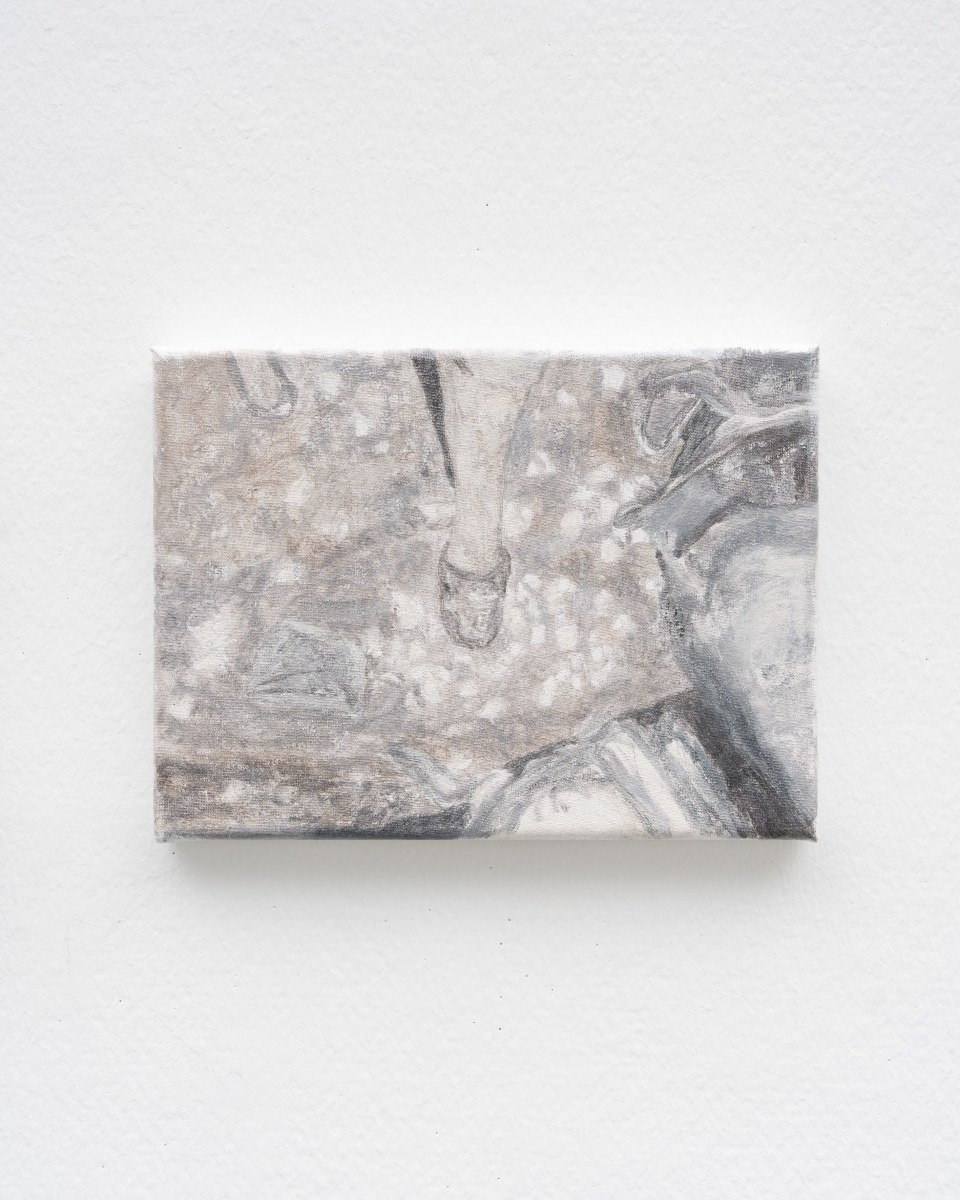
Who is the dog featured in the work? Was it your family's dog?
The dog isn't a family dog at all. It belongs to one of my rather crazy acquaintances.
My mother and I don't like dogs very much, and in general we're fairly indifferent to animals. My father is the one who loves every creature he comes across.
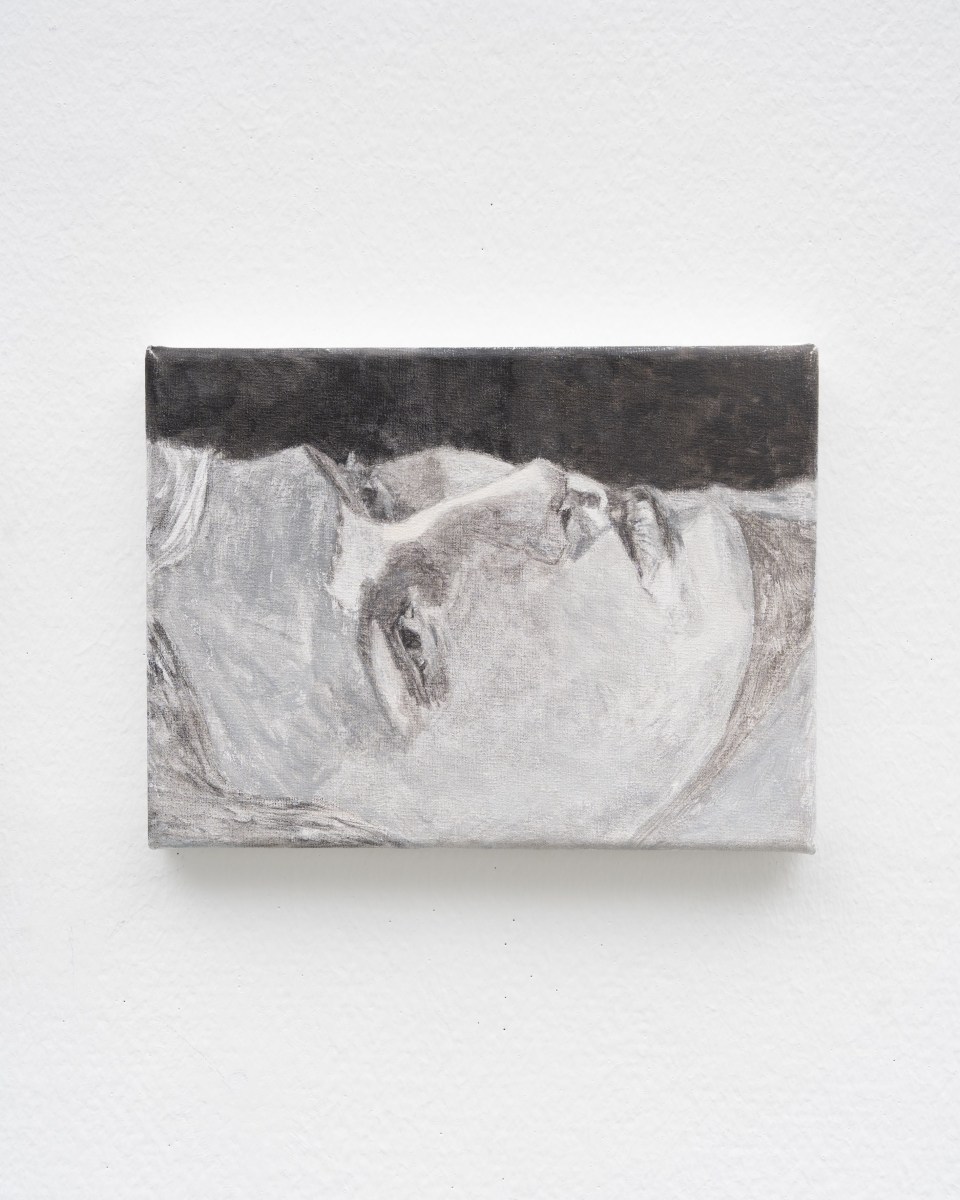
Who is the male figure that appears in the series? Is it your father?
No, I've never painted my father. He's far too kind and good-hearted, and honestly far too handsome to paint. To be honest, there's nothing more boring than painting very attractive people, at least for me. And I didn't paint my dad because I genuinely don't see any need for it. What's the point of painting somebody who already adores you?
The man in that small work is actually that same crazy acquaintance. It was his puppy.
I painted him mostly out of curiosity. I've often wanted to tell my mother more about the questionable people I spent time with when I was younger, but I chose the least traumatic way possible.
Are you currently working on a new project, or are there any future plans you are particularly excited about?
At the moment I'm planning, and very much hoping to realise, a project about portraying other people's mothers together with their prodigal daughters, using the same principle as I used for the portrait of myself and my mother. One condition is that the photograph of the mother I work from must show her at the same age as her daughter.
I would like to give women who struggle to communicate with the important ones in their lives a chance to look at one another standing side by side through the eyes of a stranger. I want to use photographs where they are the same age because any resemblance between them, whether physical or emotional, becomes much more obvious that way. If even a complete stranger can see a similarity and a closeness between them, I'd like to believe that they might eventually be able to see it too.