19 may 2026, Flor Linckens
In Memoriam: Ossip
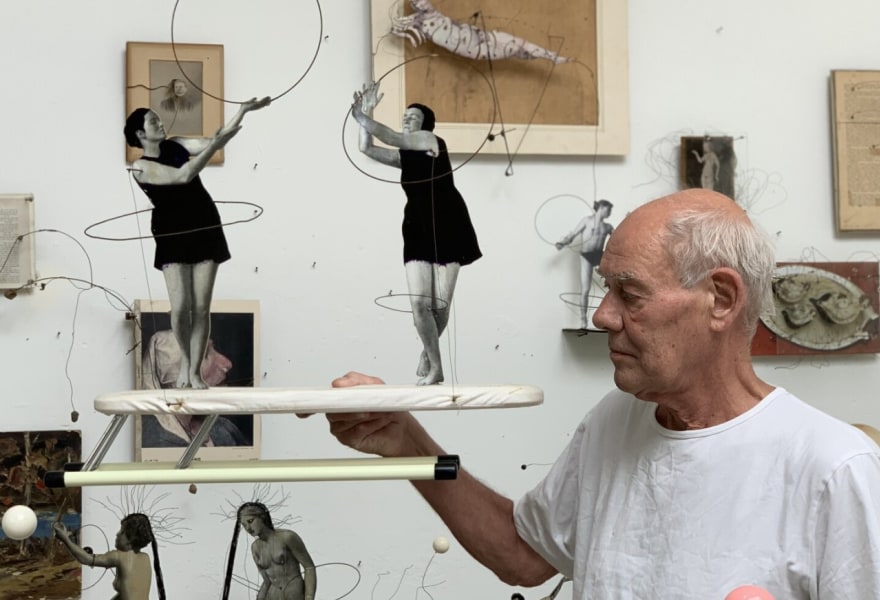
Earlier this month, the artist Ossip passed away. That means that the Dutch art world loses a unique and extraordinarily idiosyncratic artist. Ossip was a self-taught artist who, over the course of fifty years, built an entirely singular and enigmatic universe, situated somewhere between an anatomical theatre, a forgotten family album, a dream world and a cabinet of curiosities. His work resists easy categorisation or confinement within a single movement, and that was precisely the point.
Ossip’s studio seemed to have more in common with the domain of a collector, psychologist or explorer than with a 'conventional' artist’s workspace. Everywhere, there were sculptures, wire constructions, old photographs, clippings, objects and half-finished assemblages. His studio was so central to his artistic practice that Kunstmuseum Den Haag created a partial reconstruction of it for an exhibition in 2009, complete with enigmatic details, found objects and seemingly carelessly abandoned items. It felt almost as though you were briefly allowed to step inside his mind for a moment. In 2024, Ossip’s work was on view in a major retrospective at BRUTUS, which brought together more than five hundred works from across his oeuvre. The exhibition revealed the remarkable breadth of his practice, ranging from early text collages and near pop art-like works from the 1980s to the mysterious photographic worlds for which he ultimately became known.

Ossip frequently worked with anonymous portraits taken from old medical books and magazines dating from the early twentieth century, which he found at flea markets and thrift shops. He was not particularly interested in the historical context of these images, but rather in the feeling they evoked. The selected photographs were subsequently cut out, enlarged, altered, dissected and reassembled into fragile, often three-dimensional and kinetic assemblages. These works incorporated elements such as iron wire, weights, strings, wood, glass, lamps, perfume bottles and even scraps of wallpaper. Some figures appeared trapped or bound, while others seemed weightless, playful or almost circus-like.
In their original context, the figures in his work had often been photographed purely for scientific documentation. In Ossip’s hands, they were granted a new life. Suddenly, they became mysterious protagonists in open-ended narratives without a clear conclusion. At times vulnerable and poetic, at others absurdist or even unsettling. Although his work bears certain affinities with Surrealism, Ossip himself seemed allergic to overly theoretical or grandiose interpretations or categorisations of his work.

Gallerist Catalijn Ramakers, with whom he worked for nearly three decades, described him on Instagram as someone who remained uncompromisingly faithful to his artistic vision. That same quality can be felt in the work he leaves behind: a universe unlike anything else, one in which the viewer can briefly lose themselves for a bit.
Ossip Jan Snoeck was born on 29 August 1952 in The Hague, the son of sculptor Jan Snoek. He was named after the renowned sculptor Ossip Zadkine. In 2019, AVROTROS released the Close Up documentary ‘Ossip - Van Vader op Zoon’. His work has been included in the collections of the Centraal Museum, Museum Voorlinden, Kunstmuseum Den Haag, the LAM Museum, the Verbeke Foundation and the collections of ABN AMRO and SNS Reaal.

