12 may 2026, Yves Joris
Dreamtime: so near and yet so far
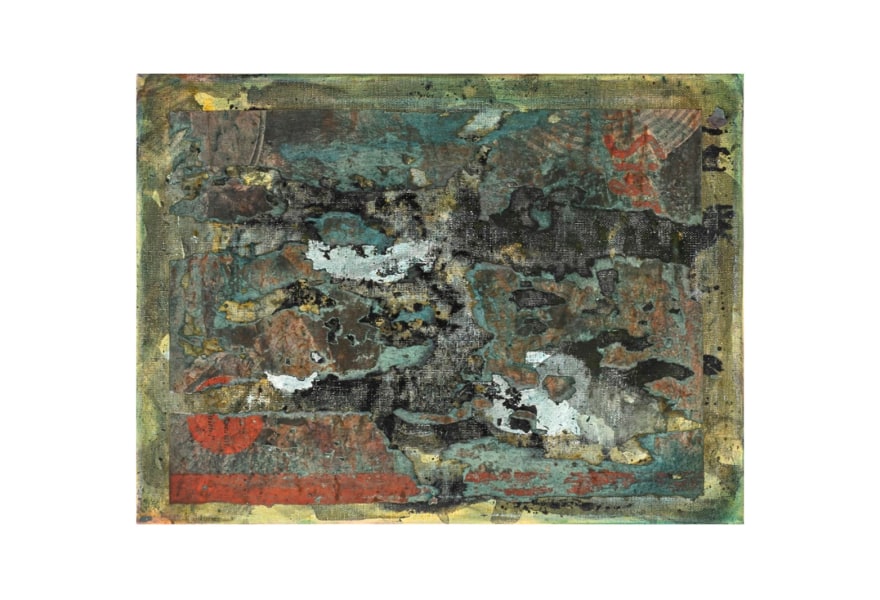
The gallery door is blocked by a ladder. Jef Gysen is busy installing the signboard for Antwerp Art Week. Inside, the work of Marc Schepers already hangs quietly, waiting: collages of cut-out microphotographs and propaganda images, informal compositions untouched by haste. It is precisely this contrast—the working hand, the pulsating present and behind it all, the layered, timeless image—that sets the tone for what this exhibition is really trying to say.
Right now, Shoobil is at a pivot point. A gallery in the final weeks of its existence, fully immersed in the rhythm of the art week, yet completely attentive to the work it is presenting. It feels natural for Schepers to be exhibiting here on the Waalse Kaai where he personally ran a gallery for nearly 40 years. That Jef is putting up the signboard here. That Serena briefly visits a fellow gallerist together with me. That all this is taking place just before the silence sets in.
The time that always exists
Dreamtime: so near and yet so far. The Aboriginals did not use the word for something that had passed, but that always exists, a continuous calibration of how we look at the world. No nostalgia, no escape. Schepers chose the term deliberately: he places his work in the area of tension between what is perceived and what is dreamed, between the recorded image and the associations it evokes. Anyone who steps inside immediately understands what is meant.
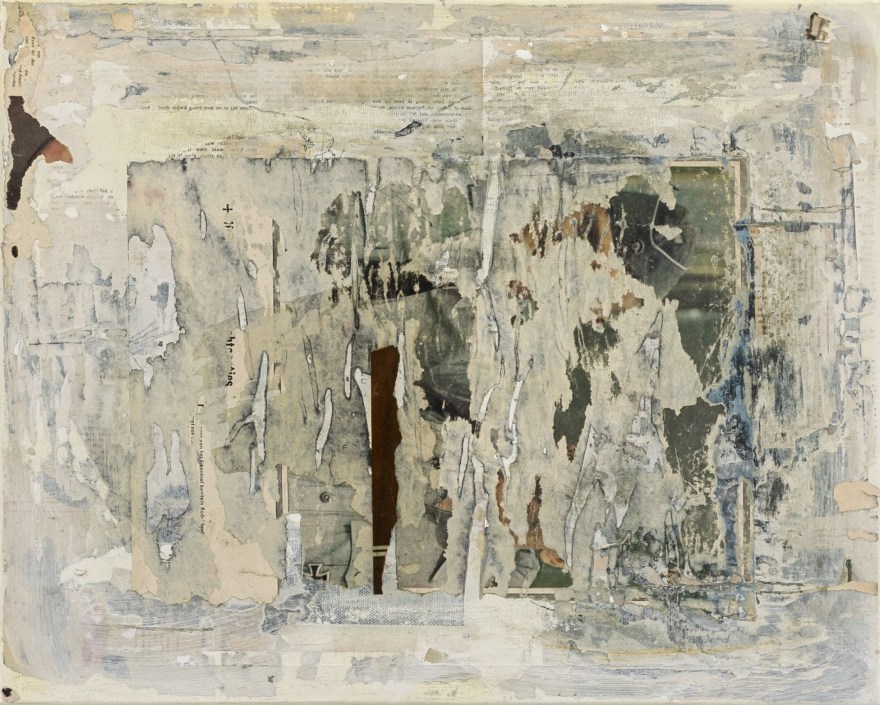 Marc Schepers, Dérive, 2026, Shoobil
The image as toy, the marker as key
The points of departure are diverse, but the line of thought is consistent. Medical microphotographs—microscopic tissue normally unseen by anyone—are altered by Schepers with glue and paint. It is an exercise in attention, in trusting that every image carries a story if only we dare to look associatively. Charles Baudelaire once described in La philosophie du joujou how children take expensive toys apart in order to regroup the pieces using their own imagination. Schepers does the same, but with the visual material of the world, and approaches it with the same seriousness as a child in deep concentration.
Compost of history
More charged and politically heavier is his use of Signal—the Nazi propaganda magazine that concealed its horrors behind glossy photographs of smiling people, advertisements for UFA films and undramatic war imagery. Schepers does not treat this material illustratively, but destructively-constructively: cutting, tearing, regrouping, allowing images to merge into an informal compost composition. The term is precise. Compost: what has undergone decay becomes the most fertile ground. He does not destroy the propaganda by erasing it, but by dismantling its direction of reading, allowing the cliché images to dissolve into an informal space where time and space collapse together without telling the imposed story someone wanted you to believe.
Leonardo da Vinci advised his students in the Trattato della Pittura to study weathered walls attentively—the irregularities, stains, peeling layers—because figures hide within them that awaken the imagination. Schepers uses that method as an ethical instrument. The weathered wall here is history itself: the peeling memory of the horrors of Nazism, hidden beneath a smooth surface of everyday normality. By allowing the images to weather—literally tearing them apart and letting them decay into new compositions—he makes that past visible in a way that is not an accusation, but confrontation with the mechanism itself.
 Marc Schepers, Dérive, 2026, Shoobil
The man who offered space to others for 40 years
There is something paradoxical in the biography preceding this work. For nearly 40 years, Marc Schepers was primarily another kind of bridge-builder: as the gallery owner of Ruimte Morguen—first in Borgerhout and from 1987, on Waalse Kaai in Antwerp South—he offered space to others: to Danny Devos, to Paul De Vylder and three times to a then-young Luc Tuymans, who took his first steps toward international fame there. Ruimte Morguen was not a white cube, but a laboratory, a place where art and society could challenge one another, as the M HKA would later describe it. When the pandemic silently forced the space to close, Schepers transferred his archive of four decades to the museum and returned to what he had always done alongside running a gallery: creation itself.
Association as knowledge
What connects Schepers' work throughout—from the fortune teller laying cards side by side to the microphotographs filled with hidden figures, from Sigmund Freud's The Interpretation of Dreams to the cut-up propaganda material—is a fundamental trust in association as a form of knowledge. Not knowledge that proves, but knowledge that enables. That punctures a habitual way of seeing, as he formulates it, and invites the viewer to discover the image in the process of its becoming.
So near and yet so far. So near because every image consists of familiar material—newspaper pages, medical photographs, playing cards—and so far because the meaning they carry lies just beyond the reach of immediate understanding. It is in that space—that narrow, fertile strip between recognition and mystery—that the work of Marc Schepers exists. And anyone willing to spend time within it discovers that the space is much larger than it seems.
Three people who believed in rearranging the world
A quiet melancholy hangs over this exhibition that the text cannot conceal. Shoobil Gallery, founded in 2015 by Serena Baplu—who trained at the Royal Academy of Fine Arts Antwerp and is an artist who always called Ruimte Morguen one of the spaces that shaped her way of seeing—will soon close its doors. All those years, she was accompanied by her partner Jef Gysen: painter, early riser, someone who enters his studio in an old farmhouse in Sinaai at four in the morning to explore, under artificial light, the tension between abstraction and figuration, capturing the complexity of spaces through maquettes he repeatedly dismantles and reconstructs. He, too, belonged to the heart of Shoobil. Three people, each of whom believed in their own way that meaning arises through rearranging what already exists.
The circle is smaller than it seems: the gallery that gave Schepers a second wind did so from a shared temperament. All chose the first steps, the unknown work, the space not dictated by the market. That Schepers was able to celebrate his rebirth as an artist at the exact same place where Ruimte Morguen once stood, and that this same place is now closing once again, is not a coincidence presenting itself as allegory, but simply how time works at the margins of the art world: generous, invisible and always too brief.
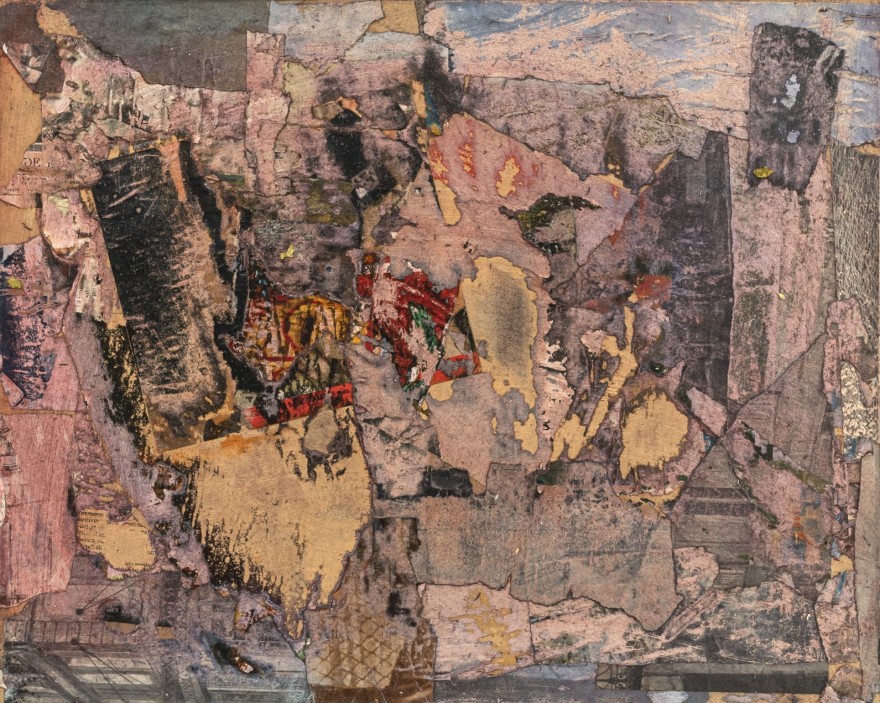 Marc Schepers, Dérive, 2026, Shoobil