05 may 2026, Yves Joris
Why an echo is never a copy: a reflection on Echoes in Fabric, Marble and Metal by Nick Ervinck
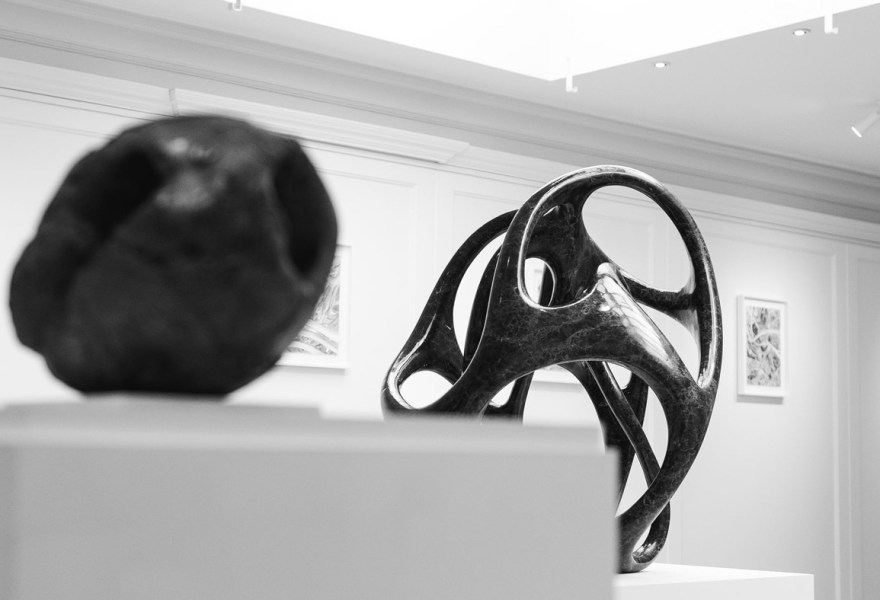
There is something curiously soothing about the notion of a digital line unfolding itself. It grows without resistance, turns without weight, branches without the consequences that every branch in the physical world inevitably entails… In Nick Ervinck's studio, form lives a brief, privileged existence: weightless, scalable, free from any material consequence. It is everything at once—and not yet anything. It is precisely this duality that makes Echoes in Fabric, Marble and Metal at Gallery Ysebaert so compelling.
The line as living entity
The line is the oldest tool in the visual arts. Kandinsky viewed it as spiritual energy, Moholy-Nagy used it as a constructive element structuring space and light and Picasso transformed drawn lines into three-dimensional metal sculptures. Ervinck consciously situates himself within that genealogy—and takes it further. In his work, the starting point is not a figurative form that is subsequently abstracted, but the abstract line itself as a living entity. It behaves like a vein, a nerve, a root or magnetic field. It is both natural and artificial, body and landscape.
What this line generates in Ervinck's digital universe are forms he calls blobs: organic, fluid shapes without sharp angles, almost liquid, as if they have only just solidified. They are inspired by natural phenomena—rocks riddled with holes, hollowed stones, skeletons, roots, shells. What fascinates him is not only the mass of a sculpture, but also the emptiness within it. The negative space—openings, voids, cavities—is just as important as the material itself. Sometimes, it is precisely that emptiness that defines the form.
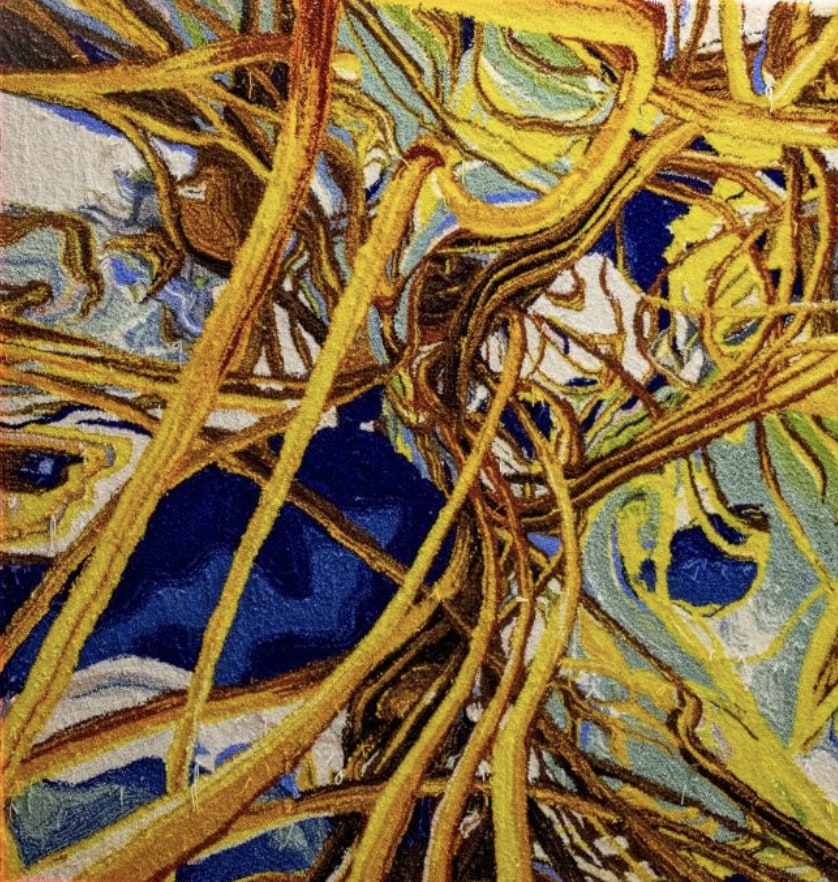
Nick Ervinck, TANABRALUN, 2023, Gallery Ysebaert
From soft to hard—or not?
At first glance, the sequence in the title seems logical, almost self-evident: fabric first, then marble, then metal. From soft to hard. From handwoven to the geological to the industrial. From the hand to the machine in a narrative line that encapsulates the history of human production in three words.
But is this really the intention? Marble is carved using tools that are at least as mechanical as those used in metal casting. And textiles—especially the large-scale tapestries used by Ervinck—are by no means exclusively handcrafted. The Jacquard loom, the nineteenth-century device that is the direct predecessor of the computer, has been translating patterns into binary instructions for two centuries: thread up or thread down. So, fabric did not precede the digital, but within the history of automation, actually anticipated it.
This makes the sequence fabric–marble–metal subtler than it appears. Not a linear progression from primitive to sophisticated, but a triangle of materialities, each possessing its own relationship to coding and repetition—long before Ervinck drew his first digital line.
What an echo reveals about the original
The title speaks of echoes, not variations or translations. That choice of words is telling. An echo is not an interpretation or a creative rereading of a source, but what remains after a sound has left its source and encountered resistance—a wall, a cliff face, the hard edge of reality. It carries the shape of the original, yet distorted, softened, influenced by the space it has traversed.
What Ervinck calls echoes are therefore neither copies nor variants. They are the traces his digital forms leave when they collide with the stubbornness of material. In marble—which has its own geological agenda and fractures that no algorithm can predict—the line mutates from code into vein within stone. In polished metal, that line becomes even more complex: the surface reflects its surroundings and unleashes continuous movement, so that the sculpture does not stand apart from its space, but remains in continuous dialogue with it. And in textile, the digital composition is created thread by thread in a rhythm riddled with fatigue, attention and repetition, as an almost meditative act. The pixel becomes thread. The render becomes fabric. The tapestry slows down digital speed—and in that slowing down, the energy of the line acquires a bodily texture, verging on the vulnerable.
Each echo sounds different, yet is proof that there was an original sound.

Nick Ervinck, WINEYER, 2024, Gallery Ysebaert
The time loop as structure
There is another dimension underpinning this exhibition, one that goes beyond material translation. Ervinck speaks of modern antiques—objects able to withstand the passage of time. Marble refers to classical statuary, a material millions of years old that has outlived entire civilisations, while bronze carries the memory of modernist abstraction and mirror-polished steel reflects our current digital culture. Finally, tapestry connects us to pre-industrial craft.
Together they form not a linear timeline, but a loop—a circular connection of past, present and future, echoing precisely what the echo already achieves acoustically: making the original resonate through time, albeit in a different form.
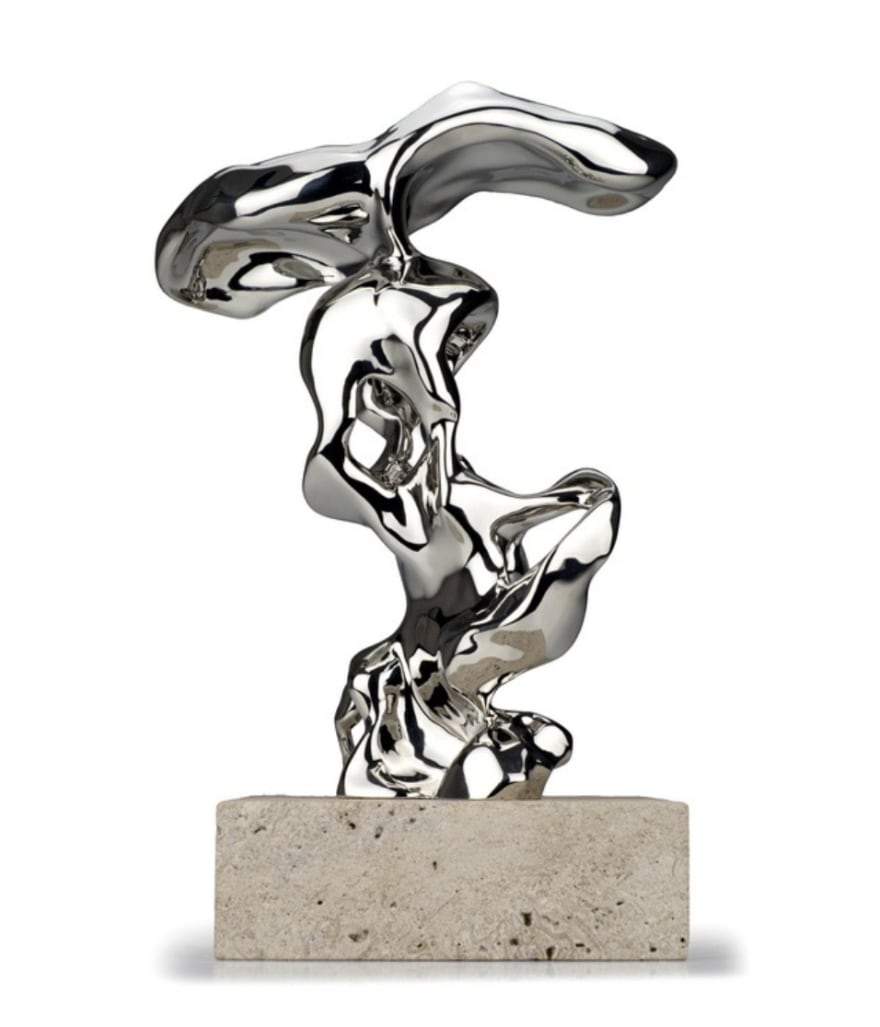
Nick Ervinck, TIHUVULIA, 2024, Gallery Ysebaert
Friction as method
This is the quiet tension that runs through the exhibition. Not the spectacular encounter of old and new—that narrative has been told too often and too easily—but the more nuanced question of what resistance does to an idea. Code is frictionless. It scales without loss, without effort, without any sense that something is at stake. Material does just the opposite: it pushes back, has its own will and reminds the maker that not everything is malleable.
It is in that resistance that Echoes in Fabric, Marble and Metal becomes more than a technological tour de force. Ervinck does not use material as a passive medium that obediently absorbs his digital forms, but as a conversation partner that occasionally says 'no'—and in doing so, forces the form to become something the code could never fully contain: present, recalcitrant, unrepeatable.
The sequence fabric, marble, metal suggests a journey. But it is not a straight line from soft to hard, from hand to machine, but a circling around the same question, asked each time in a different language—and answered differently by the material that responds.
Nick Ervinck – Echoes in Fabric, Marble and Metal, Gallery Ysebaert, through 7 June 2026
