01 may 2026, Wouter van den Eijkel
Rogier Houwen: Aether at Galerie Wouter van Leeuwen
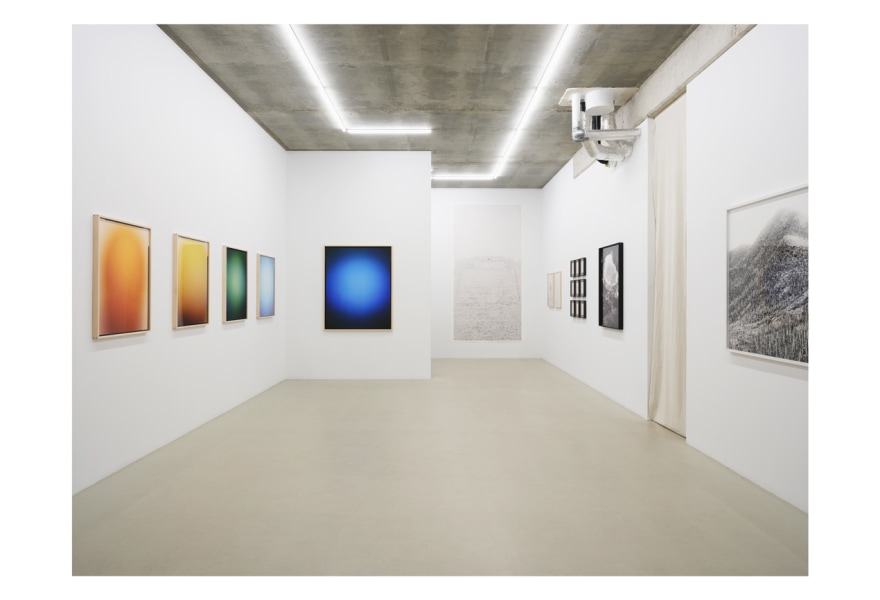
If you walk down Amsterdam's Hazenstraat this month, it's impossible not to have your attention drawn at some point to the large, monochrome colour photographs by Rogier Houwen. The presence of the works cuts straight through the glass façade of Galerie Wouter van Leeuwen.
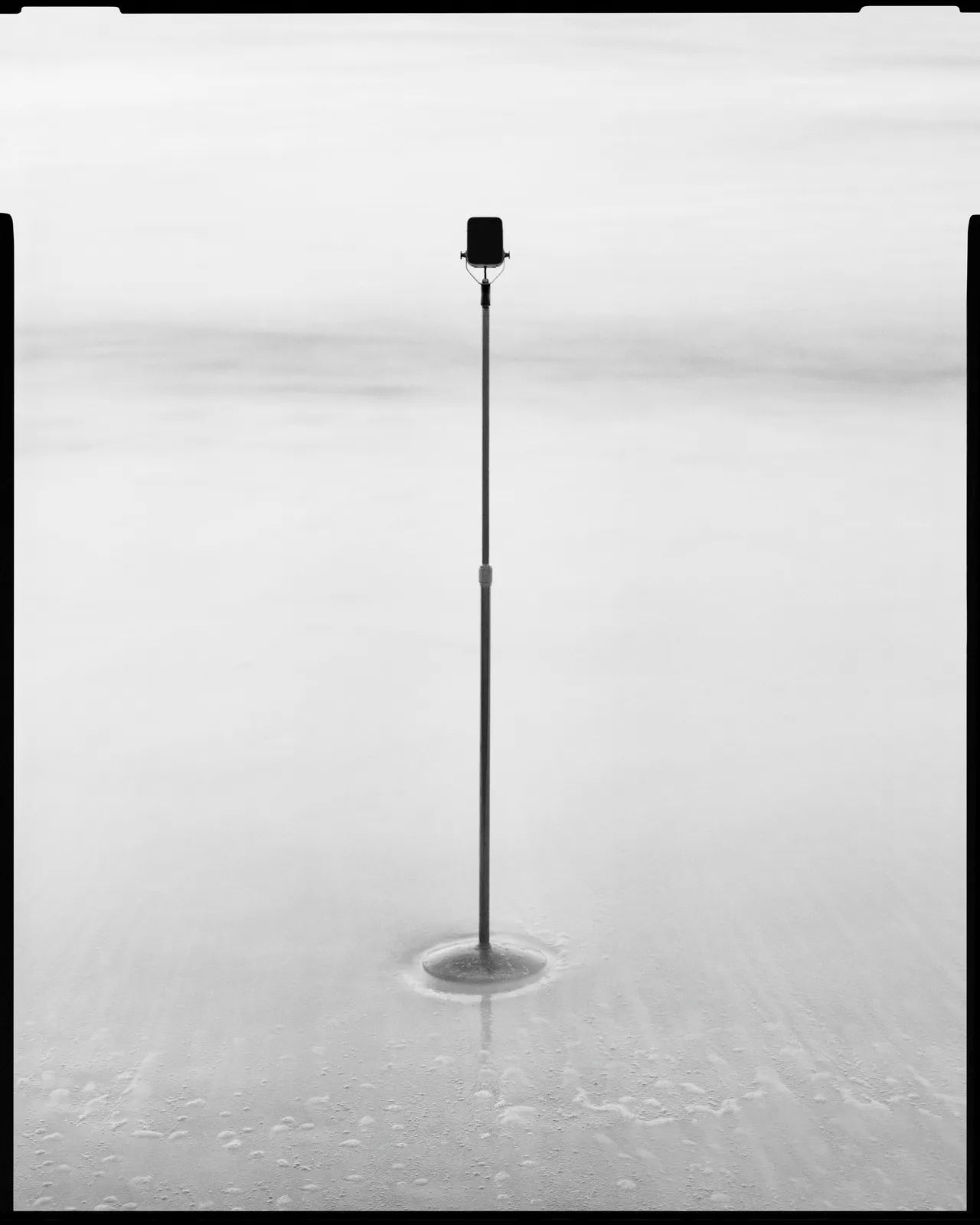
In Aether, Rogier Houwen brings together works from his recent series Cosmos, Aether, and Kleurklank. The series are thematically related: all 26 works refer directly or indirectly to sound. In Cosmos, the perception of vibrations is central. The images in Aether refer to the sound of a landscape, while in the Kleurklank series Houwen explores the vibrational frequency of everyday objects through their colour.
Aether by Rogier Houwen is on view through May 24 at Galerie Wouter van Leeuwen in Amsterdam.
Rogier Houwen (Netherlands, 1992) graduated from HKU in 2014 and has been working on his oeuvre for a total of 15 years. He previously worked as a printer for, among others, Willem Diepraam, and alongside his artistic practice he runs the photo lab Temple Studio, where he produces prints for fellow photographers. His mastery of both the darkroom and the digital photo lab is evident in the precise toning of his prints and his use of handmade paper, which gives his images a tactile and painterly quality. Aether is Houwen's first solo exhibition at Galerie Wouter van Leeuwen.
'Rogier had already told me he was working on a new series, so I expected black-and-white photography, like in the Cosmos series,' says gallery owner Wouter van Leeuwen. 'I didn't expect colour photography at all, let alone work with such a strong presence in the gallery space.'

Rogier Houwen, Galerie Wouter van Leeuwen
The works from the Kleurklank (2026) series dominate the gallery space to such an extent that it seems as though the room has become narrower. This is partly due to the size of the prints. The smallest format already measures 87.5 by 70 centimeters, while the largest is 2 meters by 1.6 meters. Houwen produced Red Peppers in this largest format, and the red plane acts like a magnet for passersby. But that is not the only difference: according to Van Leeuwen, the Kleurklank works also attract a younger audience than Houwen's black-and-white photographs. At the gallery, five smaller works hang in a row, moving from the red of a tomato, via an apricot to a lemon, then to the light green of a lime, ending in the deep blue of Portrait of a Blue Sky at Midday. On the street-facing side, Red Peppers is displayed in large format.

Rogier Houwen, Galerie Wouter van Leeuwen
The series is inspired by The Art of Colour by Johannes Itten. In that book, the Swiss artist-theorist introduces his well-known colour wheel and colour theory, in which colours are categorized based on light refraction and vibrational frequency. For instance, light waves of the colour red vibrate more slowly than those of yellow, because the light waves refract at sharper or less sharp angles. According to Itten, colour is not only visual but also musical.
"Based on the idea that every colour has a sound, I set out to find the colour-sound of everyday objects," Houwen explains. "I photographed vivid objects such as red peppers, apricots, and lemons as closely as possible using a 4x5" technical camera. As a result, the form fades and the dominant colour tone remains — in other words, the colour-sound of the object." In this way, Houwen reveals the connection between colour, light, and vibration, inviting viewers not only to see objects but also to observe their vibration.
Rogier Houwen, Galerie Wouter van Leeuwen
For a gallery visitor, the connection between the Aether and Cosmos series is easier to see; they simply resemble each other more than the works from the Kleurklank series. Nevertheless, there is an overarching concept that Houwen develops convincingly: the ancient concept of aether.
Aether appears throughout history under different names, across various cultures, languages, time periods, and scientific paradigms. In Sanskrit it is called ākāsa, the fifth element: a subtle vibration that permeates and connects the four elements—earth, water, fire, and air. In ancient Greece, Aether referred both to the god of the upper air and to the substance of the celestial spheres.
For Houwen, the word Aether represents humanity's attempt to understand the invisible structure of physical reality. In his exhibition, he uses this concept as a metaphor for a vibrational field that connects everything.

Rogier Houwen, Galerie Wouter van Leeuwen
Cosmos
On the long wall to the right upon entering hang works from two other recent series, Cosmos (2025) and Aether (2026). Both series are black-and-white photography. Houwen made the images for Cosmos during a journey through Mexico: from the mysterious Yucatán, once the heart of the Maya civilization, to Mexico City. Along the way, he captured landscapes where culture and nature merge: Maya temples rising out of the forests, caves with dramatic light, lush botanical gardens, vast cactus fields, and antennas that almost resemble archaeological finds embedded in the landscape.
'The works we selected from Cosmos relate to the perception of subtle vibrations,' says Houwen. 'The Maya temples have acoustic properties comparable to those of a Greek theater. The caves and cenotes also have the quality of a resonance chamber. Even from a great distance, you can communicate with each other in whispers.'
The modern antennas covering the overgrown Maya ruins also pick up vibrations. We cannot see such vibrations, but they constantly travel through the air and form part of our landscape. 'That's something worth reflecting on,' he adds. Through the way Houwen prints the antennas, they almost appear as living beings. He overexposed the sky so that nothing is visible except the antennas.

Rogier Houwen, Galerie Wouter van Leeuwen
