07 april 2026, Martine Bontjes
The studio of... Cindy Bakker
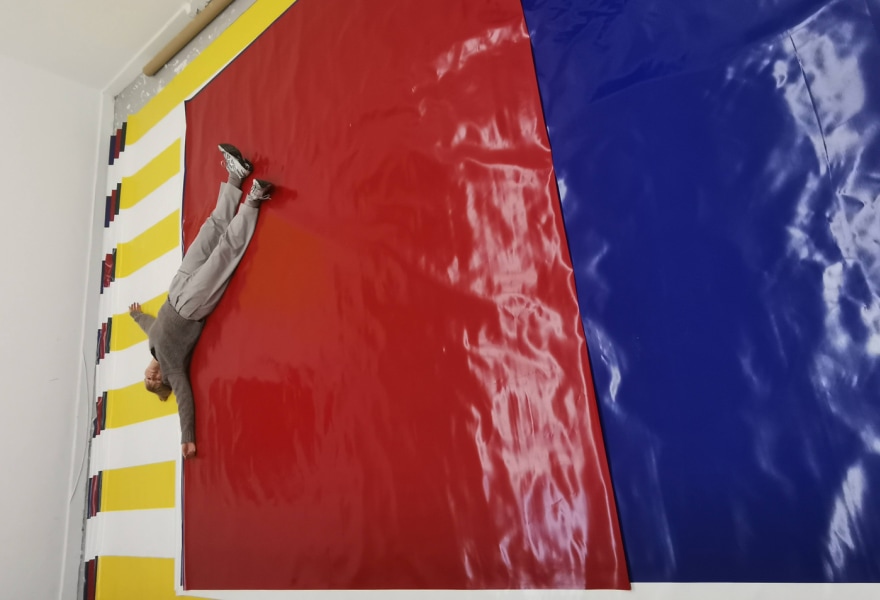
The color red alerts, warns and seduces. In the exhibition De Boei by Cindy Bakker, that color takes on a physical presence: a monumental object that balances between threat and attraction. Do you keep your distance, or are you drawn towards it? The work was originally presented in the exhibition Een Muur van Blauw at the ICOON Museum in Hoek van Holland, where it entered into dialogue with the sea, dunes and a bunker landscape. From Friday 10 April, De Boei will be on view at Galerie Bart, where it is presented in a new context. The opening starts at 15:00.
Recently, Bakker changed her studio, including a small farm, for a studio at home in Rotterdam. This transition required practical solutions: her work consists of large glossy PVC canvases that take up considerable space and require careful storage. She developed new ways to produce her sculptures without compromising the visual impact of her work. The result can be seen from 10 April through 2 May at Galerie Bart.
Where is your studio and how would you describe this place?
My previous studio was on the edge of Rotterdam. It was an old school where each artist had their own classroom. A large, raw space with high ceilings and plenty of daylight. We transformed the schoolyard outside into a garden with a few chickens, a kind of small farm. It may sound idyllic, and it truly was. It grounded us, allowing conversations with fellow studio artists over coffee in the garden. The rhythm of caring for something alive works surprisingly well alongside making large, often quite abstract works.

Cindy Bakker, Cone, Galerie Bart
Where is your new studio? Is it your dream studio, or do you still dream of another space?
It comes close, but I think a dream studio always shifts a little. We unfortunately had to leave that previous space as it is being converted into apartments. At the moment I share a studio at home with my partner Ektor Ntourakos, who is also an artist. In a small front room we have a table, chairs and a sofa where we live. The back room, which makes up the largest part of our home at 60 square meters, is dedicated to art. We literally live among our work, and our 1,5 year old son walks around daily with paintbrushes and toys. It is a very special time, and given the circumstances it suits us now. Our work is stored in garage units or with friends. Sometimes I long for more outdoor space, or a place where I can build on a larger scale without having to consider transport or storage. At the same time there is beauty in having a studio at home, and perhaps it is exactly the right place for where I am now.
You often start with photographic research. How do you translate an image into a spatial work, and how do you determine its scale?
Photography is a way for me to observe what is happening around me. I often capture these memories in photographs. They are usually objects in unfamiliar contexts, such as trash bins or bollards where form and color play a role. When a certain theme recurs, I begin to see connections that I then develop in three dimensions in my studio. This can result in sculptural work.

Cindy Bakker, Arch, Galerie Bart
Did you develop your sensitivity to everyday forms and colors early on, or did that way of seeing develop over time?
Yes and no. I think that way of seeing, recognizing possibilities in everyday forms, emerges very early, but we also lose it over time. The beauty of ordinary things often passes us by. As a child I played with objects that were not meant as toys, as I think many of us did. I remember hours of fun with a salad spinner and clothespins, pots and pans. I try to hold on to that love of the mundane, even as the work is taken more seriously.
You mentioned that color strongly influences how people interpret and engage with objects. Can you explain what you mean with that?
Color is never neutral. It guides us, often without us realizing it. In public spaces this effect is even stronger. A bright color like yellow can invite and alert you, think of sale signs in shopping centers. Red warns, think of traffic signs that alert you to not enter. It affects how long someone looks, whether they come closer, whether they feel addressed. I see color as a kind of first language of the work. It is universal in meaning because of how we use it.
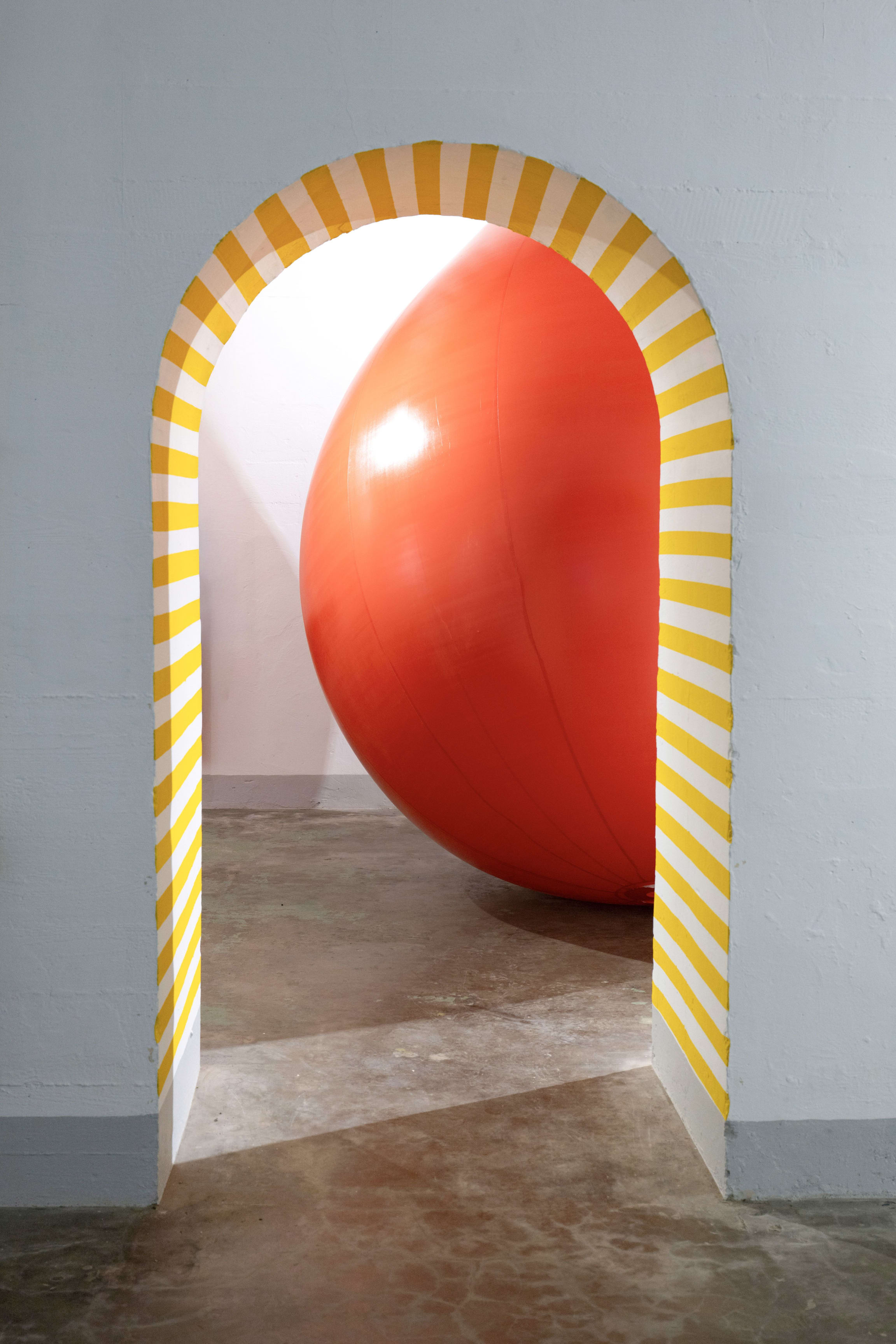
Cindy Bakker, De Boei, Galerie Bart
You created De Boei for the exhibition Een Muur van Blauw at the ICOON Museum in Hoek van Holland, where it was presented in a setting with the sea and dunes. Does the meaning of the work change now that it is shown in a gallery space?
Yes, inevitably. In the setting of Hoek van Holland with the bunker in the dunes by the sea, the work had a direct relationship to water, to safety and danger, perhaps to holiday memories. In the gallery space it becomes more abstract. The object stands more on its own, and the focus shifts to form, color and association. I find that interesting, that a work is not fixed but moves with its context.
You want to evoke personal memories in the viewer. Can you share a specific memory connected to the buoy?
For me a buoy evokes a double feeling. On the one hand it evokes safety, something to hold on to, and on the other hand a personal fear. The work is a memory of summers at the sea, especially one summer when my brother and I went too far out into the water. We got caught in a current we could not escape. The coast guard had to rescue us.
What materials did you use for De Boei?
The work is made of PVC fabric and is 350 centimeters high. It is inflatable, which I do with an air pump. Because of the narrow entrance to the gallery and the lack of storage space, I had to rethink the production of this particular work. Despite being inflatable, its glossy finish gives it a solid, almost massive quality, and hopefully makes it tempting to touch.

Cindy Bakker, Bean, Galerie Bart
Red is dominant in this work. What associations do you hope to evoke?
Red is a color that is difficult to ignore. It exists somewhere between warning and attraction. With a buoy that association is quite obvious, rescue or danger. But I also hope it evokes something bodily, something which attracts.
What projects are you working on at the moment?
Recently I have been working on many projects, including a residency at the Watersnoodmuseum. This resulted in a video work and a sound piece. I am very much looking forward to reflecting on what this work means within my practice. I had never worked with video before, nor with actors or sound. Last weekend I also showed work at Art Rotterdam for the first time, and this summer I will participate in Enter Art Fair in Copenhagen in collaboration with Galerie Bart. Showing my work in the context of an art fair is new for me, and I am curious how it will relate to that environment and how it will be received by a broader audience.
