24 march 2026, Martine Bontjes
The studio of... Dirk Hardy
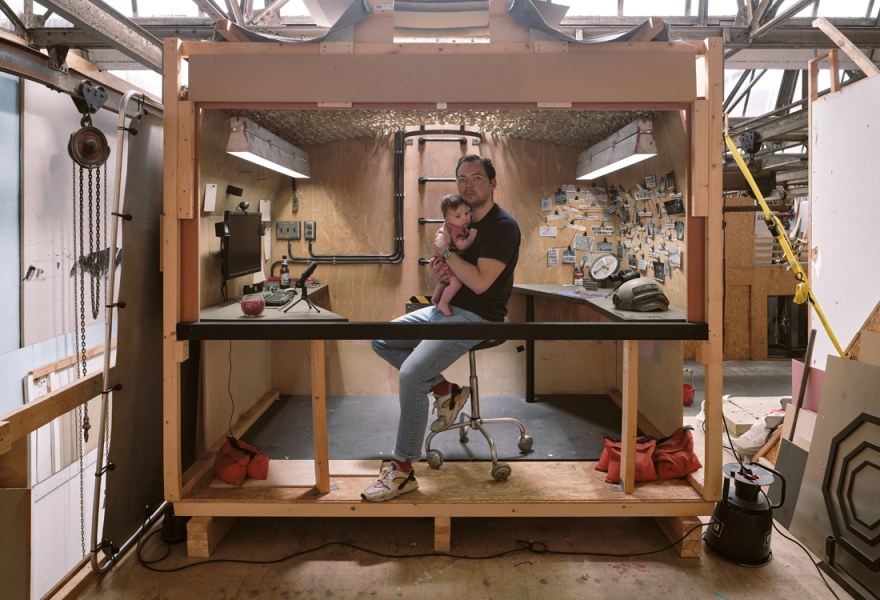
From his studio at the Maakhaven in The Hague, Dirk Hardy constructs meticulously staged worlds that balance between reality and fiction. At first glance his images seem convincing, but a closer look reveals that these worlds are entirely constructed. Hardy designs, builds and directs everything himself, from a flat earth clock to polystyrene bricks, and from costumes to the lighting that brings his scenes to life.
At the core of his practice is Vivarium, an ongoing series of dioramas in which complex social questions are condensed into moments of stillness. From 27 to 29 March, Project 2.0 / Gallery presents works from Vivarium alongside the series Residue City at Art Rotterdam. In this solo presentation, the human figure takes center stage, both in its presence and in the traces it leaves behind.
How did you end up working here? Is this your first studio?
After graduating I worked in various temporary spaces, but as my practice developed I needed more room. Maakhaven has now been my base for six years. In this self-built studio I have the space and tools to focus on the life-sized sets I construct. Over time the studio has grown into different zones. On the ground floor my partner and studio manager Kim Nuijen works. In the main space I build and photograph the lifelike Vivarium sets. Upstairs I keep my 3D printer and laser cutter, where I produce the more delicate elements such as the landscapes for Residue City.
You are trained as a photographer, yet for Vivarium you build entire worlds in your studio. How did you teach yourself set construction?
My father helped me a great deal in the beginning. He has a lot of practical experience, as my parents always renovated their homes themselves. There was always some kind of project underway in our family, and I learned a lot from that. Over time I became more skilled and invested in a wide range of tools. Since my first Vivarium episode I have built every set myself, and through many mistakes and poor decisions I gradually became a better set builder.
Patience is essential. Sometimes I spend five months working on a single episode. It is a long process of testing and refining. I was always determined to build physical environments, real sets, and photograph them. That obsession, combined with patience, allows me to immerse myself for months in the narrative of a Vivarium episode. This is not only important for constructing the world, but also for developing the protagonist and the story I want to tell.
Do you make everything we see in your work yourself?
Each time I build a new world within the same enclosed space. In my latest Vivarium episode 14, an old wooden table functions as a wall, and the panel comes from a child's bed I found on the street. I often make props myself as well, such as the flat earth clock and the casing for the fluorescent lights in Vivarium, Episode 11, Echo Chamber. Many objects contribute to the narrative, and the search for the right combination is what makes the process so engaging. I have been working on Vivarium for eight years now, and there are still many new episodes in my mind.
How do you find the people who appear in your Vivarium episodes?
I search for them on the streets. Often I already have a character in mind for months while building a set. In a way that character already exists before I have found the person.

Dirk Hardy, Vivarium, Episode 11: Echo Chamber, 2023, Project 2.0 / Gallery
That must be quite a challenge, approaching strangers on the streets?
It still is. My heart is always racing when I approach someone and I hope they will listen to my story. Asking someone if they would like to act in a fictional ticket booth is quite an unusual request. Yet people always respond positively. Usually they first visit the studio, try on the clothing and sit in the setting, and then they understand what I have in mind. The man in Echo Chamber from Vivarium, Episode 11 I met in a hardware store. He became the embodiment of Red Pill Roy, a flat earth believer recording a propaganda video, completely convinced of his own worldview. Like actors in a film, they take on a role within my narrative, and so far people have always found it fascinating to step into someone else's skin.
What was your starting point for Vivarium, Episode 11, Echo Chamber?
In 2023 my partner was pregnant. I was about to become a father for the first time and felt an immense sense of responsibility. What kind of example do I want to set for my son, and with what worldview will I raise him? In recent years I have noticed a growing need for meaning and interpretation in an increasingly complex world. This can bring people together, but also drive them apart. I combined the idea of fatherhood with neotribalism, a form of contemporary group behaviour in which identity is no longer rooted in family ties but in shared interests or ideologies. At the same time I explored how echo chambers can contribute to political polarisation and even extremism.
It was a heavy subject to work on, yet the father and son relationship in this episode remains hopeful. I believe that a child, through its sense of wonder, can transform your worldview. That is why Red Pill Roy is visited by his son. While the father proclaims his beliefs, the boy fills the room with soap bubbles. This simple act undermines the entire flat earth theory, as the forces that shape bubbles into perfect spheres are the same forces that give planets and stars their form.
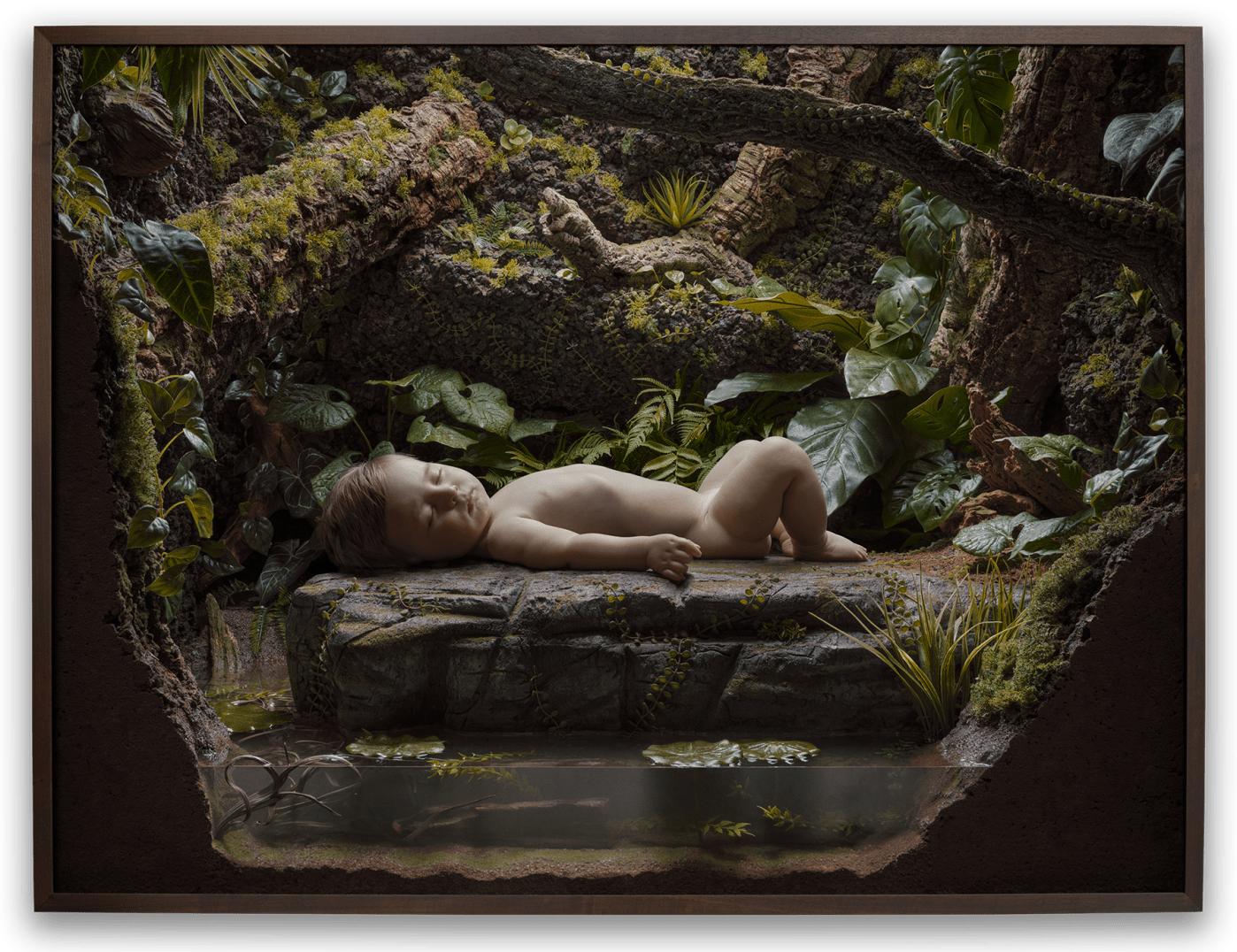
Dirk Hardy, Vivarium, Episode 13: Echo Down the Passage, Day - True Size, 2024, Project 2.0 / Gallery
In Vivarium, Episode 13, Echo Down the Passage part 2 we see your son Lou asleep on a stone. Why did you choose to portray him this way?
Episodes 12 and 13 together carry a piece of my family history. I am the second son in my family. My older brother Teun died at eight months old from a rare heart virus. Four weeks after his death my mother became pregnant with me. In that deep grief, new life emerged. This has always moved me, that my existence is inseparable from that loss. I connected this to the idea that new stars can only form from dead stars, that something must disappear before something new can begin. That convergence of energy is what I depict in episode 12.
Until my son was born, I experienced the death of my brother from the perspective of a child. Becoming a father brought me closer to my parents' loss and grief. I felt a sense of stillness and vulnerability, but also of protection. I chose to photograph Lou at the same age Teun was when he died. Together, episodes 12 and 13 represent a transfiguration, a fragile transition between loss and new life, deeply personal yet universal at the same time.
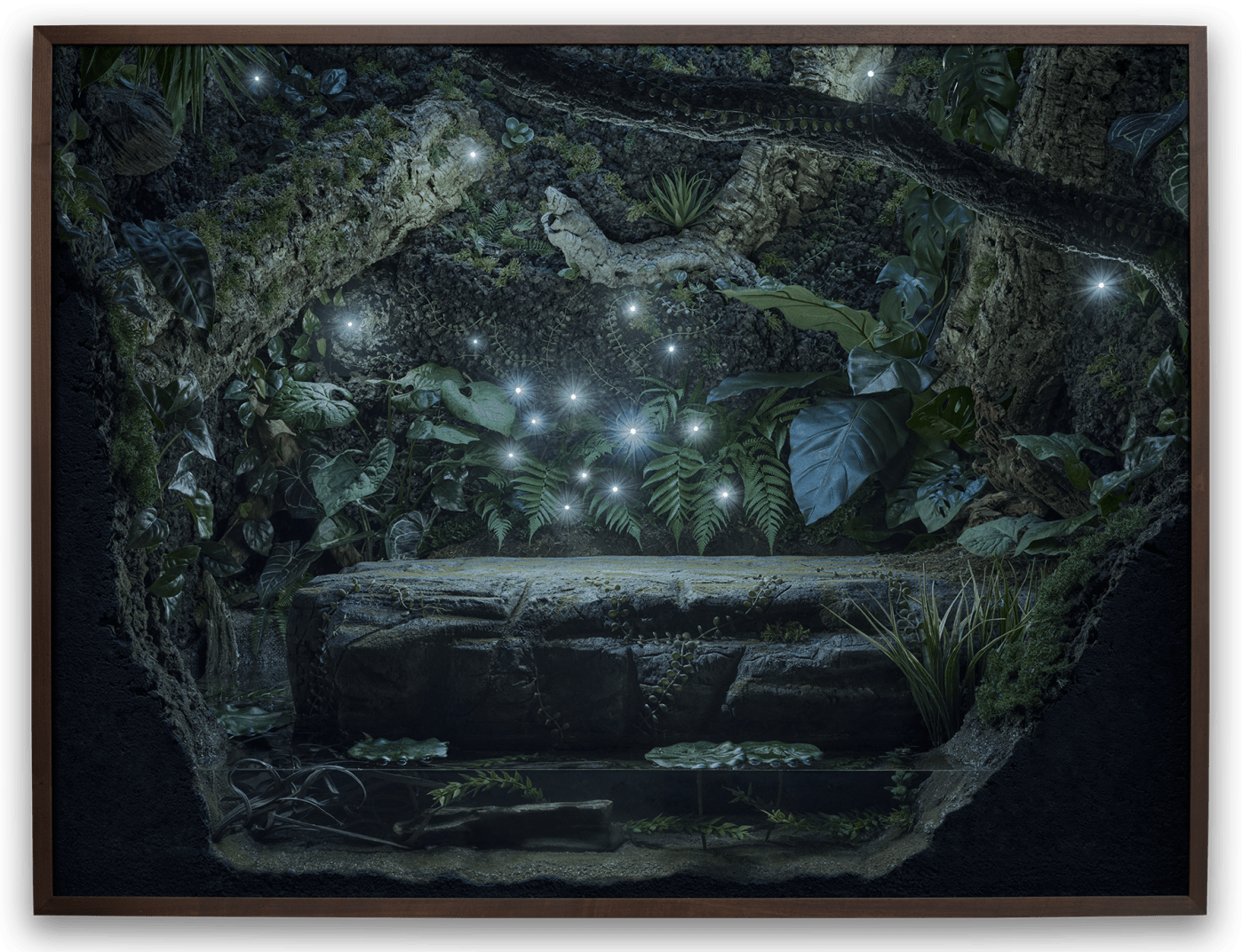
Dirk Hardy, Vivarium, Episode 13: Echo Down the Passage, Day - True Size, 2024, Project 2.0 / Gallery
In the Vivarium series, the scenes are set in interiors, while Residue City moves outdoors. Why this shift?
In Residue City I undertake an inner journey as the sole witness to a post-human world. I reconstruct and photograph the memories of these imagined visits in my studio, as tangible traces of an invisible journey. Where Vivarium deals with the present, Residue City reflects on its consequences. In Vivarium the human presence is visible, while Residue City shows only the traces left behind. I would love to witness the slow, theatrical process in which the earth erases our presence. I believe there is great beauty in the silence that returns. This thought strongly fuels my imagination. A concrete pillar that once supported a highway becomes an immense sculpture in an empty landscape. A silence after the storm.
However poetic it may sound, Residue City is also my way of coping with climate grief. I do not have solutions, but my concerns about the future need an outlet.
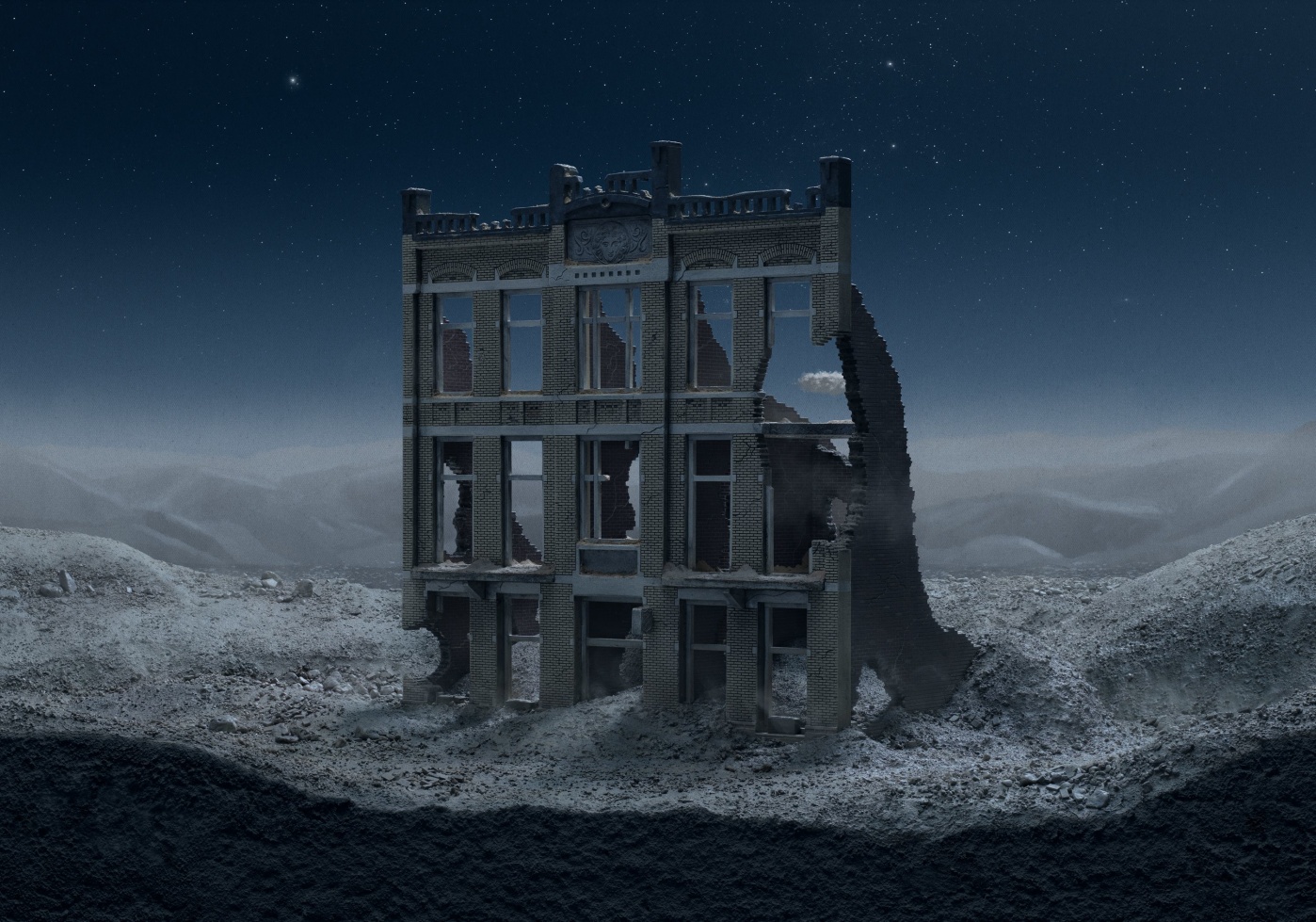
Dirk Hardy, Residue City: But Now I'm Falling Apart (XL Size), 2025, Project 2.0 / Gallery
What can we expect from your presentation at Art Rotterdam?
I have been given a solo presentation, which is an exciting opportunity to develop a cohesive concept together with Project 2.0 / Gallery. The central thread is my experience of fatherhood and the universal search for safety, a theme that has become more urgent since the birth of my child. We will present Vivarium episodes 11 through 14 alongside a large-scale work from Residue City measuring over two metres wide. The rest remains a surprise.
