03 february 2026, Yves Joris
IN-SPIRATION at NQ Gallery
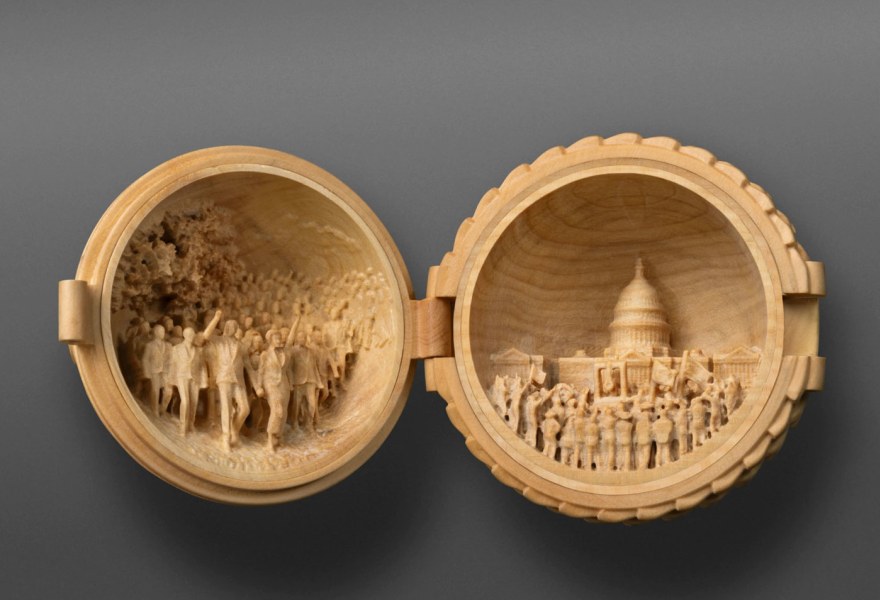
From 8 to 26 February, the NQ Gallery is presenting the exhibition IN-SPIRATION. At its core is the CARVED TIME Series of Contemporary Prayer Nuts by Caspar Berger: eight prayer nuts meticulously carved from boxwood that function as a contemporary moral compass. Small objects, scarcely larger than your palm, yet laden with images that weigh heavily on our collective memory.
This is not an exhibition aimed at speed or instant consumption. It demands proximity. Silence. Slowness. Berger’s prayer nuts cannot be read from a distance. They must be opened—literally and figuratively. What unfolds inside are not narrative scenes, but concentrated moments from our recent history, images that have embedded themselves in memory and refuse to disappear.
Carved time
The prayer nut is an object with a history. In the 16th century, it served as a personal devotional instrument, a portable space for concentration and contemplation. Berger returns to that tradition, but radically shifts the perspective. Whereas the Passion of Christ was once depicted, micro sculptures now appear of iconic moments from modern history: 9/11 and the fall of Kabul, the napalm girl in Vietnam and the washed-up Syrian boy, Hiroshima and the moon landing, George Floyd and institutional racism.
By using digital technology and extremely refined micro-milling techniques, Berger literally carves time into matter. CARVED TIME freezes moments that usually circulate within an endless stream of images. Here, they are fixed, slowed down, isolated. Not to neutralise them, but to make their moral weight palpable once again.
These objects illustrate nothing. They explain nothing. They show—and that is precisely where their power lies.
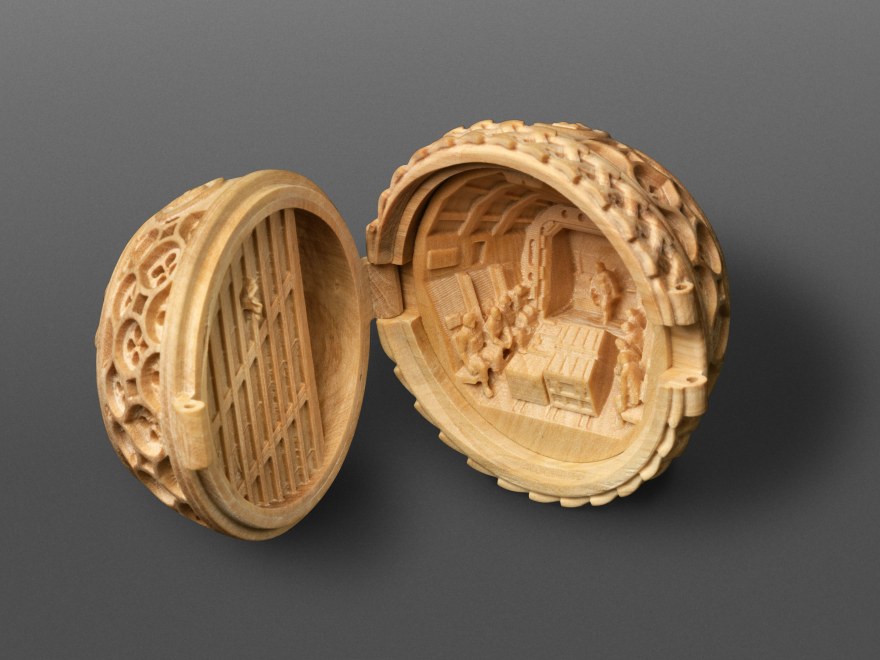
Caspar Berger CARVED TIME New York/Kabul, 2025, NQ Gallery
A moral compass in miniature
Sometimes a single image is enough, an iconic snapshot that lodges itself in the mind and refuses to let go. Such an image ceases to be an illustration of a story and becomes a moral point of reference, something we continue to measure ourselves against, even as contexts change. The question CARVED TIME asks is not whether images move us, but whether they can shape us in lasting ways, whether they can offer direction in a world that seems to be constantly changing course.
The prayer nuts function as a moral compass in miniature. Not because they impose direction, but because they make doubt visible. Cause and effect are placed side by side. Progress and destruction. Hope and violence. Each object contains a fault line, a tension that is not resolved, but held.
From silence to inspiration talks
Precisely because this work evokes so much emotion, silence alone is not enough. Some images demand dialogue, shared reflection, voices that do not necessarily affirm one, but challenge each other. From that conviction, gallery owner Niqui Van Olphen is organising a series of Inspiration Talks alongside the exhibition.
These talks are not a side programme, nor are they traditional lectures. They form an essential part of IN-SPIRATION. Open conversations in which two speakers and a moderator, together with the audience, explore what these images set in motion—morally, politically, historically and personally.
The decision not to hold the Inspiration Talks in the gallery itself, but at Samenloop, is deliberate. Samenloop is a social and cultural project with a focus on ‘encounter’, a place where collaboration, care and learning are part of everyday practice. That conversations about responsibility, solidarity and ethical positioning take place here is no coincidence, but a meaningful extension of the exhibition.
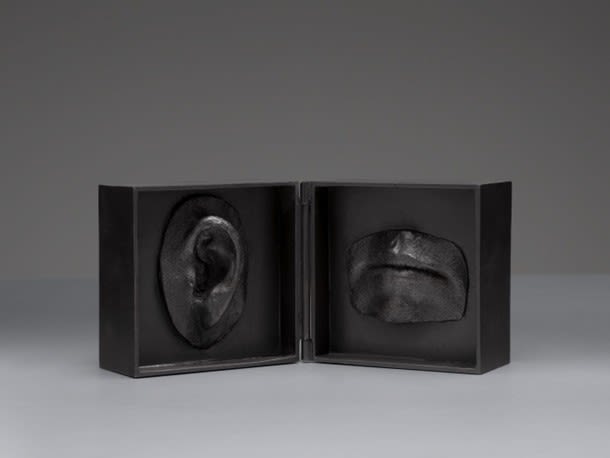
Caspar Berger Are you talking to me, 2022, NQ Gallery
Polyphony and friction
The Inspiration Talks start from one clear premise: no single perspective is sufficient on its own. The conversations bring together different voices from diverse fields, with differing sensibilities. Not to reach consensus, but to allow friction. Because meaning often emerges precisely where things rub.
On Sunday 8 February, Nicky Aerts is moderating a conversation with Bert De Vroey and Yasmien Naciri. Central here will be the question of how images connect innocence, vulnerability and responsibility. When does empathy become a moral obligation? And what does it mean to be a witness rather than a bystander?
On Sunday 15 February, during a conversation moderated by Gie Goris, Chris Bryssinck and Jan Vanheukelom will delve deeper into power, systems thinking and the illusion of moral superiority. How do images function within political structures? When does outrage become a pose? And how do we avoid moral righteousness turning into complacency?
On Sunday 22 February, Philip Heylen will be concluding the series with Mirjam Hoijtink and Emile Van Binnebeke. Themes such as institutional racism, democratic hope and historical legacies will be the topics of discussion, not as finished analyses, but as questions that linger. What does responsibility mean when systems are larger than the individual? And where does personal courage begin?
Continuing to look
The Inspiration Talks invite openness and engagement. The audience is gently encouraged to think along, ask questions and share experiences. Looking can slowly turn into speaking, listening into a form of shared attention.
In a time when images circulate endlessly and moral outrage is often fleeting, these conversations propose a different attitude: slowness, attentiveness and the awareness that looking away is no longer a neutral act but a choice.
What remains
IN-SPIRATION is not a project that asks for quick conclusions. It asks for repetition, for return visits, for conversations that extend beyond the walls of the gallery or the table at Samenloop. It only becomes complete in the interplay between exhibition and Inspiration Talks—between silence and voice, between image and thought.
Those who visit the exhibition and take part in an Inspiration Talk may leave without answers, but hopefully with more questions, with an image that lingers. And with the realisation that moral orientation is not a fixed given, but a continuous exercise.
Perhaps that is the most urgent form of inspiration today.

Caspar Berger, CARVED TIME Turkish beach, 2025, NQ Gallery
The space of conversation
A dialogue with Niqui Van Olphen (NQ Gallery)
It became clear early on that Caspar Berger’s prayer nuts could not remain in silence. Not because silence falls short, but because some images linger with us. They seek an outlet, pose questions, demand conversation. The Inspiration Talks emerged from that awareness—not as a side programme, but as a necessary extension of what is shown in the gallery.
Initiator Niqui Van Olphen does not speak of a pre-planned strategy. The idea grew organically, from a shared intuition that this work demanded more than being looked at.
When did you feel that Caspar Berger’s work needed not only to be shown, but also actively discussed?
“That actually arose spontaneously during a conversation between Caspar and myself. We wanted to show the prayer nuts in Belgium, yet we also felt we needed to consider how we could give them greater impact. Through Robert Kaerts, a close friend of Caspar’s and closely involved with Samenloop, the idea developed further, also in the choice of speakers.”
That need for conversation turned out not to be an abstract idea, but an experience that had already presented itself earlier.
What can conversation add to these prayer nuts that silent viewing cannot?
“I felt that very strongly at PAN, where the nuts were shown for the first time. Conversations arose spontaneously among visitors—sometimes with me or the artist, but often among themselves. You could feel that the work truly created a sense of momentum. And that was precisely the intention when Caspar made the prayer nuts.”
The conversations do not aim to explain or pin down meaning. They move within the tension between direction and uncertainty.
Do the Inspiration Talks aim to provide direction or rather to show how uncertain our moral compass is today?
“In a way, both. They provide direction by making you realise that our moral compass is sometimes uncertain. That uncertainty does not need to be smoothed over. On the contrary, it can remain visible.”
How important is friction in these conversations? And… is the audience allowed to disagree?
“The audience is absolutely allowed to disagree.”
No expectations are imposed on participants—no required level of activity, no obligation to take a stance.
What do you expect from visitors: attentive listening, participation or actually taking a position?
“There is no expectation. Listening is fine. Speaking up as well. In that sense, the Inspiration Talks are not an answer to the work, but an open dialogue around it. A place where images are not resolved, but carried further. And of course, that many people go on to view the work in the gallery—that is the ultimate goal.”
