03 february 2026, Wouter van den Eijkel
The studio of... Marian Bijlenga
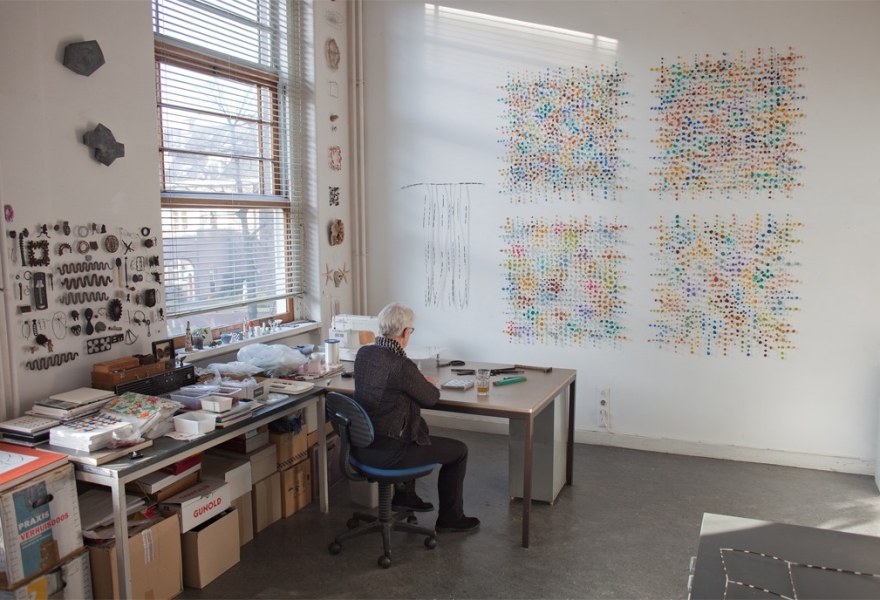
“You’ve arrived at the perfect time,” says Marian Bijlenga. “The sun has just disappeared behind the building across the street, which creates a beautiful soft light inside here.” These are the words of an individual who knows her surroundings inside out. Bijlenga has had a studio in the former ophthalmology clinic of the Wilhelmina Hospital for 42 years.
You can still recognise the building’s former function in the typical hospital handrails along the walls and doors with a round window. The studio space is not particularly large, but tall—so tall that Bijlenga has installed a mezzanine. Near the entrance, part of the long wall is filled with postcards, photographs and images of patterns. She calls that section ‘her brain’. “Sometimes you don’t notice a card for years and then suddenly it jumps out at you.” Further along, small works of art hang grouped together; she plans to take some of them to China in early January.
Since the early 1980s, Marian Bijlenga has been making work she describes as spatial drawings. Horsehair is an important component of her compositions. The hair reinforces the dots, lines and textile forms that comprise her compositions. They are interconnected and held in place by transparent threads. We spoke with Marian Bijlenga about her work, her working process and the duo exhibition with Cecile Kemperink at Galerie Franzis Engels.
Your studio is so tidy…
“You think so? I’m always organising.” She points to the windowsill, to a collection of loose-cut locks. “That little wall has things I found on the street, things like that grow over time. The objects I pick up on the street often attract me because of their shape. That often has to do with calligraphy. I then organise them in my studio into a kind of illegible script.”
Do you spend the entire day here on your own?
A studio is ideally suited to being in your own environment and working. I don’t work together with others here. I’ve always like having a studio outside my home. But it’s nice to be in a shared building where several artists work and see what others are doing. I write emails once a week. I don’t have internet here. I only got a smartphone very recently. For 16 years, I had a small Nokia and that was more than enough.
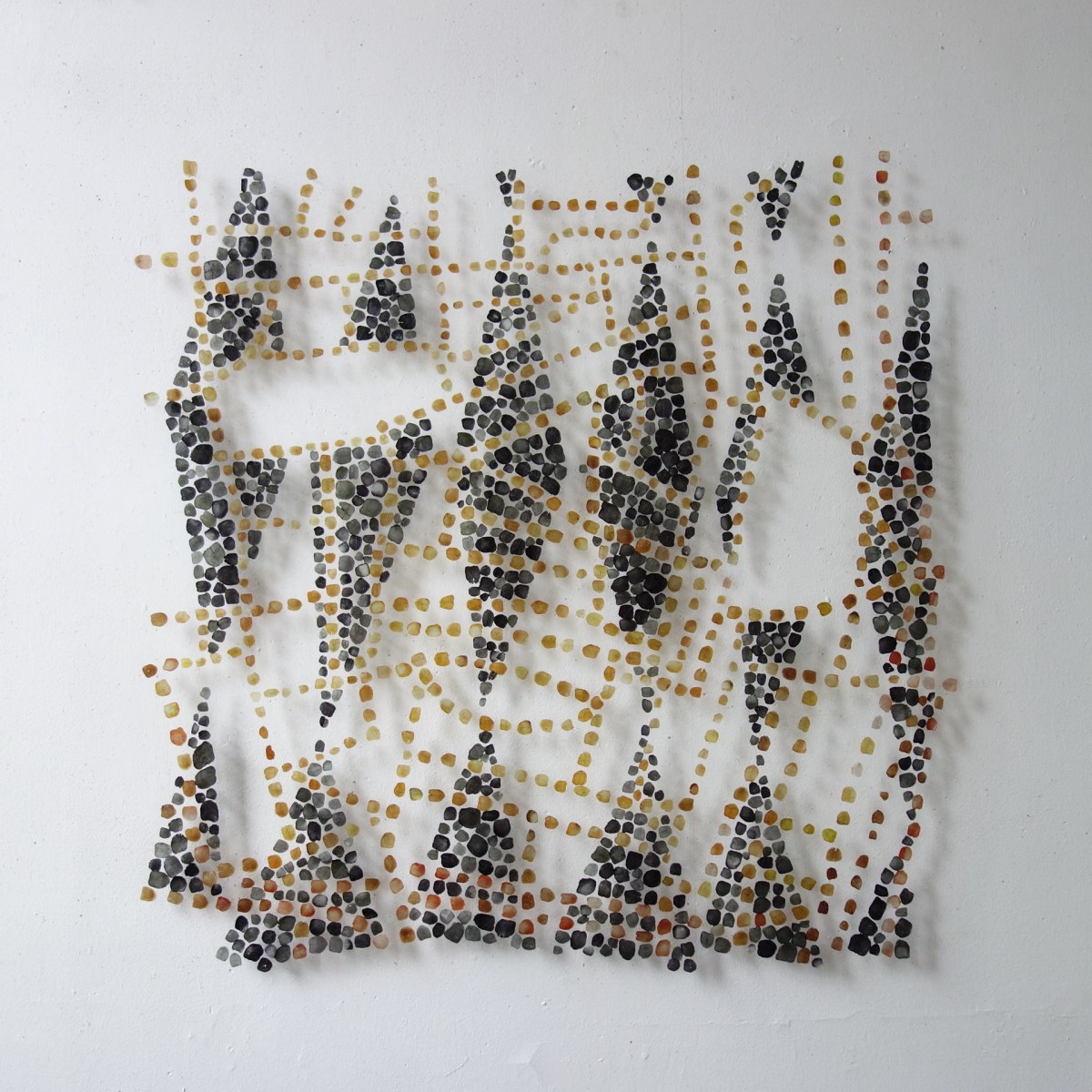
Marian Bijlenga, Schub, 2022, Galerie Franzis Engels
What does a typical work day look like?
I always start slowly. I live in Landsmeer and start the day with a paper newspaper. Around ten, I prepare my lunch and if the weather’s nice, get on my bike and bike to my studio. I then drink some coffee and get to work. Sometimes, I read a book as part of my work or review at what I’ve already done.
Do you receive visitors or prefer not to?
Rarely. I often have to fend off buyers because it takes a lot of time and I don’t want to show everything. During open studio days, I often invite other artists to exhibit together because this can strengthen both of our work.
Your work is currently on view at Franzis Engels in a duo exhibition with Cecile Kemperink. She makes sculptures, mostly of ceramic rings. Do you prefer duo or group exhibitions over solo shows?
I prefer exhibiting with others because our work can enhance each other. If you exhibit with sculptors or painters, for example, the focus shifts more to form and to what light does to a work and less to how it is made.
We should probably talk about materials. You’re known for using horsehair in your work. When did you start working with that material?
I started working with horsehair in 1990. The hair reinforces the dots, lines and forms. And the protruding ends create a softer contour than when I make a hard edge.

Marian Bijlenga, Zigzag, 2000, Galerie Franzis Engels
And the fabrics you use, are they special? Do you have a preference for a particular type of fabric?
I work with materials I’ve collected over the years. Often, I’ve found or been given them. I then keep what I think I can use. Right now, I’m working with yarns from the estate of Desiree Scholten (designer of wall hangings, who Bijlenga worked for early in her career, ed.). I kept those for 35 years and have now incorporated them into transparent, colourful work. It’s a beautiful memory of her and of the years, the early 1980s, when I assisted her.
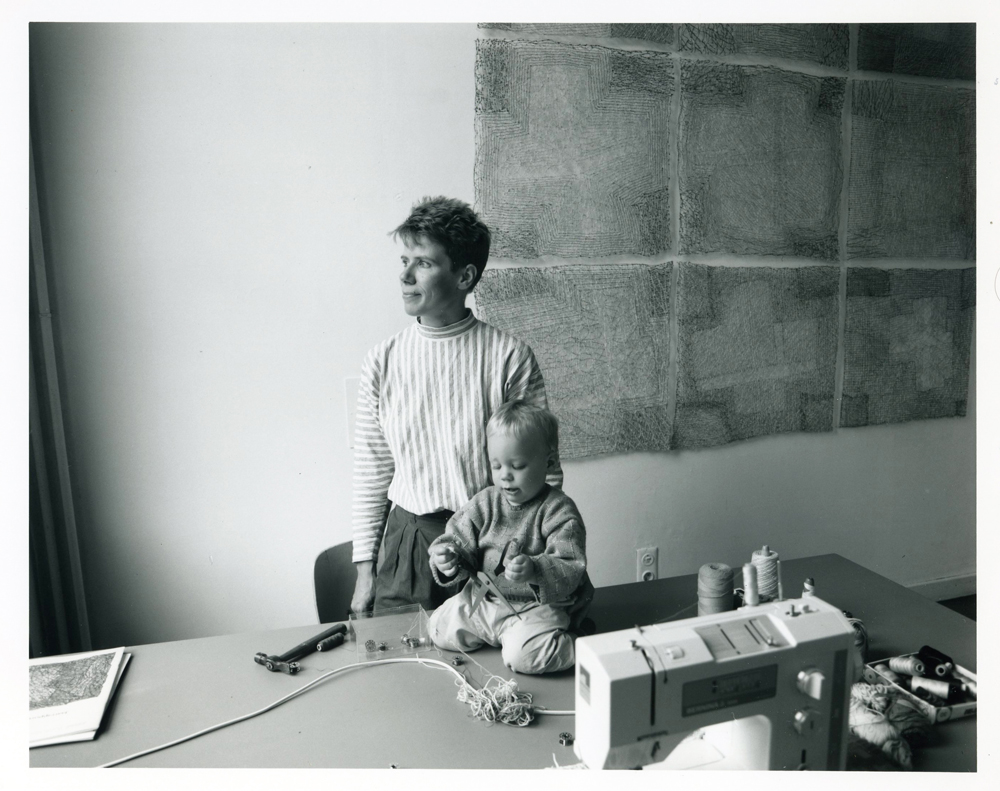
Marian Bijlenga in her studio 1988, photo: Ronald van Wieren
You’re known for work with dots, but the background doesn’t have to be textile. You’ve also made compositions with fish scales and porcupine quills. How did you get the idea to work with fish scales?
In 2007, when I was very involved with dots made of textile and horsehair, I did a residency in northern Iceland. I visited a fish leather factory where scales were lying on the floor as waste material. When you see them lying there, they look like dots. I didn’t do much with them right away, but I did take a bagful home. The exhibition in Nagele (in 2009, ed.), the land reclamation and former seabed, prompted me to experiment with the fish scales. A large new series of works emerged from this. At first, I used the grey-green scales of Nile perch that I had ordered from Iceland. I later coloured the scales with henna or silk dye.

Marian Bijlenga, Scribbles fold, 2025, Galerie Franzis Engels
You just mentioned the residency in northern Iceland. You’ve also been to South Korea and Hawaii. In January, you’re going to China. Is traveling something you need for your work?
Most importantly, I don’t want to repeat myself. It’s good to have some distance from your daily routine now and then and be surprised by what you encounter elsewhere. For me, a work is only good when I think: hey, what’s happening here? In that sense, I don’t consciously look for other materials, but am very much someone who responds to patterns. Traces fascinate me: a nibbled leaf, torn pavement, nail holes in a wall, areas of wear, chewing gum on a wall, the pattern of chair legs in a soft floor.
This summer, I was on holiday in northern Germany in an area with salt walls made of bundles of branches that are misted with salt water. I could walk there for days. You more or less come across something like that by accident. A residency, on the other hand, has the advantage that you meet other artists.
What’s your approach? Do you design a pattern beforehand or does a composition emerge as you work?
When I’m working, I first make all kinds of loose elements on the wall until I feel that I need to connect them in a certain way. I then trace them onto a water-soluble interfacing and connect them. I see patterns emerging. I start with a dot, then another and yet another. It’s not something I plan in advance. A pattern then develops.
What do you actually call your work?
My work consists of dots and lines, horsehair and fabric, invisibly connected into transparent structures, floating in front of the wall. I therefore call them drawings in space. I work in a highly graphic way with lines and patterns.
It's mid-December as we speak, early January you'll be headed for Hunan, China. What will you be doing there?
I was approached on Instagram by a small company called UmUm. Five years ago, they had seen a fish-scale work of mine at my London gallery, Flow Gallery, which takes my work to Collect, the fair in London, every two years. The company had been contacted by the Zephyrus Art Resort Hotel in Chenzhou, Hunan. The trip will be an initial exploration of various traditional crafts. The aim is to create a (traveling) exhibition together with the invited artists, starting at the Zephyrus Art Resort Hotel. That will take place in May. I will then go to China again to do the exhibition itself. It will be an intensive trip with a busy schedule. On some days, I’ll be traveling for hours. We will visit, among others, bamboo weavers—who make baskets from narrow strips of bamboo—paper makers, a museum with a lace collection and lace makers.
On the wall are small works you want to combine with work by local artisans. Do you already know which pieces you want to take with you?
No, but the nice thing about textile is that you can roll it up and take it with you in your suitcase.

Marian Bijlenga, Rhytm of color, 2022, Galerie Franzis Engels
