21 january 2026, Wouter van den Eijkel
The studio of... Bas Meeuws
Sometimes, a work of art leaves you with questions. How exactly was it made? Can I figure it out? The photographic floral still lifes of Bas Meeuws have that effect. Much is immediately clear: they are floral still lifes with a clear connection to the 17th-century masters. Yet the works remain enigmatic: the image is sharp everywhere, with every petal in focus.
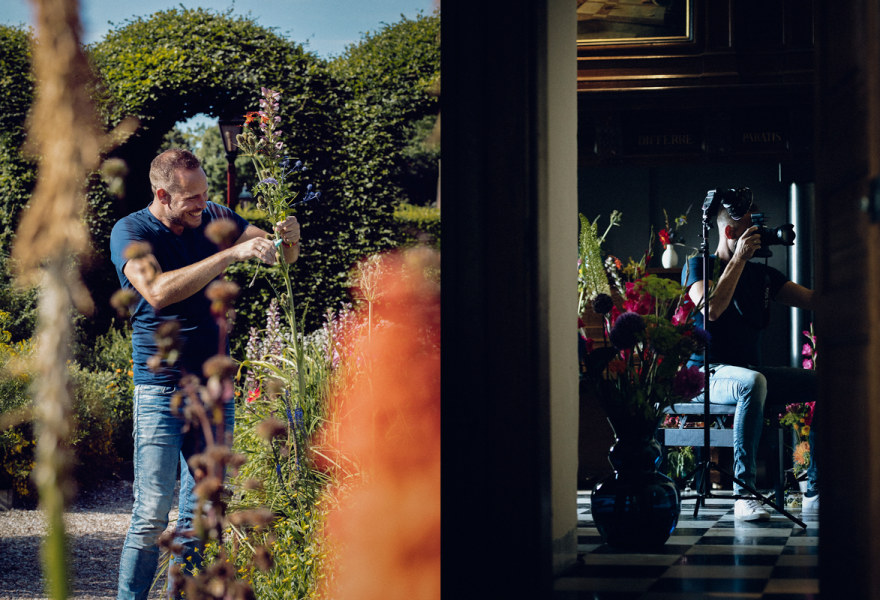
Meeuws creates his floral still lifes with a camera and first and foremost using a computer. He says that image editing accounts for about 95% of his work. Consequently, he does not have a studio in the traditional sense of the word.
Meeuws has recently wanted to adopt a slightly more activist stance in his work. The decline in biodiversity weighs heavily on him. Over the past year, he has often gone out into the field with ecologists to document endangered plant species. Some of the photographs he took during these expeditions have been incorporated into his most recent work. These still lifes can also be seen in Echoes of Nature.
Echoes of Nature, featuring work by Bas Meeuws, Wietske van Leeuwen and Tomas Hillebrand, can be seen at Galerie Wilms in Venlo until 28 March.
Where is your studio and how would you describe it?
My studio is at home or somewhere on location. I photograph the flowers, insects, vases and other objects I use wherever possible. Sometimes, vases are not allowed to leave a museum’s storage, so I photograph them there. Some flowers may not be picked, so that also has to be done on site. I then bring my camera, several lenses, two flash units and small tripods. I compose my work entirely on the computer, which doesn’t require much space. So, I don’t really need a studio in the traditional sense of the word.
You make floral still lifes not with a brush, but with a camera and computer. I can imagine you have different requirements for a studio than a painter, who often prefers natural northern light. What is absolutely essential for you?
I need a computer, a large calibrated monitor and plenty of storage (also for backups). I also use a drawing tablet instead of a mouse or trackpad. For photography, I always use studio lighting.
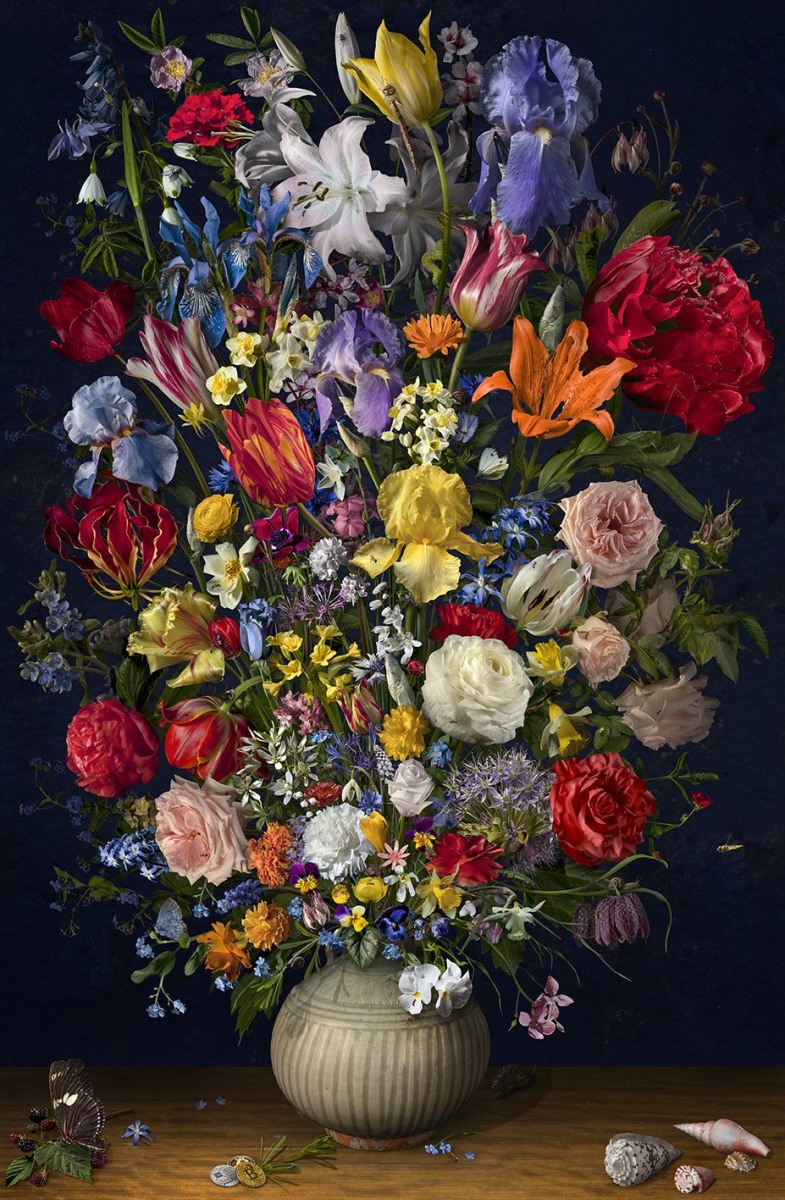
Bas Meeuws, Untitled (#205), 2026, Galerie Wilms
What does an average working day look like?
I think the division of labour—photographing versus composing—is about 5% to 95%. I almost always start the day by reading the newspaper because I think it’s important to know what’s going on in the world. After that, I sit down at the computer with music playing in the background. When I really get into the flow, the day can suddenly be over and I won’t even have felt the need to eat lunch. If the flow isn’t quite there, I often go for a walk. I live on the edge of Eindhoven and can be in the woods within ten minutes. During those walks, ideas tend to come naturally.
Your work clearly refers to 17th-century floral still lifes. When did you know you wanted to work within this tradition?
In 2010, I started making autonomous work. At the time, I was still working 27 hours a week as a manual therapist. Time and space were limited. In the evenings, I transformed my living room into a photo studio, where I experimented with photographing fantasy landscapes. Through trial and error, these gradually turned more into still lifes. From there, it was only a small step to flowers. From that moment on, my love of photography and image editing came together.
My work refers to 17th- and 18th-century painting traditions in the Netherlands, especially in the early part of my career. I think my work primarily refers to painting traditions in general, not solely to the 17th and 18th centuries. The strongest responses are to work in which the link with older painting traditions is most clearly visible. Despite that popularity, I keep challenging myself to take a small step in a different direction each time.
How do you relate to this tradition? Is there something you want to add to it?
I deeply admire the great 17th-century floral still lifes. As mentioned earlier, religious and other symbols were very important at that time. I would very much like to adopt a more activist stance. Fragile nature and declining biodiversity are very close to my heart. Over the past year, I have frequently gone out with ecologists from Het Levend Archief (The Living Archive) to document endangered plant species. The results of this are gradually becoming visible in my most recent work, especially as I explore how these base photographs can be used. These still lifes are also on view at the exhibition Echoes of Nature.
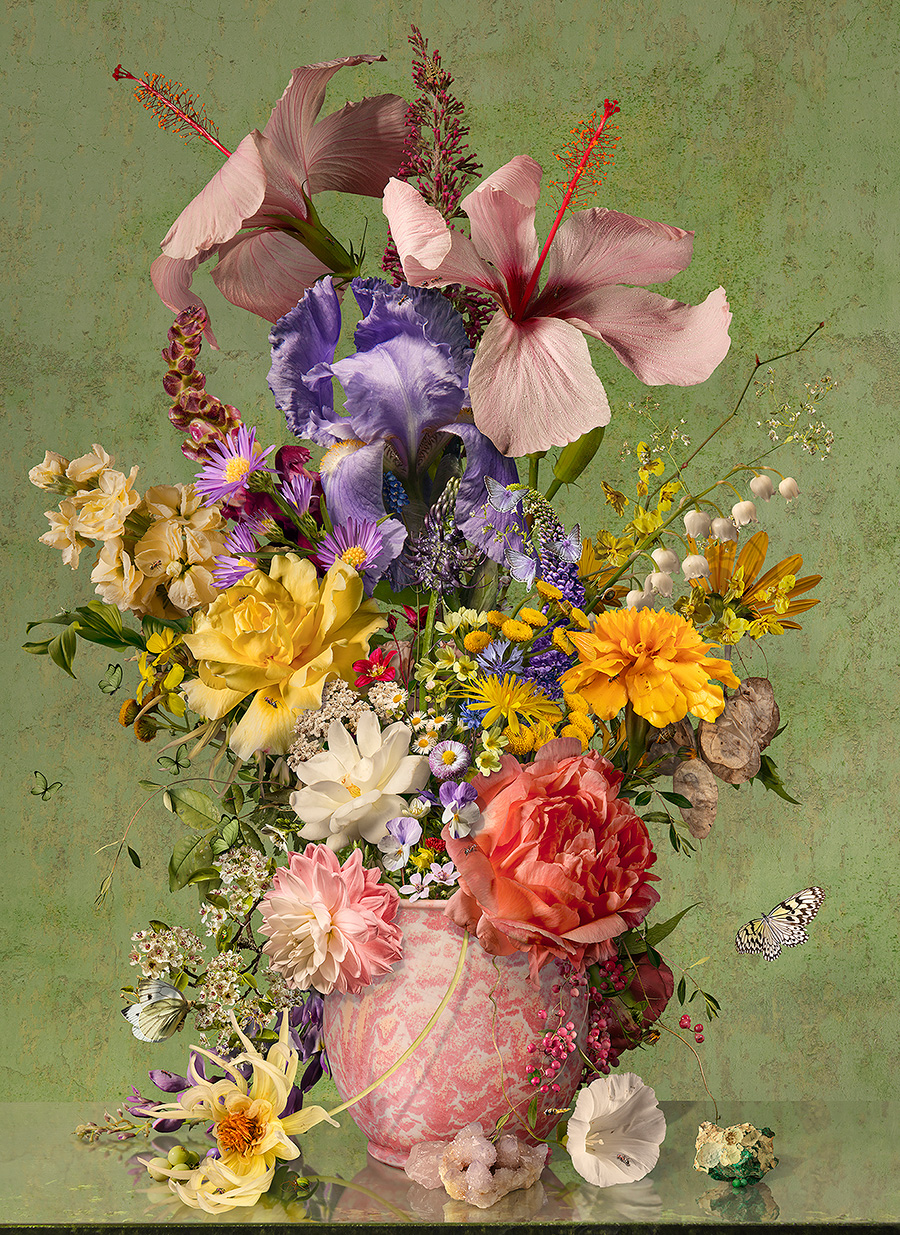
Bas Meeuws, Untitled (#216), 2026, Galerie Wilms
Your work has something surreal about it because every element is equally sharp. Can you explain how the images are created?
The surreal quality of my work stems from my working method. I photograph everything separately, one by one, in studio lighting. This means that I can still use photographs from 16 years ago. Because all the photographs are sharp, the final result is also completely sharp. That feels unnatural because we normally focus with our eyes on one area while the rest is blurred.
Besides everything being sharp, I can also experiment with proportions. I can make flowers as large or as small as I feel is necessary for them to work within the composition. Flowers from all corners of the world and from all seasons appear together in a single bouquet—sometimes even flowers and fruits from the same tree. Occasionally, the opening of the vase is so small that not even a single stem could fit through it, let alone an entire bouquet. Most people only notice this when it’s pointed out to them. I think that means it’s been done well.
What is the most beautiful flower to work with? Do you have a favourite?
I don’t have one specific flower as my favourite. Every flower in each work is ultimately equally important for the entirety to be effective. Every detail, no matter how small, is there for a reason. That said, I do find certain tulips very attractive, as well as hibiscus, peonies, some lilies, cornflowers and fritillaries.
Over the past year, I have also photographed lots of unique native plant species. Parnassia, Sticky Stork’s-bill, Rye Lily and Nodding Avens are particularly beautiful in detail. But then again, there are 500 endangered plant species in the Netherlands.

Bas Meeuws, Hommage à Sanyu (#33), 2026, Galerie Wilms
You have also created work in India and Taiwan. Is there any other country or region where you’d like to work because of the flora? Do you have any plans?
In recent years, I’ve been to quite a few places around the world thanks to my work. In 2015 and 2018, I was invited by Tasveer Arts in Bangalore, India, to photograph flowers, Indian vases and architectural elements. This resulted in the Mughal series, which is now also part of the collection of the Museum of Art and Photography in Bangalore. Since 2014, I have regularly been in the Far East, visiting China and Taiwan several times, which is where I also first saw with the paintings of Sanyu.
Over the past year and in the years ahead, I am focusing more on projects closer to home. As I mentioned earlier, I’ve started a fantastic project in collaboration with Het Levend Archief. This is a group of ecologists from Radboud University and Wageningen University. Their goal is to safeguard all endangered native plant species for the future. They monitor the locations where these plants still grow and determine what is needed to restore the nature there. They harvest part of the seeds and conduct germination tests. Some of the seeds are refrigerated, while others are frozen. The intention is to open a national seed bank around mid-2028 as a hard backup of Dutch nature. I am allowed to accompany these ecologists on field research. During these expeditions, I can photograph the flowers on site without picking them. This requires a fair amount of flexibility on my part—quite literally, since I am two meters tall and the plants are sometimes only two centimetres in size—and when it comes to my techniques.
Over the past year, I’ve managed to document about 10% of the plants. Over the next three years, I hope to photograph the remaining 90%. One of the ultimate goals would be to capture the entire endangered Dutch plant world in a single image. I also plan to create other work from this material, both in editions and as unique pieces.
Congratulations on Echoes of Nature at Galerie Wilms! It’s a group exhibition with work by Wietske van Leeuwen, Tomas Hillebrand and yourself. What do the three of you have in common?
Wietske’s work connects with mine through her use of explicit natural forms, such as shells and snail houses. Her work feels very organic, partly because of her glazes. Her work is somewhat rougher than Tomas’s. I have previously exhibited with Tomas at the PAN in Amsterdam. His work resonates with mine through its level of perfection—at least, I strive for something that I consider perfect and in my eyes, his work is perfect and elegant. In any case, I am very pleased that the work of the three of us can be seen together in this exhibition. It is a beautifully balanced selection.

Bas Meeuws, Untitled (#209), 2024, Galerie Wilms
