25 november 2025, Flor Linckens
The unexpected universe of Elspeth Diederix
In the exhibition ‘All That Glitter’ at Galerie Stigter Van Doesburg, Elspeth Diederix turns her attention to objects that usually slip past our gaze. The artist is known for her ability to charge the familiar with new meaning. No idyllic setting, but objects you would normally glance at for no more than a second, which in her hands become carefully constructed images filled with tension, poetry and subtlety. At times sublime and improbably beautiful, at other times distinctly human. For this exhibition she does not draw from botanical or underwater worlds, but from scenes that appear to have originated close to home: in the kitchen, on a table or in her famous garden.
Elspeth Diederix was born in Nairobi in 1971 and grew up in Colombia as the daughter of a geologist. In 1990, she moved to the Netherlands, where she studied at the Gerrit Rietveld Academie, followed by a residency at the Rijksakademie. She initially worked within sculpture and painting, but ultimately found her place in photography: the medium through which all these backgrounds could converge. That sculptural and painterly sensibility remains clearly present in her practice. Sometimes she pushes personal boundaries, as in her series of dreamlike underwater still lifes, despite describing herself as a somewhat fearful diver. Her work has been shown at Foam Fotografiemuseum Amsterdam, Huis Marseille, the Stedelijk Museum, De Nederlandsche Bank, the Mauritshuis, Centre Photographique Rouen Normandie, Kunsthal Rotterdam, Het HEM, the Fries Museum, De Mesdag Collectie, Fotodok, the Rietveld Arsenale at the Venice Arsenale, the Dordrechts Museum, Stedelijk Museum Schiedam and the Nederlands Fotomuseum. It was acquired by the Stedelijk Museum Amsterdam, the AkzoNobel Art Foundation, the AMC hospital in Amsterdam, the Rabobank, ABN AMRO and the UMC hospital in Utrecht. In 2002, she received the prestigious Prix de Rome for Photography. The artist also published several photobooks.
When the artist moved into a studio on the Witte de Withstraat in Rotterdam in 2009, it turned out to include a large garden. She decided to follow a horticulture programme, to better understand how plants grow and respond. In 2019 she launched a remarkable long-term project in Amsterdam-West: the 800-square-metre ‘The Miracle Garden’, an experimental public flower garden in the Erasmuspark, designed, created and maintained entirely by the photographer. The garden contains hundreds of striking flower species and, over the years, a number of failed experiments as well. The result is a dynamic garden that looks slightly different with each visit. In 2021, the project was nominated for the Amsterdam Prize for the Arts.
This combination of observation and intervention lies at the core of her practice, even when nature is not the direct subject. Diederix is not an observer but a builder. She constructs her seemingly effortless images with extraordinary precision: adjusting, shifting or creating every element by hand. Her photographs arise through maquettes, drawings, tests and meticulous physical interventions. Digital manipulation is absent, if something in the image needs to change, she alters the object itself.
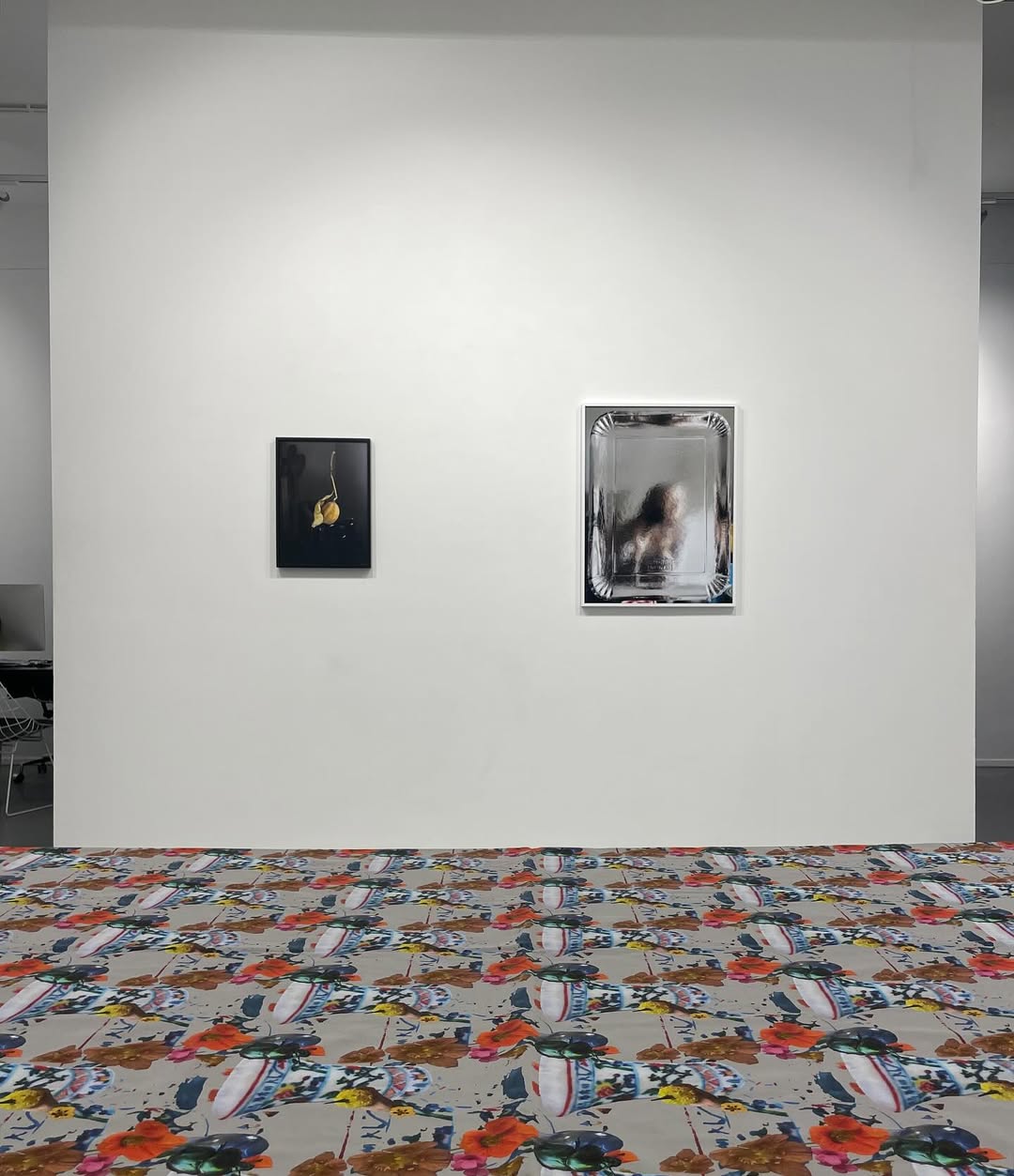
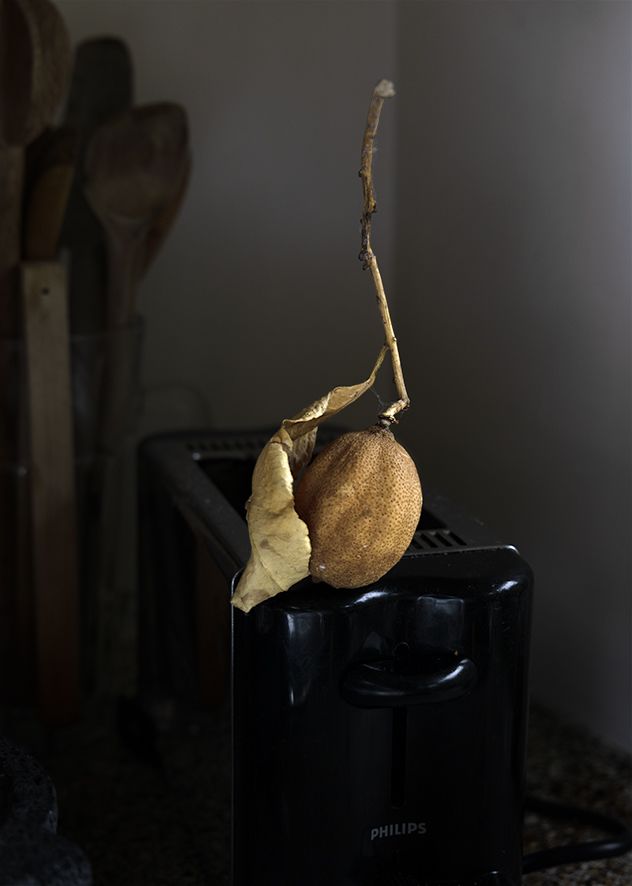
In the exhibition at Galerie Stigter Van Doesburg we see a citrus fruit that seems to be transforming into leather, casually balanced on a toaster yet presented as a seventeenth-century still life. The matte surface of the fruit and leaf contrasts with the gleaming appliance beneath it. Here, Diederix plays with texture, light, shadow and transformation. She does not position the fruit as a memento mori but as an invitation to look at the moment right before decay, at the beauty within the process itself.
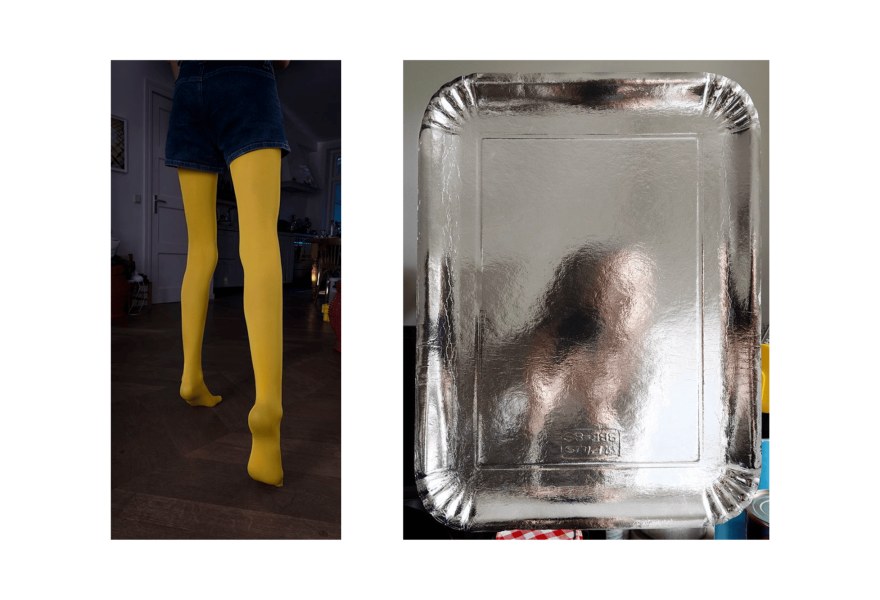
The exhibition also includes a partially visible self-portrait, reflected in a matte silver-coloured paper plate. The reflection is so diffused and distorted that the image takes on a faintly surreal quality: the artist is present only as an echo, dissolved into the surface. Diederix doesn't offer a direct gaze into the lens, but rather an observation of how a body returns in the distorted reflection of an everyday disposable object that unexpectedly becomes pictorial.
We also see two long legs in a bright yellow (or blue) pair of tights, printed at nearly life-size on 120 x 57 cm. The artist also shows a draped tablecloth with an intriguing pattern, its embroidered motifs floral yet not naturalistic, suggesting a system of order while remaining playful and rhythmic.
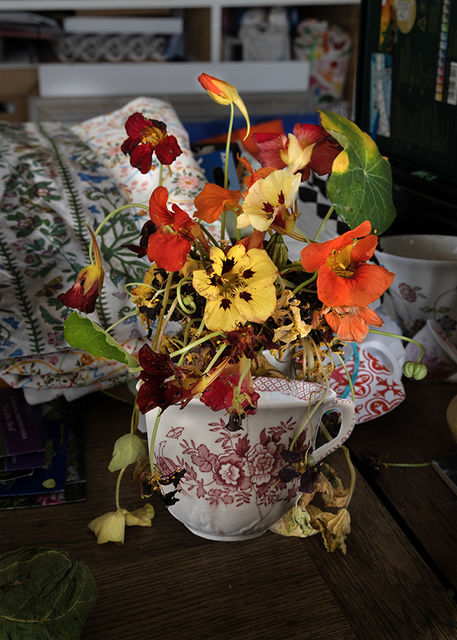
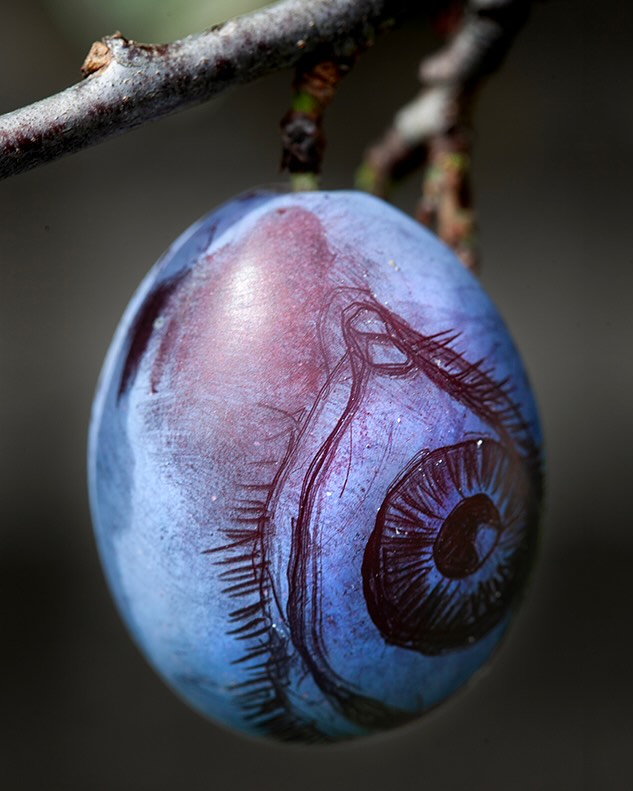
In another work, a half-wilted bouquet in an old-fashioned carafe includes a few still lively flowers that stand out with stubborn poise. The flowers are not fresh, but in that fragile stage where colours remain intense while the stems begin to lose strength. Further on, a plum bearing a drawn eye seems to return the viewer’s gaze. The work gains a faintly unsettling charge through the structure of the plum, with its thin outer membrane and soft, almost liquid flesh beneath, which evokes the uncomfortable suggestion of an eye.
With these works, Diederix appeals to the viewer’s sensory awareness. She shares scenes in which she briefly holds, slows or releases energy. The exhibition also refers, implicitly, to the long-standing collaboration between the artist and the gallery, which began more than twenty years ago with Diana Stigter and is now visible in the intuitive harmony between work and space.