24 october 2025, Emily Van Driessen
Come CLOSER at Hilde Vandaele Gallery
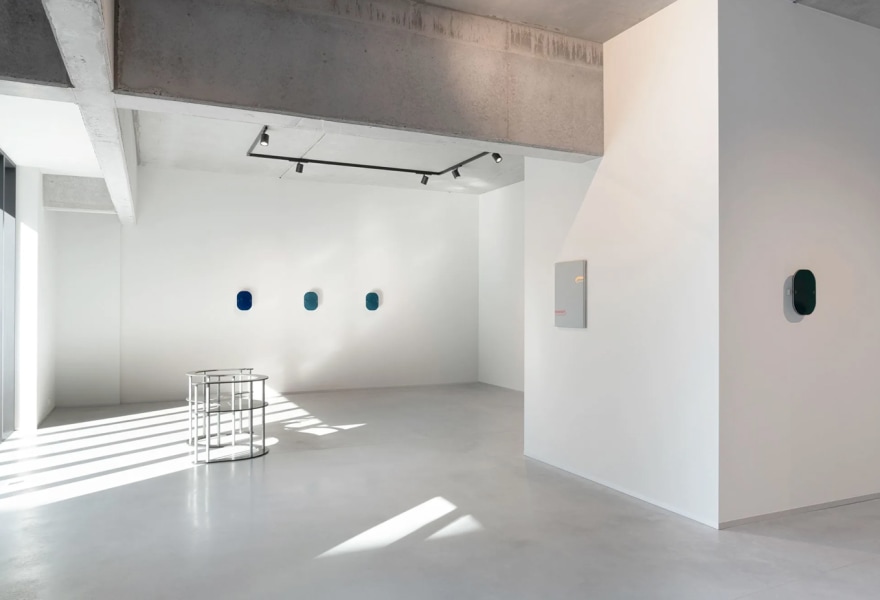
At Hilde Vandaele Gallery in Kortrijk, CLOSER brings together German artist Lena Marie Emrich (b. 1991) and Cuban-born artist Carlos Caballero (b. 1983). The two first met through the gallery, who intuitively sensed a connection between their practices. The result is a delicate exchange where two distinct visual languages meet in unexpected, poetic resonance.
On Sunday 26 October at 11 AM, as part of Kortrijk Art Week and Wonder Festival, both artists will join curator Els Wuyts for a talk at the gallery about their work and collaboration. The reflections below offer a glimpse into that dialogue.
The title CLOSER borrows from Mike Nichols’ film of the same name, a story where love, lust, lies, intimacy and faithfulness constantly blur. “The film in essence is about communication and miscommunication,” Lena says. “That topic feels very relevant. In politics, in human relations, in reconnecting after the pandemic. There are so many layers, physically, mentally and verbally, where we have to reunite with each other.”
The title, CLOSER, also suggests a movement of proximity. “If you really want to understand my artworks, you have to come closer,” Carlos smiles cheekily. “When you get close to someone or something, you start seeing both the incredible things that you love and the things you don’t like at all. I like those contrasts. The ugly and the beautiful. The black and the white. I don’t like grey zones. ”
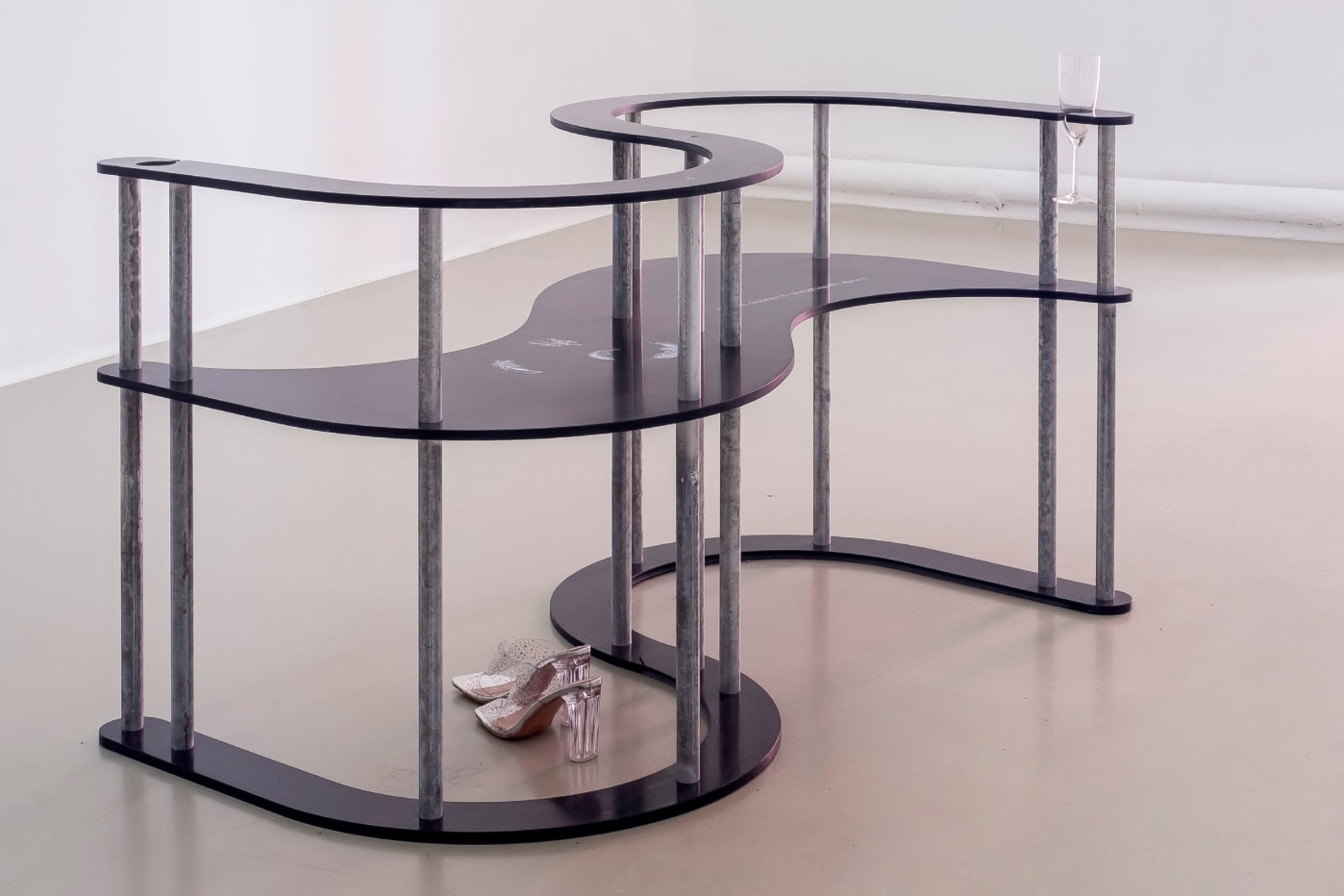
Lena Marie Emrich, Gossip Chair (Where glorious uncertainty reigns), 2024, 2025, Hilde Vandaele Gallery
Beyond the film reference, Franco “Bifo” Berardi’s Poetry and Chaos resonates deeply with how Lena looks at her own work on a conceptual level. “It speaks about breathing, about how we live in an accelerated rhythm and how poetry can reintroduce a sense of space that can open new ways of experiencing reality,” Lena explains.
That notion of poetry as a form of space also touches something that connects her practice to Carlos’s. Both Lena and Carlos engage with a kind of poetic language, though from very different directions. In her work, the poetic gesture lies in how materials and relational references are subtly interwoven. His paintings, by contrast, form a kind of pictorial grammar, an alphabetical system that holds both structure and a chaotic force. Together their works suggest a visual semantics that reflects how meaning moves poetically. .
Lena’s Gossip chairs, S-shaped benches echoing Victorian design, seem to breathe Berardi’s notion of poetry as space: “Through their form, you are almost forced into dialogue, whether with someone you know or a complete stranger.” The engraved lace bra hidden in the material adds another layer. Though light and mischievous, it seems to carry the erotic undercurrent of the film CLOSER where intimacy always holds a risk of vulnerable exposure.
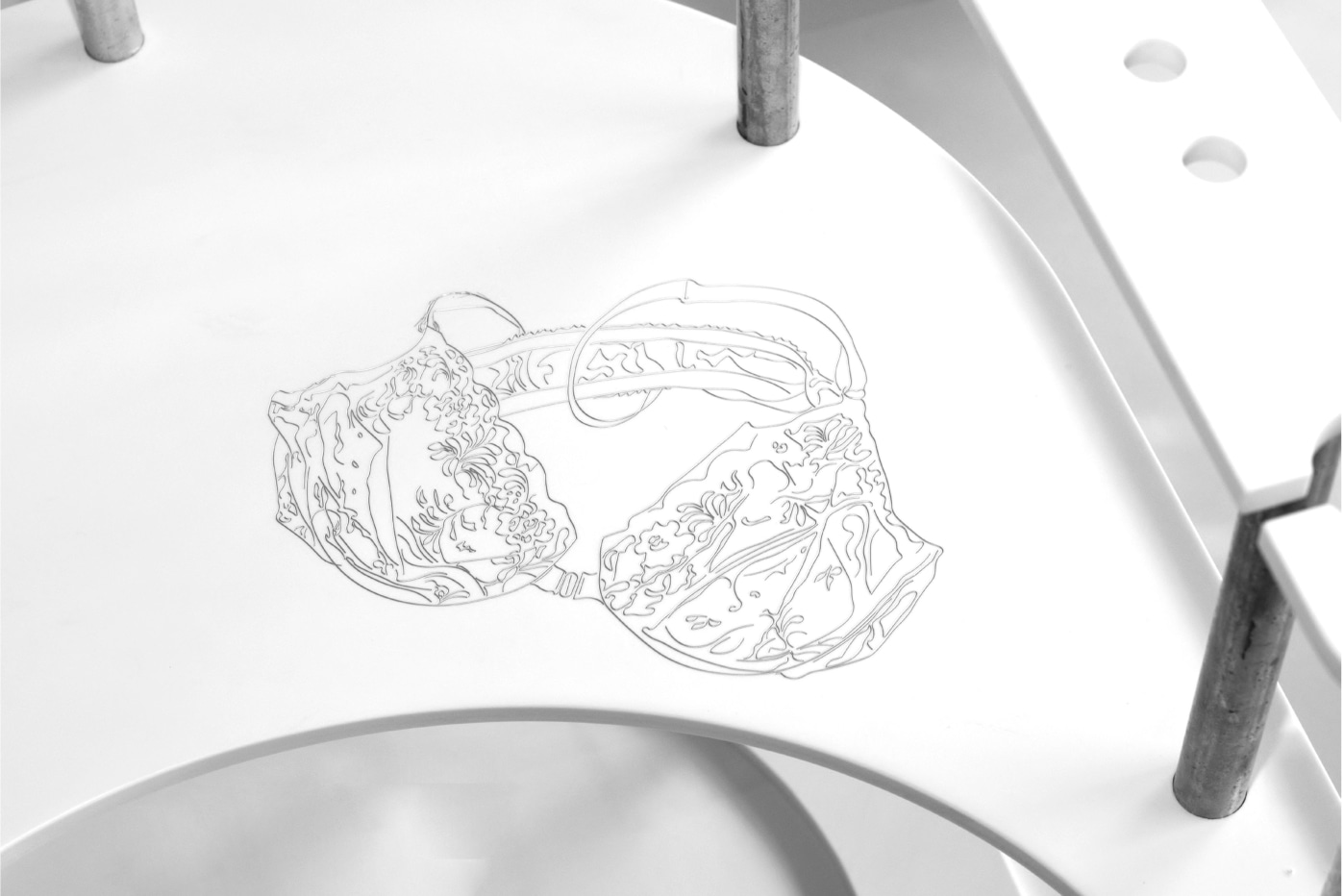
Lena Marie Emrich, Gossip Chair (Lingerie Drop), 2025, Hilde Vandaele Gallery
Also in the window sculptures, the absence of the body becomes tangible through imprints and traces left behind. “Within the layers of the plexiglass, you find fingerprints from someone yearning for what’s in the distance, the imprint of a shoulder blade from someone who fell asleep,” Lena explains. Each artwork incorporates both digital and handmade processes: drawings are vectorised, engraved, and re-materialised as tactile surfaces. “I like that back and forth between analog and digital,” she says. “It’s how our generation lives who’s constantly shifting between screens and physical presence.”
The Back Tray series also extends that reflection on presence and absence where a familiar form of an airplane or train seat back becomes almost meditative. “It’s a rigid object reduced to its absolute form. It’s a structure you always see but rarely really notice whenever you’re travelling, one may travel for leisure another may travel forced by political failures – still the gaze rests on the same form,” she explains. “I added the colours of the horizon, blue and yellow, to evoke a sense of hope.”
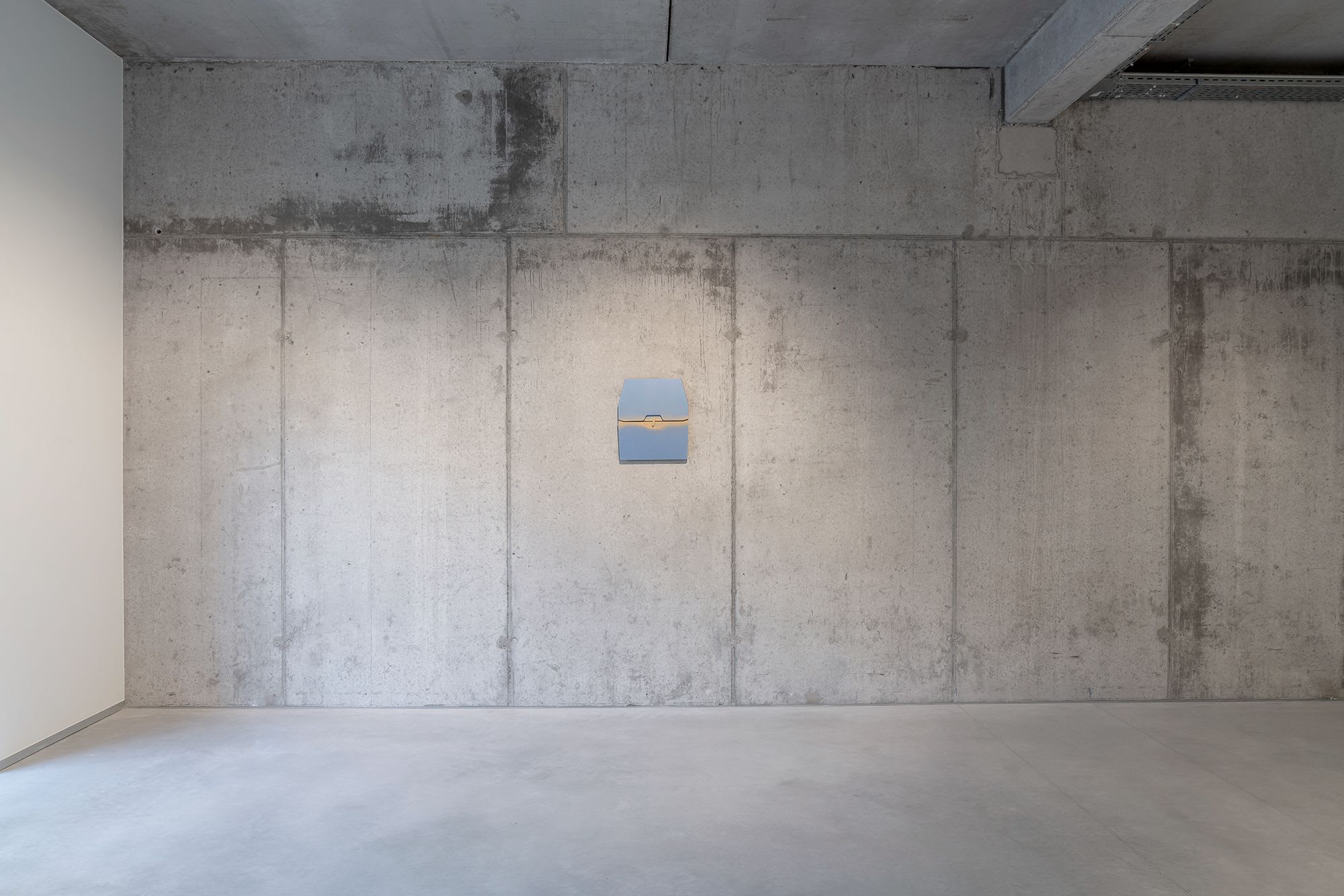
Lena Marie Emrich, CLOSER, Hilde Vandaele Gallery
Carlos’s paintings echo a similar kind of unraveling. “I aim for my paintings to speak in their own language, rather than tell a story,” he says. “I came from figuration, but I was completely tired of the narratives behind figurative work.” Language, for him, became a structure to rebuild. “When I first arrived in Belgium, Dutch was a totally abstract language for me,” he recalls. “That’s where my motivation came from to create my own alphabet. It’s an ongoing system that I’m still building.”
That poetic alphabet feels like his way of breathing, balancing precision and release, much like in Berardi’s Poetry and Chaos. “I control maybe fifty percent of my work, even when they look very controlled. The rest I let go. If I try to control everything, I will start building my own prison.” He describes his process as organising his own chaos, yet that very failure to fully organise is what keeps the work alive. His poetic language is also linked to early computer games, like Tetris, with simple codes and movements. In the exhibition there seems to be a subtle hint at the iconic Nokia Snake game in the work Ouroboros.

Carlos Caballero, Loop (Ouroboros), 2025 / Alignment (left), 2025, Hilde Vandaele Gallery
His relationship to colour is equally systematically interesting. “In Cuba and Florida, where I used to live there was so much light,” he recalls. “Here in Belgium, the light is different. Much darker and constantly changing.” The climate forced a shift in his practice: oil paint dried too slowly, and his surfaces had become increasingly abstract and graphic. “So I started working with acrylic. I keep my colours in small pots, so I can easily find and use them again. It’s like a typographic system of colours.” In that process, he shows a deep respect for the material, a sensibility he equally recognises in Lena’s practice. “A canvas is a canvas. Paper is paper. I don’t like tricks. And I think Lena respects the material too. We also both have this care for structure, for accuracy. However, we give you hints, but never the whole picture. I prefer to create more questions than to provide answers.”
In recent years, his work has become lighter and more playful. “In 2020 and 2021, in Covid times, my paintings were more serious. Now I started adding subtle humour in them.” Learning Dutch shaped that shift too: “When I didn’t speak the language, everything sounded completely abstract, but once I began to speak it, I could hear little details in songs, in Belgian humour that caught my attention. It’s so different from Cuba, where everything is more direct, more macho. Here the humour is more subtle. For example I titled a work ‘PR’ which evokes ‘public relations’, but for me it’s simply pigment red, the colour code. I like to create such small confusions.”
And it’s in that subtle playfulness where both Lena’s and Carlos’ work meet in poetry and chaos.
You can visit the exhibition CLOSER at Hilde Vandaele Gallery in Kortrijk until 2 November 2025.
