21 october 2025, Flor Linckens
The poetry of imperfection at Galerie Caroline O’Breen
In the exhibition ‘Teratology’ at Galerie Caroline O’Breen, Anne Geene and Lana Mesić explore the beauty of deviation. The title refers to the scientific study of deformities, yet in Geene and Mesić’s work it is not about a clinical label. Their attention is drawn to what falls outside the frame, to what strays from the norm and, in doing so, reveals something essential about the way we look at the world. How can meaning be distilled from what refuses to fit within the framework?
The initiative for this duo exhibition came from Anne Geene, who invited Lana Mesić to explore how two distinct artistic perspectives might complement one another. They found common ground in their shared fascination with collecting, ordering and re-evaluating. Both artists demonstrate that classification can yield both knowledge and imagination. By placing their different methodologies side by side, ‘Teratology’ becomes a diptych about seeing: how does our perception of nature and society shift when we place imperfection at the centre?
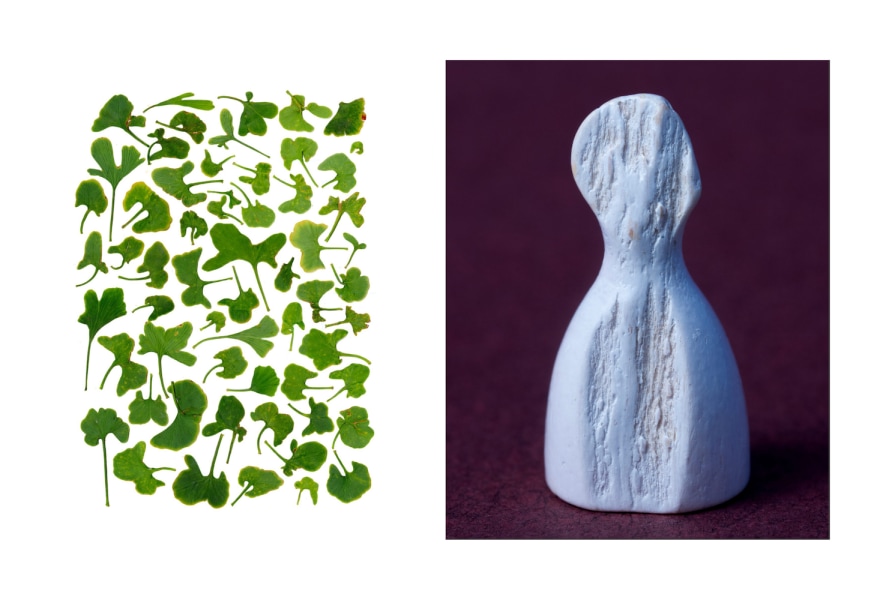
Anne Geene is known for her meticulous, semi-scientific approach. She collects leaves, seeds, insects and other natural elements, which she systematically photographs, sorts and arranges according to form, colour or pattern. Her precise method recalls the taxonomy of eighteenth- and nineteenth-century naturalists, yet her conclusions are those of a visual thinker: idiosyncratic, personal and poetic. In her universe, the small gains significance, the accidental finds structure, and the seemingly useless acquires value.

Anne Geene was born in the Netherlands in 1983 and lives and works in The Hague. She studied Arts and Culture Studies at Erasmus University Rotterdam, followed by Photography at the Royal Academy of Art in The Hague. She also studied at AKV St. Joost and obtained a master’s degree in Photographic Studies at Leiden University. Her graduation project ‘No 235 / Encyclopaedia of an Allotment’ was named best photobook of the year by the Dutch NRC newspaper in 2010 and was acquired by the Nederlands Fotomuseum. Geene received several awards, including the ING Unseen Talent Award (2014) and both the jury and audience prizes of the Volkskrant Visual Art Award (2018). Her work is held in the collections of the Rijksmuseum, the Kröller-Müller Museum, the Dutch Ministries of Education, Culture and Science and of Foreign Affairs, KPMG, Menzis and ING. The artist has presented her work at the h3h biennial, Kunstmuseum Den Haag, Stedelijk Museum Schiedam, FOMU Antwerp and in the Gallery of Honour at the Nederlands Fotomuseum. She also completed residency programs at the Vincent van GoghHuis and the Verbeke Foundation.

Lana Mesić shares Geene’s curiosity for what is not immediately visible. Her interdisciplinary practice spans photography, sculpture and installation, and examines the invisible forces that shape our lives: power, memory, identity and play. Often she begins with the everyday, using it to expose broader social or psychological processes. Her previous projects have examined the 2008 financial crisis, the Rwandan genocide and the aftermath of the Yugoslav wars. Within these subjects, she searches for the human experience and for meaning amid chaos. Rather than providing clear answers, she invites the viewer to embrace the discomfort that accompanies ambiguity. In her work, humour, play and a touch of irony serve as gentle instruments of resistance.
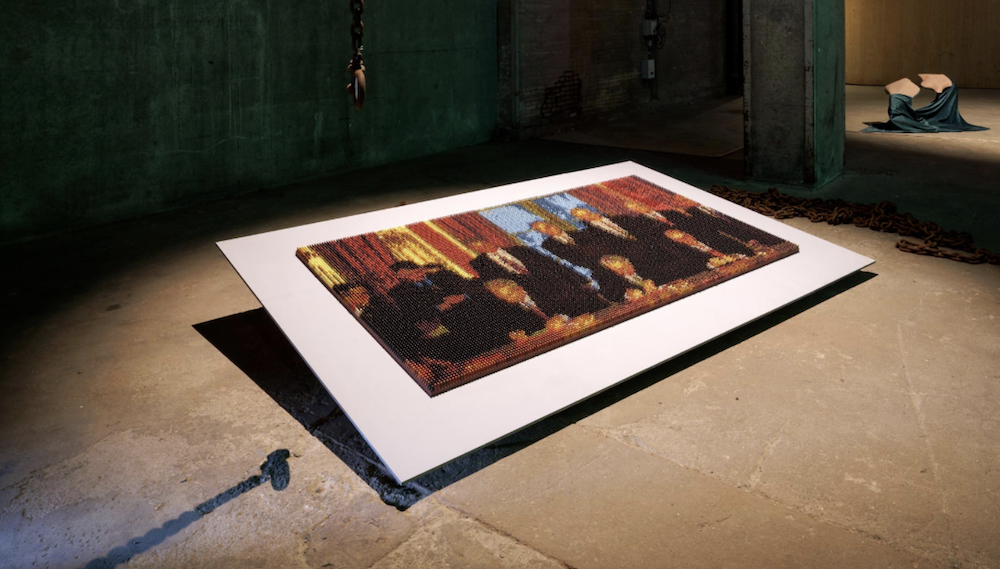
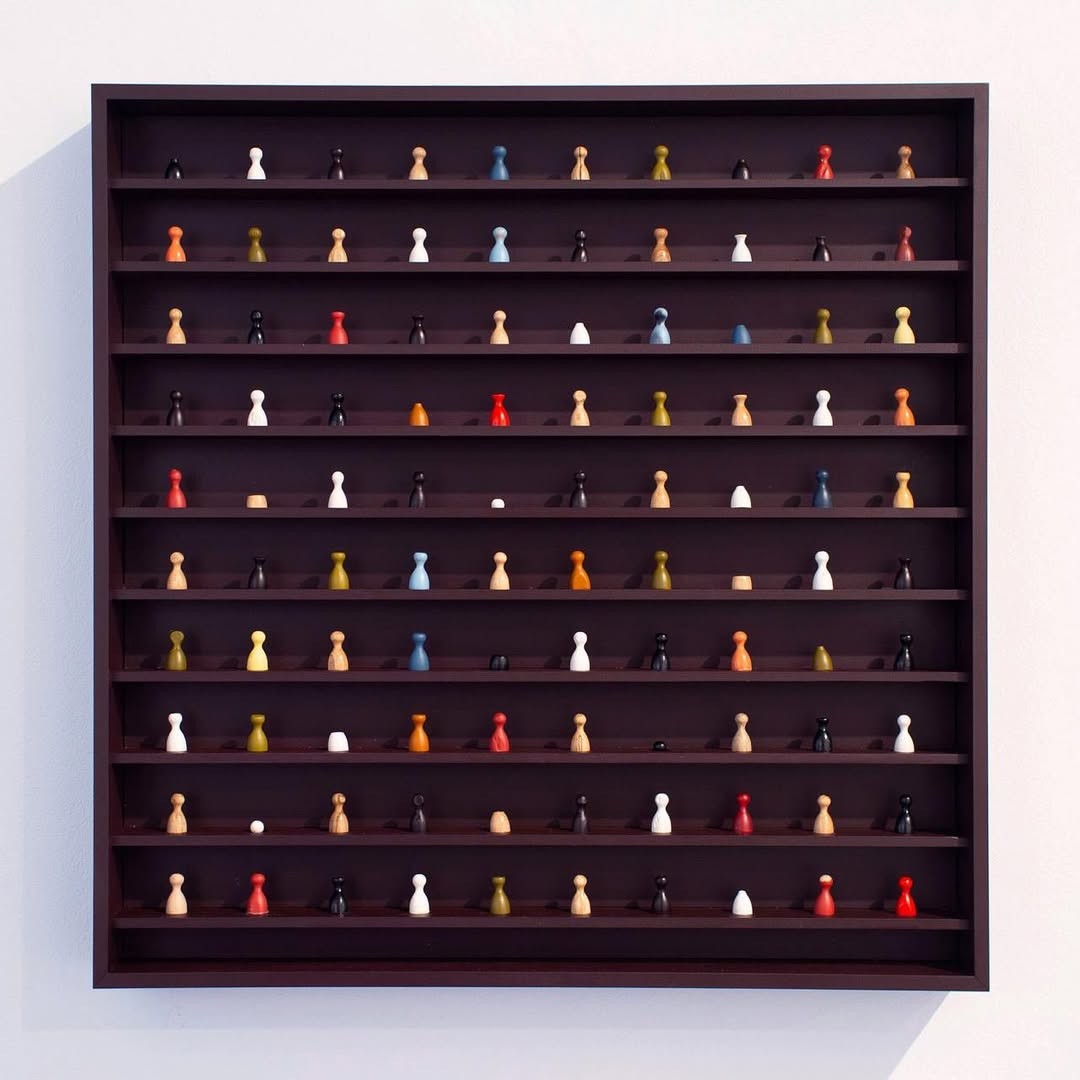
At Galerie Caroline O’Breen, Mesić presents a series of "Teratology Pawns", shown individually or in grids of one hundred. These pieces consist of damaged pawns: small wooden misfits, collected during long-term research. Each carries a scratch, a crack, or an uneven layer of varnish, and reveals something about vulnerability and resilience on a microscopic scale. For the monumental work "Čov(j)eče, ne ljuti se!" (a reference to the Yugoslav variant of ‘Ludo’ or ‘Mensch ärgere dich nicht’) Mesić used 18,245 hand-painted pawns to represent reconciliation, collective memory, unresolved tensions and collaboration. The work reinterprets the signing of the Dayton Agreement, ratified in Paris in 1995 to end the Bosnian War. Together, the pawns form a reconstruction of the iconic photograph showing the principal signatories (Alija Izetbegović, Slobodan Milošević, and Franjo Tuđman) seated at the table, with world leaders such as Bill Clinton and Jacques Chirac behind them. By reimagining this historical moment through a field of pawns, Mesić examines how power and fragility are inseparably linked and how precarious peace remains as long as the game continues.
Lana Mesić was born in 1987 in the former Yugoslavia and lives and works in Rotterdam. She studied Photography at AKV St. Joost. In 2016 she was selected for the Grolsch Unseen Residency and in 2017 was longlisted for the Prix de Rome. Her work has been shown at BRUTUS, V2_Unstable, Stedelijk Museum Schiedam, the Goethe-Institut, the Nederlands Fotomuseum, the Pirelli Photo Biennial, the International Criminal Court in The Hague, Wereldmuseum Amsterdam and at several international art fairs. Her work has been included in the collections of Stedelijk Museum Schiedam, the AMC and the LUMC.