20 october 2025, Flor Linckens
The smouldering and shifting landscapes of Raquel Maulwurf
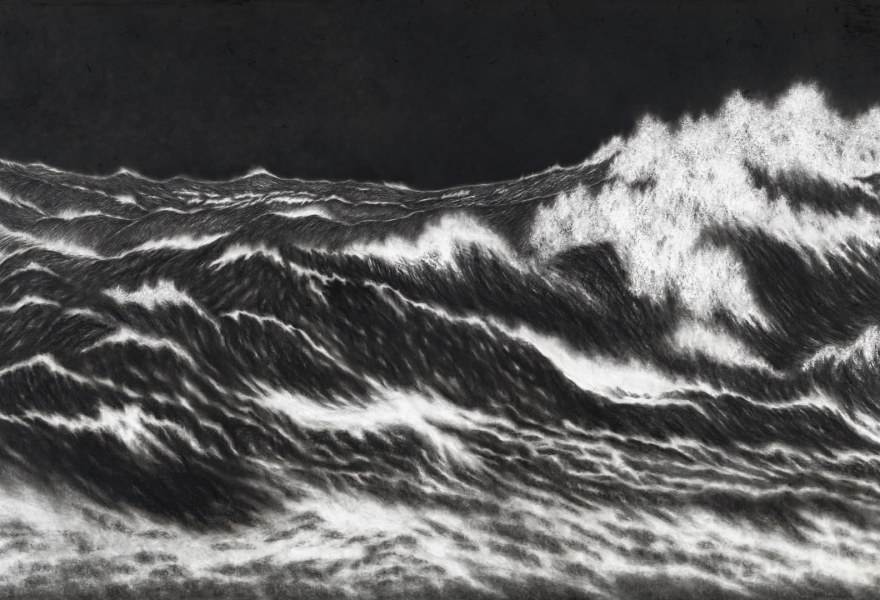
Until 6 December, Livingstone Gallery in The Hague presents a solo exhibition by Raquel Maulwurf. The Spanish-Dutch artist reveals the fragility of our world in the face of the destructive forces of both humankind and nature. In her often monumental works on paper, she explores themes such as war, environmental pollution and ecological disaster. But her black-and-white images transcend current events: rather than depicting the moment of catastrophe, they capture its aftermath, distilled into abstraction. Maulwurf creates enigmatic works that hover between beauty and devastation. Her images are charged with unease: waves surge in darkness, forests appear to glow, and night skies seem to explode. Yet the destruction is rarely spectacular. It smoulders, inevitable and slow.
The exhibition ‘A Force of Nature’ celebrates twenty years of collaboration between Maulwurf and Livingstone Gallery. Most of the works were created over the past three years, complemented by a selection of earlier pieces. Whereas her earlier works focused on war-torn cities and scarred landscapes, her recent drawings turn to nature itself and the question of whether the earth might be striking back. Her images reflect the tension between human hubris and nature’s retaliation: polluted oceans, burning forests and poisoned air seem to rise up against their instigator. Yet each work also radiates a certain stillness, a hushed beauty that draws the eye before it recognises the threat. Together they form a visual archive of human intervention, from bombardment to environmental collapse, from industrial expansion to ecological catastrophe, echoing the recent wildfires in the United States and southern Europe.
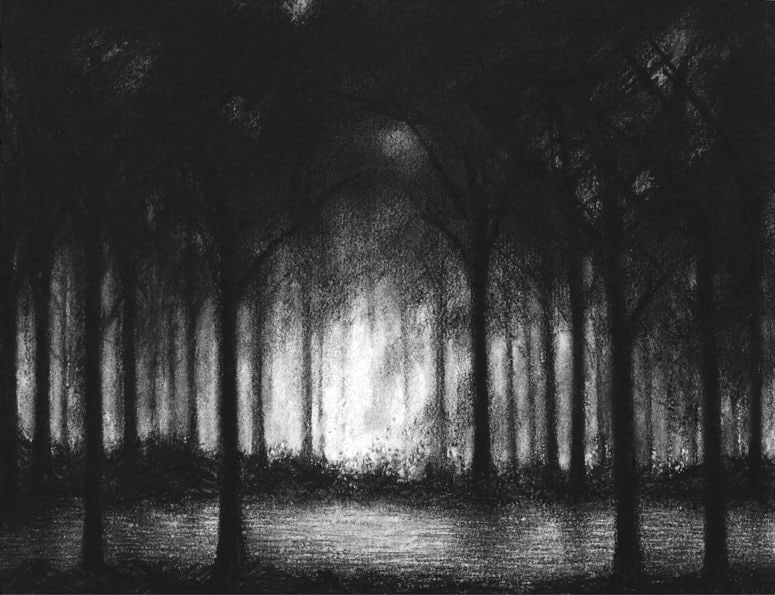
The emptiness Maulwurf evokes is never neutral. Her dark horizons recall the Romantic tradition, in which nature is both sublime and terrifying, while her subject matter resonates with contemporary headlines about climate, war, and pollution. The absence of people reinforces the sense that we are witnessing the aftermath of our own actions: landscapes that testify to our presence precisely through our disappearance. Each image serves as a reminder of both our fragility and our responsibility.
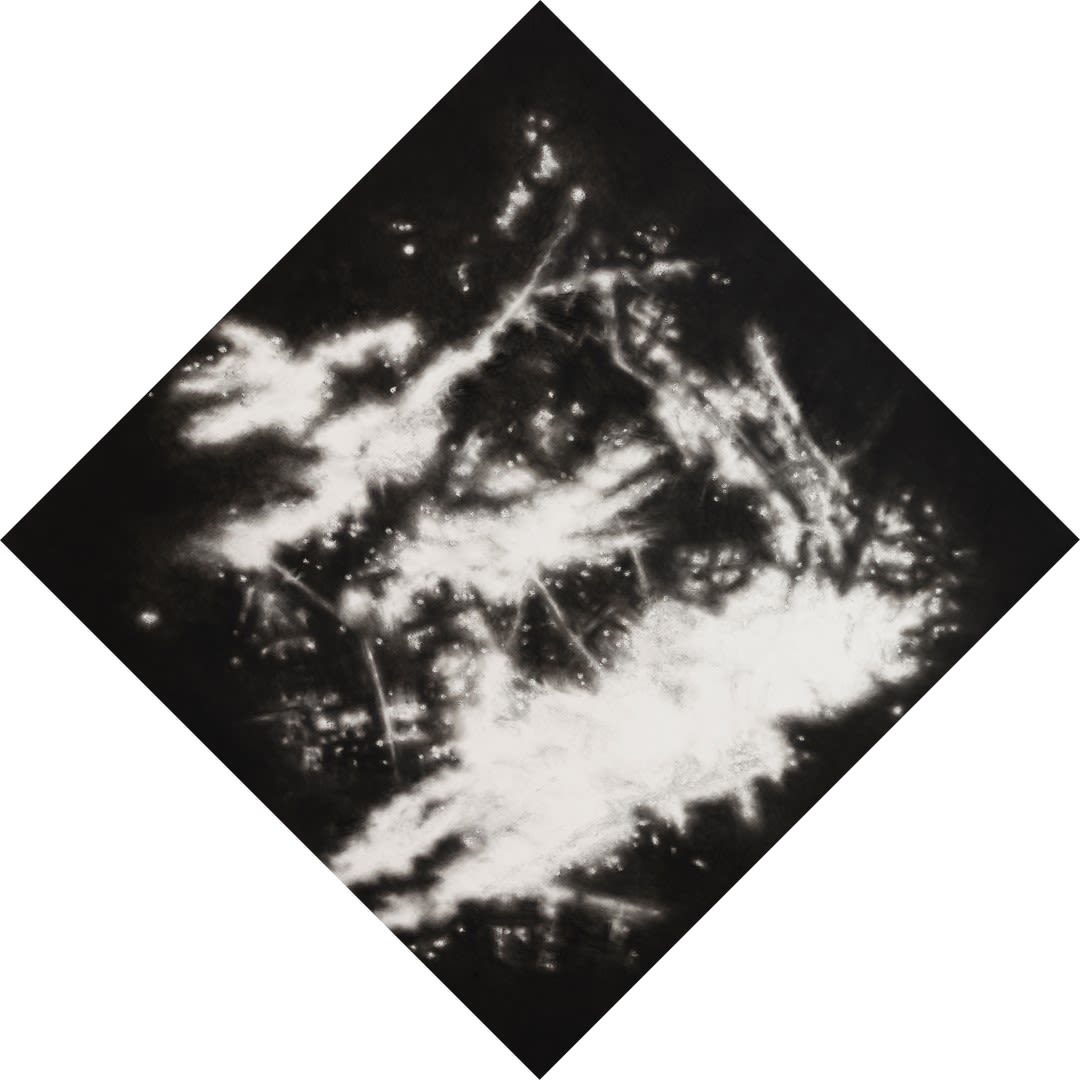
Among the works on view are pieces from her "Burning" series, in which Maulwurf portrays forests consumed by fire. Yet we do not see a roaring inferno, but rather a blaze unfolding in silence, glowing from within. Some works directly reference historical events, such as "Night raid near Stuttgart 1944" and "Night raid on Tokyo 9 III ’45". These depictions of wartime bombardments are transformed into patterns of light and smoke, where incendiary bombs merge with stars in the night sky.
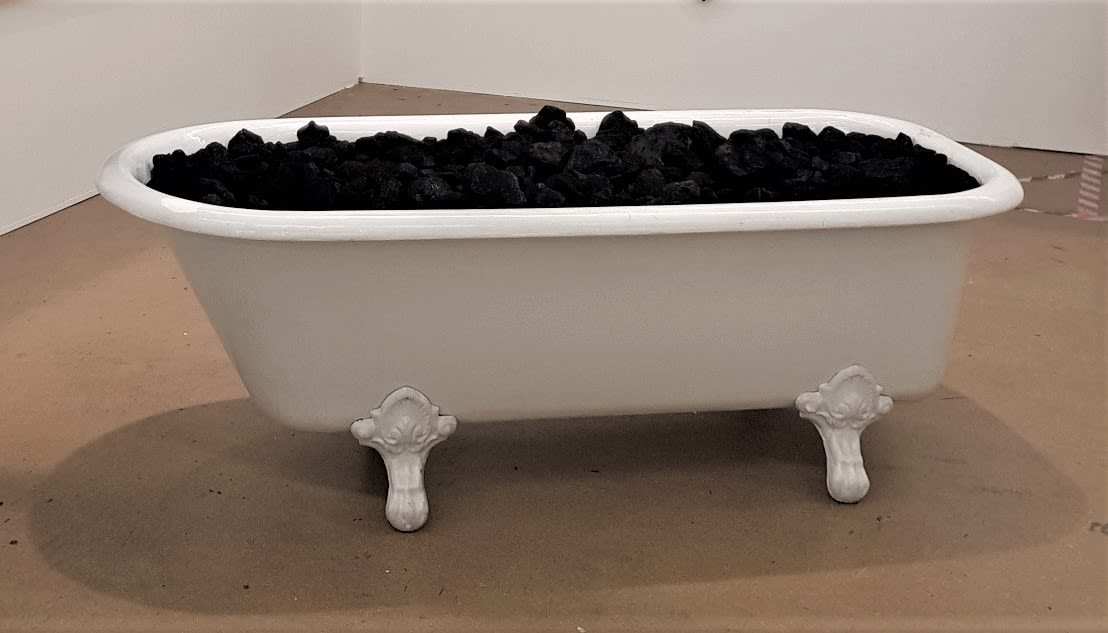
Maulwurf primarily works with charcoal and pastel but also uses materials such as lignite briquettes and black coal. In ‘The Carbon Library’, she presents a cabinet filled with lignite briquettes resembling charred books. ‘The Carbon Cleansing’ features a bathtub filled with gleaming coal, an image that simultaneously evokes purification and pollution. Both artworks originate from ‘The Carbon War Room’, her 2017 solo exhibition at Kunstmuseum Den Haag. The title refers to an initiative by Sir Richard Branson that addresses the fight against CO₂ emissions and climate change with the same urgency as the famous War Rooms of the Second World War. With ‘The Carbon Cleansing’, Maulwurf underscores that reducing emissions is far from a simple task.
Her working process is remarkably physical. Maulwurf often draws on thick museum board, attacking the surface with charcoal, pastel and sharp blades. By cutting into the material, she makes the act of destruction literally tangible. In doing so, subject and technique become inseparable. Her practice is grounded in extensive archival research, historical photography and oral history.
Raquel Maulwurf was born in Madrid in 1975 and studied at (what is now) ArtEZ in Arnhem and at the SAE International Technology College in Amsterdam, where she continues to live and work. Her work has been exhibited at Kunstmuseum Den Haag, Stedelijk Museum Schiedam, BOZAR, De Nederlandsche Bank, the Escher Museum, Palazzo Ducale Genova, the Fries Museum, Museum De Fundatie, the Nederlands Fotomuseum and the Dutch House of Representatives. Her work is currently on view at the Centraal Museum in Utrecht in the exhibition ‘Getekend, de Natuur’, on view through 29 March 2026. Her work has been included in the collections of Museum Voorlinden, Stedelijk Museum Schiedam, the Rijksmuseum, Kunstmuseum Den Haag, Teylers Museum, the Prefectural Art Museum Nagasaki, De Nederlandsche Bank and the Dutch Ministry of Foreign Affairs. Maulwurf has completed several residency programmes, including the ISCP International Studio & Curatorial Program in New York, a programme in São Paulo and a residency with Livingstone Projects in Berlin.

