17 october 2025, Emily Van Driessen
Oh baby: new group exhibition at Barbé
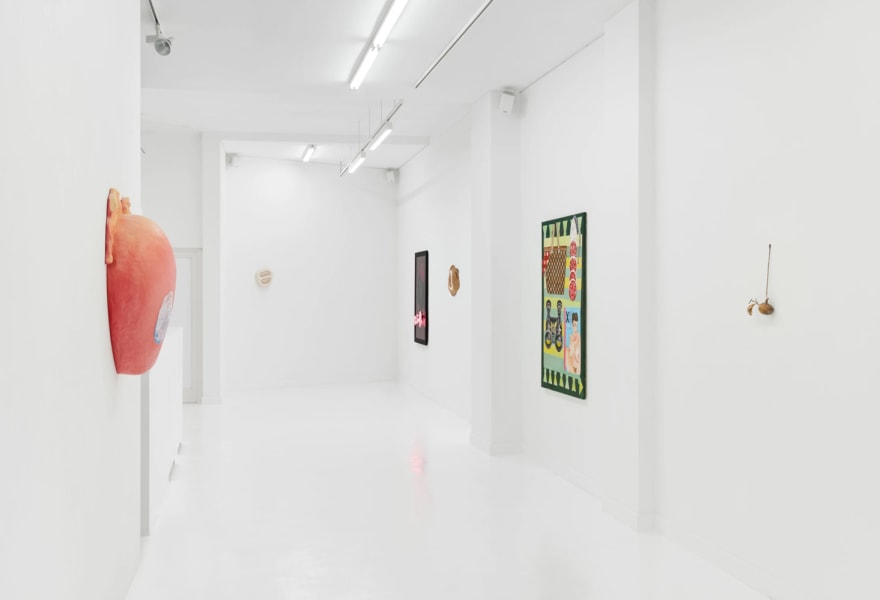
“Oh Baby is about desire, seduction, lust, love, and of course, tension and sometimes even obsession come with that,” says gallerist Oliver Barbé about the new group exhibition at Barbé in Ghent.
Eight artists each give their own twist to the game of seduction. Alice Vanderschoot links her work to online sexual image culture through an enlarged peach, a nod to the emoji referring to buttocks. In Jens Kothe’s work, you sense the fleshy excitement, the tactile closeness of bodies. His pieces resemble membranes: juicy, shiny, hard and soft at once, as if they fill the space around them. Kris Martin’s metal bed springs preserve the secrets of passionate lovers.
The sensual thread comes into sharpest focus in two Belgian artists who, across generations, explore the boundaries of looking and being looked at.
Liliane Vertessen (b. 1952) creates works that radiate seduction and desire, yet remain critical. She uses archetypes of women in society, the temptress, the dominatrix, to question the stereotypical expectations imposed upon them. Neon elements reinforce this by alluding to red-light districts or obscure places where women must present themselves sexually for the male gaze. Ellen Dhondt (b. 2000) takes this one step further. She creates a full alter ego, Ellie Dolly, through which she freely explores the limits of desire. This creates an intriguing tension between the roles we play or are assigned, and the hidden inner longings beneath them.
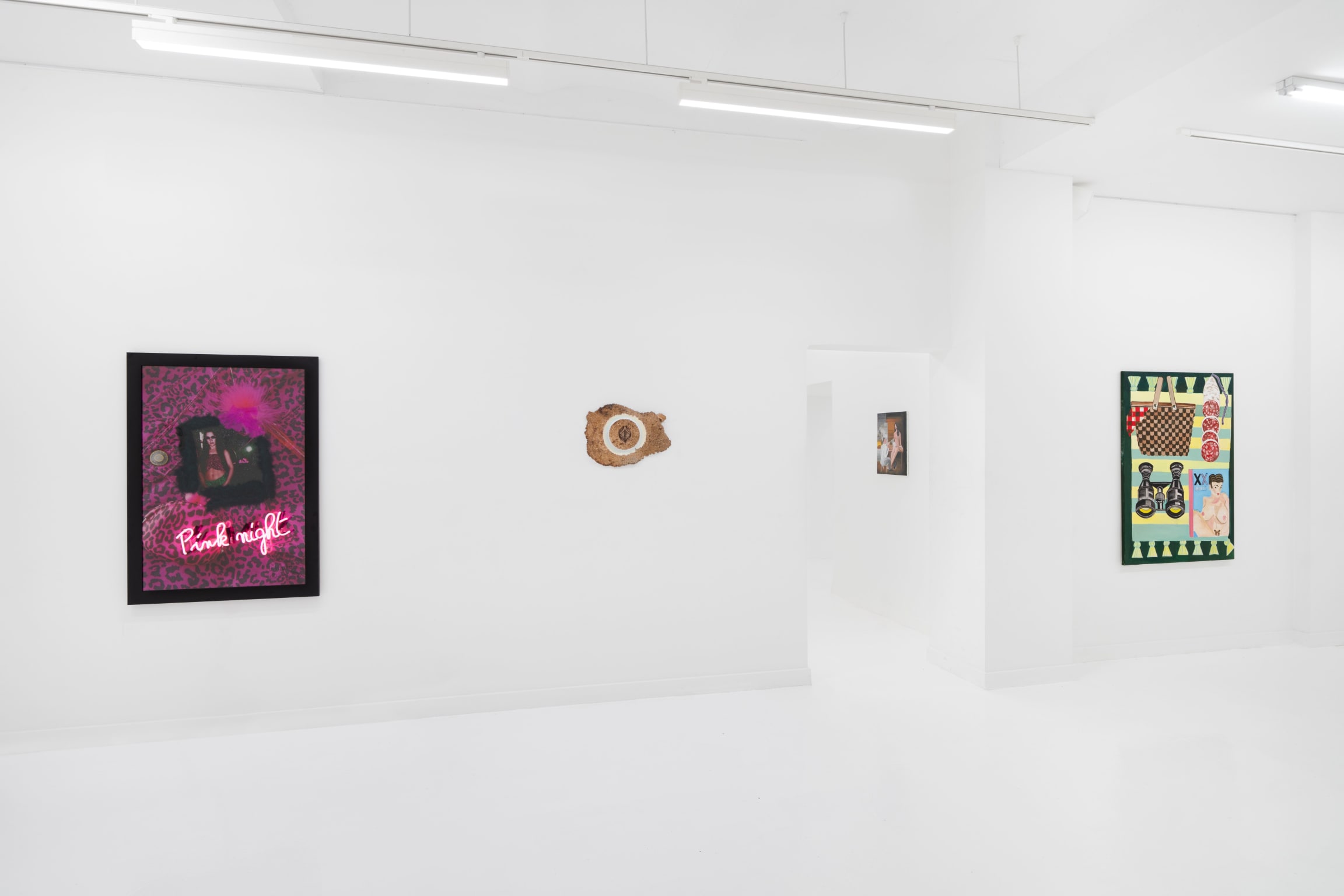
Oh Baby, Barbé
“I like to play with the idea of being perceived, with feminine performative roles and the extent to which Ellie is aware of them. The name Ellie Dolly actually comes from the idea that she is a paper doll, based on the cut-out dolls that often also had the word ‘Doll’ in their names. And there is a subtle nod to my idol Dolly Parton,” she says.
Ellie is an innocent, tragicomic character to whom everything seems to happen. Ellen uses her to express a certain helplessness, as a mirror for how perversely the world looks at young girls and women. “By using a childlike version of myself, I can highlight how wrong that feels for the viewer. I am interested in how identity is formed. That is why I often return to memories from my childhood or teenage years, and why the childlike aesthetic plays such a strong role.”
Gallerist Oliver Barbé sums it up perfectly: “Where does fiction begin and end? With both artists, you sense a lingering mystery. You never quite know where the artistic stops and the personal takes over. And that makes it all the more fascinating.”
This time I am not writing from a distance, but letting you look through my own voyeuristic gaze, to experience their works from within.
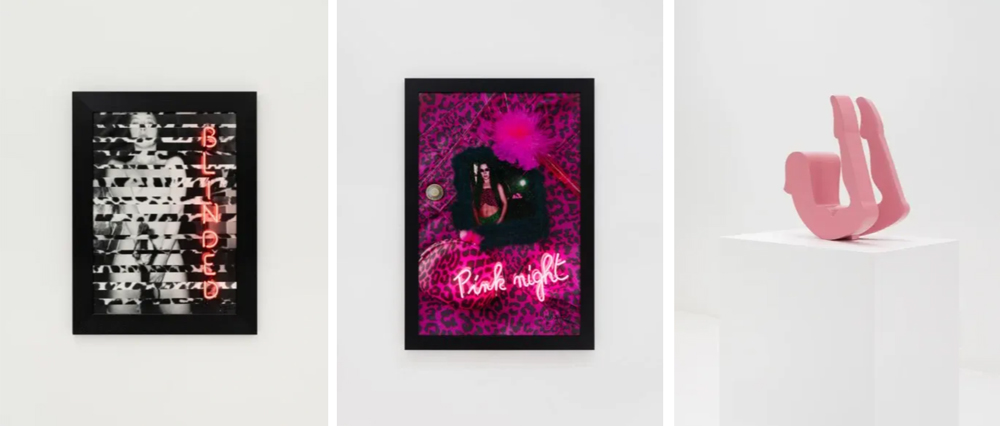
Liliane Vertessen, Blinded, 1983 - Pink Night, 2022 - Pink Bronze Lady, 2022, Barbé
Blinded (1983) says far more than it shows. Behind metal blinds appears a naked woman, but not entirely. Between the fragmented image, pieces of leopard print fill in her body. She seems trapped in a cage, a seductive wild predator hunting her prey. Is she holding an axe? A whip? Is it a sex toy or a body part? The uncertainty provokes an obsessive search for answers. The title speaks volumes: the blinds that partially block our view, but also being blinded by beauty, or by the flash reflecting in the mirror behind her. Uncomfortably, I catch myself filling in the blind spots with my own hungry gaze. Who is really the prey here? Is it me, dazzled and entranced by her stare, her pose, her energy? Or is it her, with me as the predator, driven by the same instinct? I become animalistically aware of the ambiguity between allowing and attacking.
Pink Night (2022) once again shows a young woman in neon leopard print, confidently posing for the camera. The flash bounces sharply in the mirror behind her, exposing the photographer: his outline, his presence close within her space. In the reflection, we see a dance pole, and her arm seems to morph into the leg of a dancer stepping onto the stage. The glitter, the neon, and the pen with pink feathers complete the pop-fetish.
Pink Bronze Lady (2022) reduces the female body to a torso: legs, elegant feet, the graceful, almost impossible bend of a dancer. The woman is beheaded, as if her brains and inner self has been deliberately omitted, leaving only her vital, elegant, flexible body. The title reveals the bronze, yet the material is completely hidden under a pink lacquer that gleams like oil on skin. Monumentality now lies in her petrified performativity.
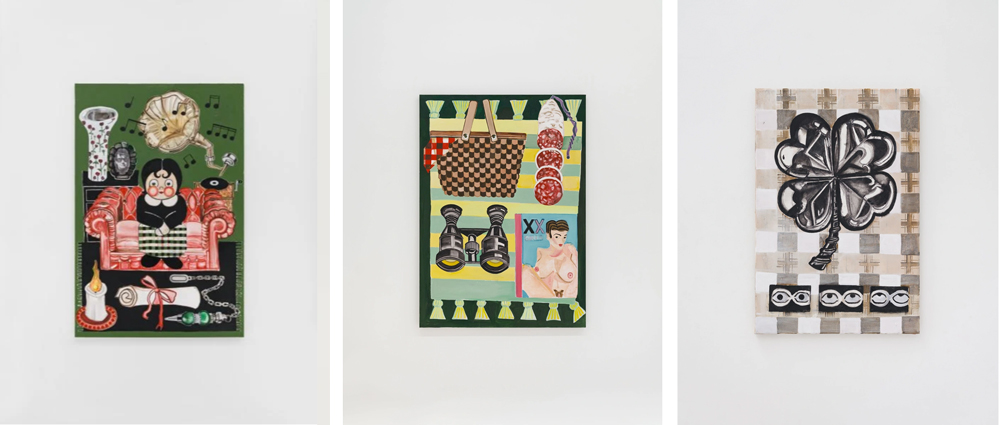
Ellen Dhondt, Roy Orbison, 2025, Picnic Voyeurism, 2025, Clover, 2025, Barbé
In Roy Orbison (2025) Ellen Dhondt’s alter ego Dolly Ellie sits neatly and upright in a leather Chesterfield, her gaze intense. A pose that rigidly embodies the obsessive longing for an idol she does not personally know. Around her lie a pendulum, a rolled-up love letter, a candle burning with desire, and a gramophone that must first be wound before it plays.
In the background stands a photo of her idol, Roy Orbison. The Big O was his nickname, once referring to the initial of his surname and his warm, full voice. But today The Big O inevitably sounds ambiguous, as in popular culture it is also known as the orgasm. Dolly Ellie seems almost hypnotised, absorbed in her longing for an unreachable idol. Is she a young, sweet teenage girl with a childish fantasy, or an obsessive old lady with an innocent blanket over her knees, keeping her desire intimately warm? The confusion seems intentional. Are sexual desires not of all ages?
In Picnic Voyeurism (2025) the sexual charge is most explicitly present. She paints the work from the perspective of the voyeur, someone who secretly peeks. I become aware that I am now that imagined voyeur of the artist, as my eyes rest on the soft-erotic magazine: her full breasts fully in view, her legs opening like the wings of a butterfly, her gaze inviting. The sausage is sliced in a way that feels almost carnal. The picnic basket seems suspiciously to stare back at me.
Someone’s getting lucky tonight in Clover (2025). A cold, gleaming, sterile clover of pleasure coils around a stem of desire. A sequence of eyes rolls back in a visual crescendo of ecstasy. I can’t help but see, in this playful spectacle, a subtle reference to a sculptural sex toy.
For those eager to explore the exhibition: Oh Baby runs until Sunday, 26 October 2025, at Barbé in Ghent.
