23 september 2025, Flor Linckens
Sea Legs: balance and movement in the work of Antonietta Peeters
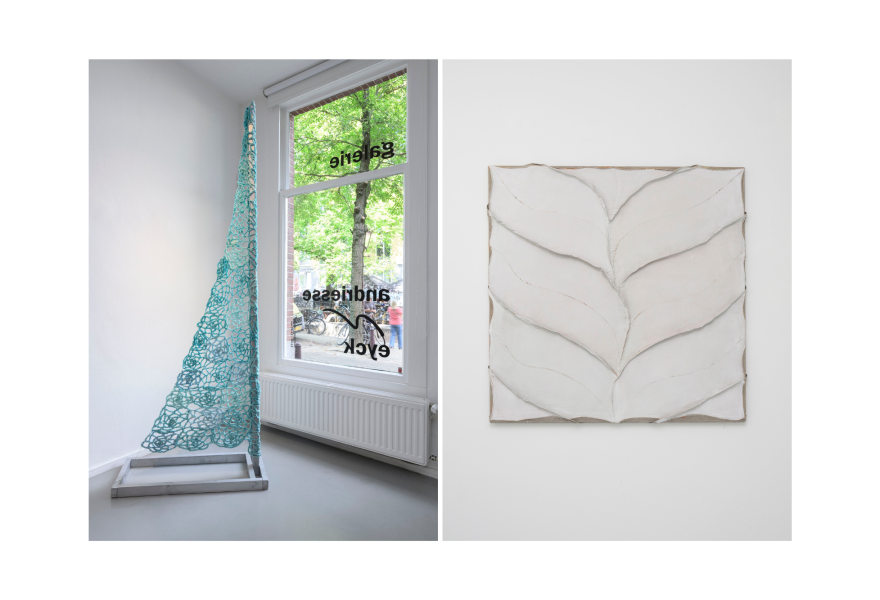
Until 18 October, a solo exhibition by Antonietta Peeters is on view at andriesse eyck galerie in Amsterdam. It explores the full breadth of her oeuvre: from crocheted sculptures to two- and three-dimensional paintings. ‘Sea Legs’, the title of the exhibition, refers to our ability to find balance on a swaying ship. That sense of equilibrium also plays a central role in Peeters’ work: her practice continuously shifts between sculpture and painting, between surface and volume, between order and chance, tangibility and abstraction.
Peeters’ method is characterised by the repetitive nature of crocheting, stitching and painting. She is particularly interested in the physical act, a deliberate and layered process. Time and again, she explores new ways to reconsider material, movement and space. Her choice of materials and the way she applies them function almost like an extra sense, allowing her to probe the possibilities and limitations of form and space.
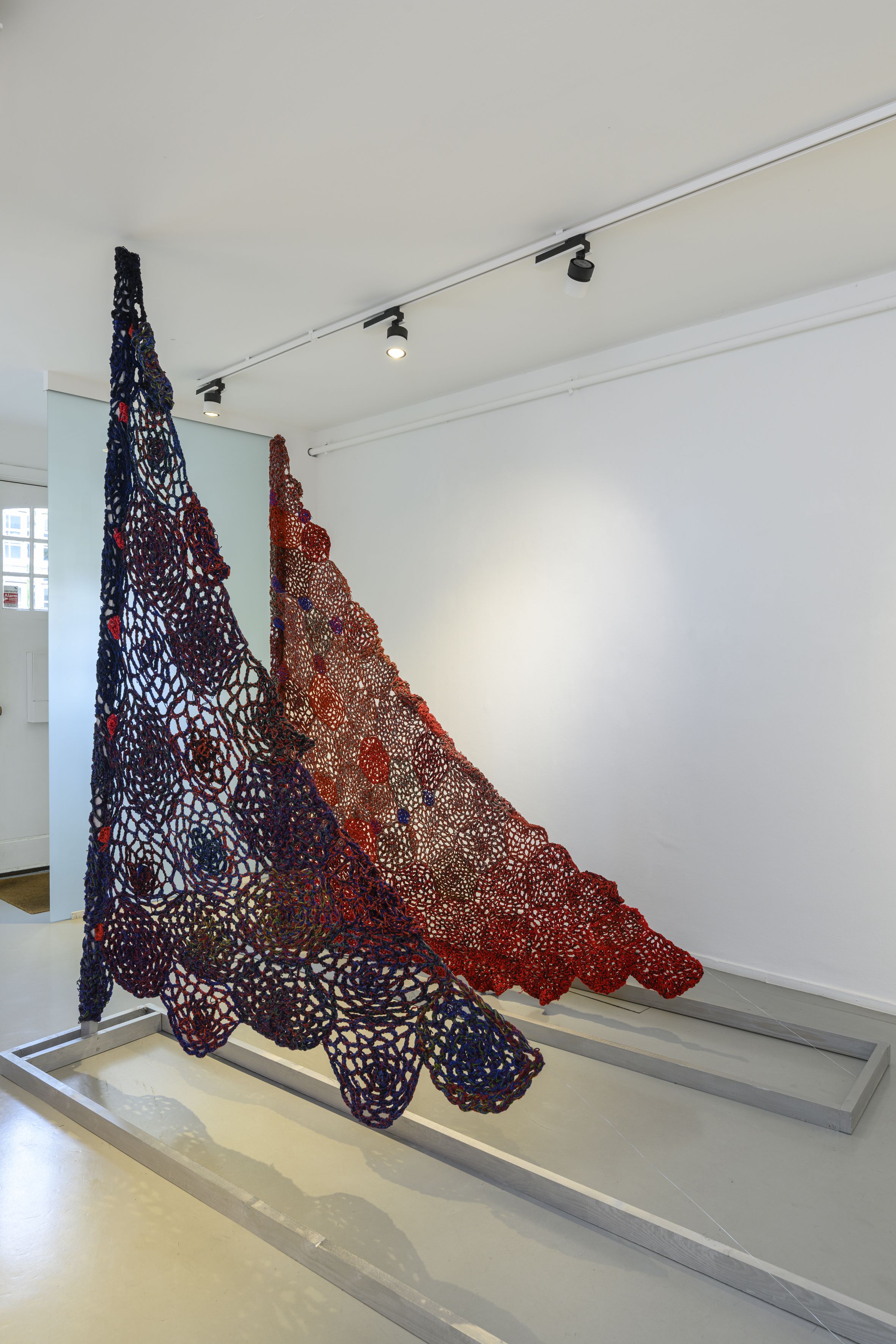
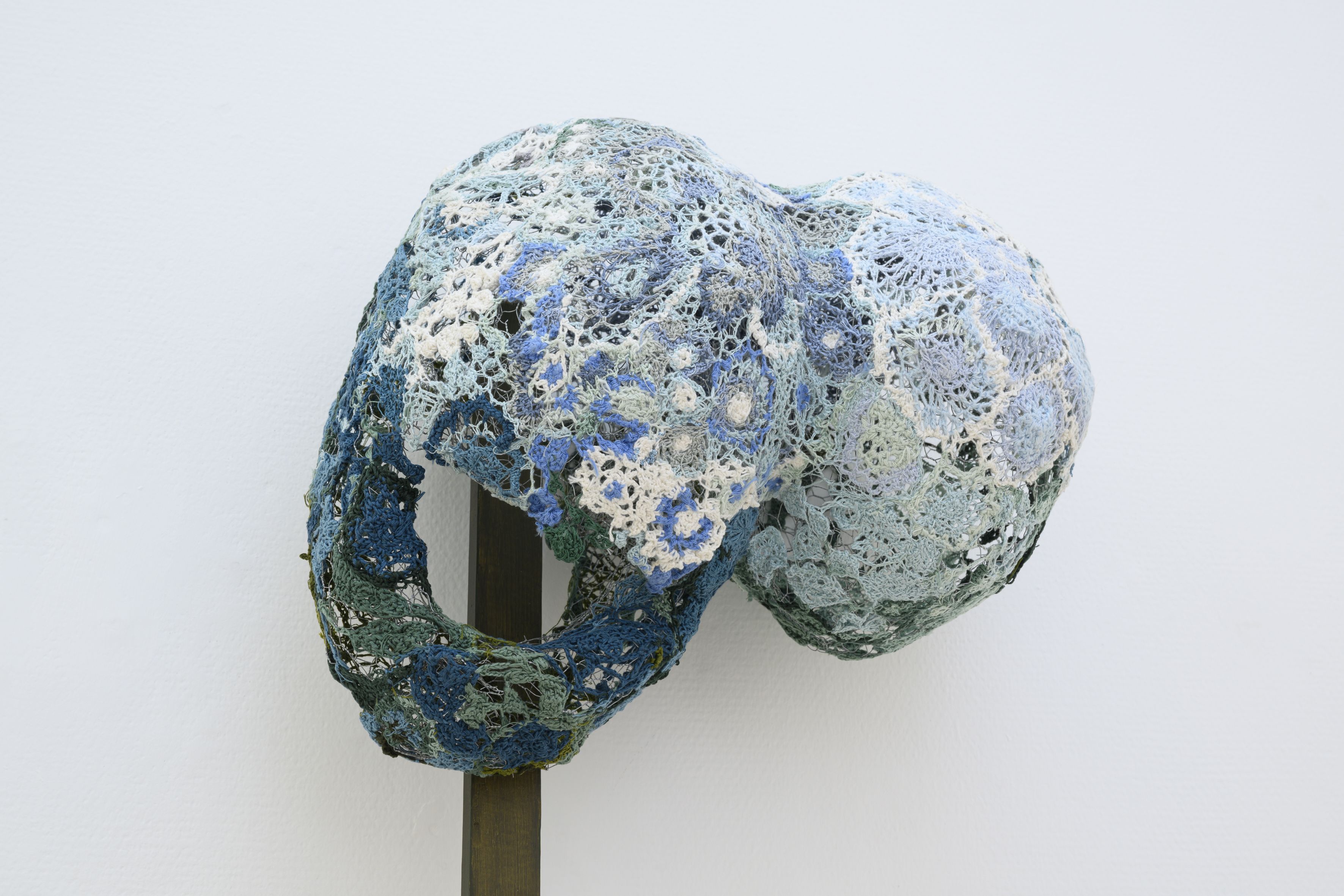
The exhibition space is marked by large, brightly coloured triangles, set up like sails across the room. On closer inspection they reveal themselves as crochet: roughly woven patterns, at times fragile and floral, other times more abstract. The structures seem to suggest movement, as if they could begin fluttering at any moment. But they remain firmly anchored in their wooden frames. Their open pattern allows light and air to pass through, but deprives the sail of its function: to catch the wind. Since her early crochet sculptures, Peeters challenged prevailing ideas about textile art. The Stedelijk Museum Amsterdam underscored their significance by acquiring her life-sized crocheted motorbike. The exhibition in andriesse eyck galerie also presents helmet-like, rounded forms in amorphous objects of thread and wire mesh, organic sculptures reminiscent of glue bubbles, growths or even coral.
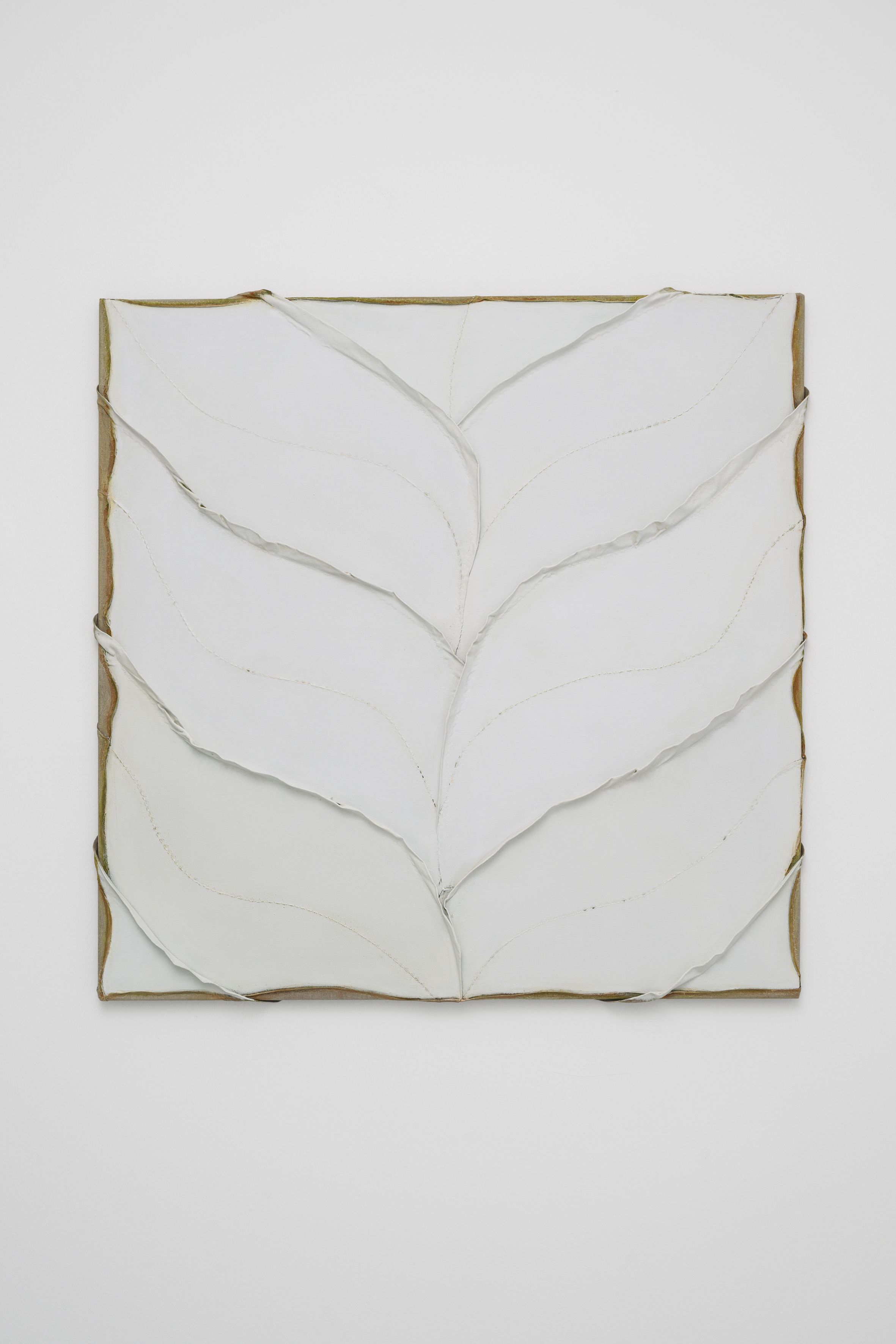
Alongside these sculptures, Peeters presents a series of new paintings, in which she transforms the flat surface into an object. Texture plays a central role here: the linen is stitched with needle and thread into a three-dimensional relief, its taut seams visibly and tangibly present. The artist subsequently applies layers and layers of semi-transparent paint. The seams evoke the veins of a leaf, a fan or rippling waves. Yet it is not the motif that matters, but the accumulation of actions, layer upon layer inscribed in the surface. In doing so, Peeters attempts to capture something elusive, a sense of dynamism, rhythm and resonance that unfolds between object and viewer.
In addition to these object-like paintings, ‘Sea Legs’ also includes Peeters’ flat, semi-landscape works, that oscillate between recognisability and abstraction. Air, water and soil merge, sometimes divided into a grid, sometimes dissolved into colour fields with hues that seem to lack any reference point in reality. They invite the viewer to project their own interpretations onto the image.

Antonietta Peeters was born in Goirle in 1967. She studied at the St. Joost Academy in Breda and continued her training at De Ateliers in Amsterdam. Later she took part in a residency programme at Sundaymorning@ekwc. In 2000, she received the Philip Morris Art Prize. Her work has previously been shown in solo exhibitions at the Stedelijk Museum Amsterdam, Stedelijk Museum Schiedam, the Cobra Museum in Amstelveen, the Van Abbemuseum in Eindhoven and SMAK in Ghent, and in group presentations at Stedelijk Museum Breda, Museum Kunstpalast in Düsseldorf, Kunstmuseum Den Haag and De Vishal in Haarlem. The work of Peeters has been included in the collections of the Stedelijk Museum Amsterdam, Museum Boijmans Van Beuningen, Museum Voorlinden, the Bonnefanten Museum, the AkzoNobel Art Foundation, De Nederlandsche Bank, KPN and Rabobank.
