14 august 2025, Wouter van den Eijkel
Best of Graduates 2025 – In Search of Your Roots
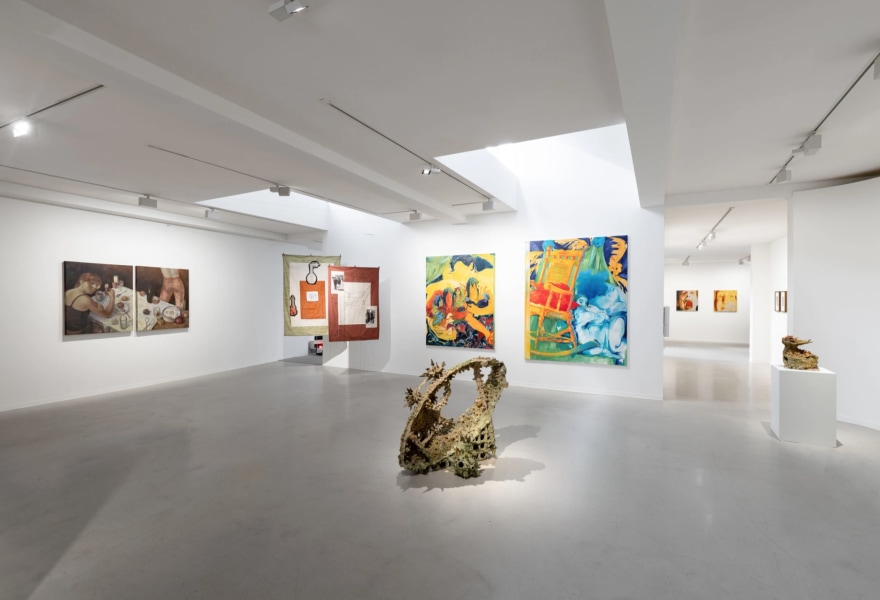
Every summer, Galerie Ron Mandos treats its visitors to an overview of graduation exhibitions from all Dutch art academies. The word ‘treats’ is apt here, as Best of Graduates is nothing less than a gift to those who don’t have the time to visit all the exhibitions. The RM Young Blood Award this year has been won by Mees de Rozario, who graduated from ArtEZ University of the Arts in Arnhem.
Like all previous editions, this 18th edition of Best of Graduates has been curated by Radek Vána. Together with Lars Been and Ron Mandos, he visited all the final exam exhibitions. This year, the show features work by 26 young artists, representing nearly every art academy in the country. Most presentations feature work by students of the Royal Academy of Art (8), followed by the Gerrit Rietveld Academie and HKU (5 each). The remaining academies are represented by three or fewer exhibitors.
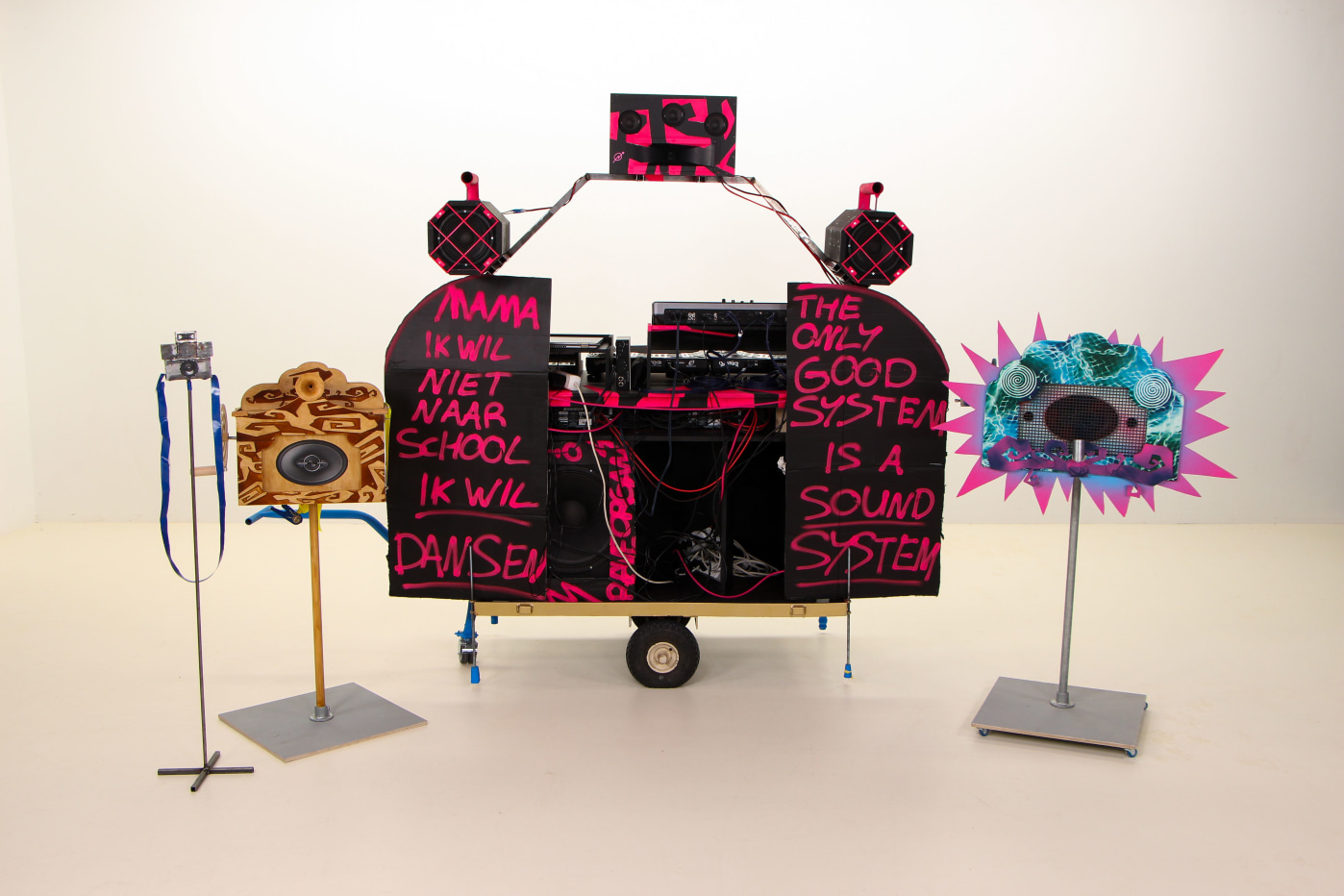
Mees de Rozario | ArtEZ 2025 | The Tekno Street Organ Cart, 2025
The winner of the RM Young Blood Award, Mees de Rozario, graduated from one of the academies with three participants: ArtEZ University of the Arts in Arnhem. On entering the gallery, you immediately encounter his Rave Organ. The organ is not based on church organs, but on another quintessentially Dutch phenomenon: street organs. The Rave Organ has roughly the same shape and is also mobile, only the colour scheme is different—black and fluorescent pink and purple—and, importantly, the music is techno instead of sentimental ballads.
The work is playful and humorous—with slogans like ‘the only good system is a sound system’—but at the same time raises essential questions about our use of public space. Who actually owns it? Who is allowed to make noise and who decides? What kind of music is acceptable in public space? Is rave really more offensive than a sentimental song?
Curator Radek Vána explains that De Rozario’s organ aligns with a trend he noticed during his visits to the presentations. “This year, we saw a lot of work dealing with cultural background, i.e. the roots of the participants. They managed to combine these with personal matters and, more importantly, translate them effectively into a visual form.”

Anthony Chiou | HKU 2025 | Windows to the inside, even zielige ziel, 2025
Also in the front room is work by Anthony Chiou (HKU). His paintings, based on photographs and memories from Suriname (the country of his childhood), are intuitive in nature. Figures are hunched, stretched or part of something larger. The result is a mix of memory and imagination. His paintings reflect his background, combining different heritages and cultures with his own twist to create something new and personal.
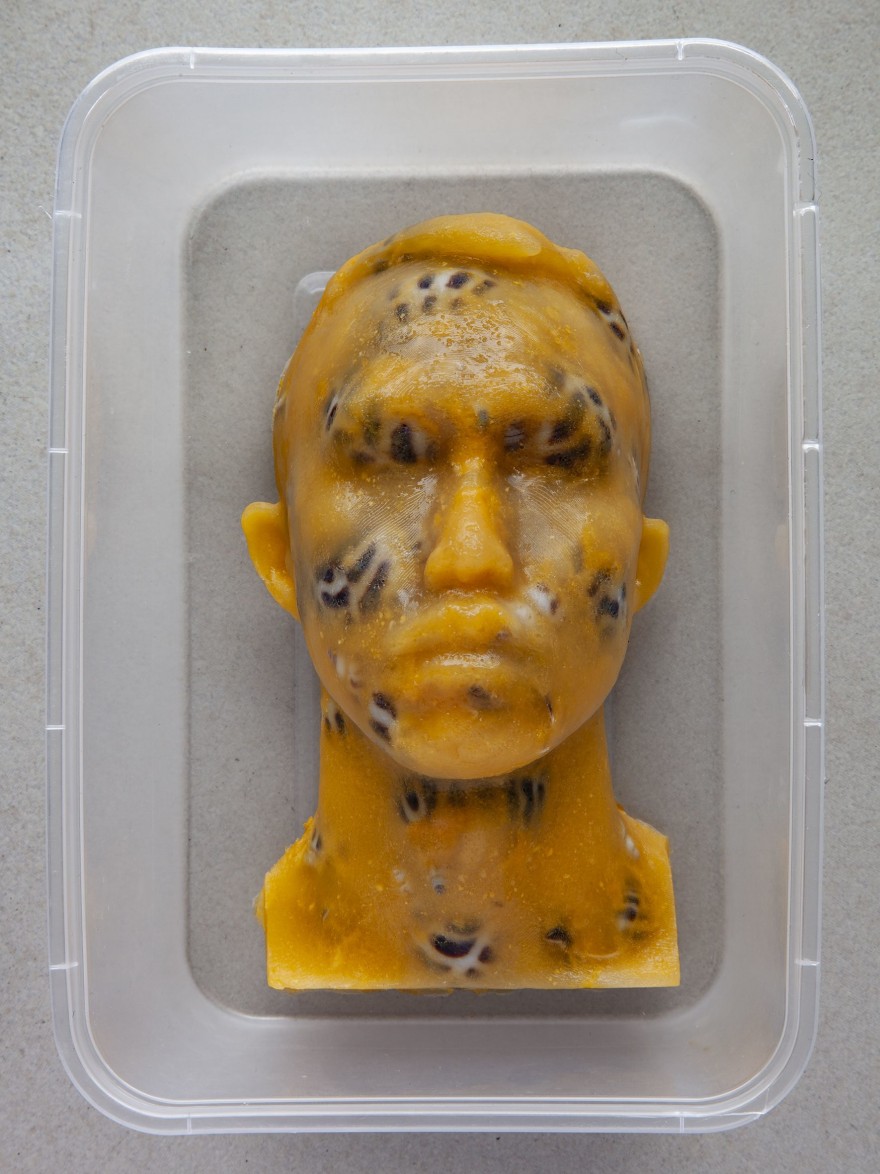
Dang-Vu Dang | GRA 2025 | Ốc Hương trứng muối / Snail in salted egg sauce, 2025
Contemporary Arcimboldos
The work of Đặng-Vu Đặng (Rietveld Academie) also addresses origins. In his series Serving FACE, each photograph is a self-portrait constructed entirely from a Vietnamese kitchen. They are a kind of contemporary Arcimboldos, functioning as a personal and cultural archive in which food, family and self-representation come together.
Vána comments, “From the precision with which Đặng has created and photographed his self-portraits, you can still see a bit of his professional background. He has worked as a dentist for the past 10 years and has completed the Doc Time programme.” The growing collection now contains more than 50 self-portraits.

Pip Greenaway | KABK 2025 | Prologue-Too Much To Swallow, 2025
Oozing with class
Other rooms in the gallery also reflect on the current times. Particularly striking are the performance video work of Pip Greenaway (KABK) and enigmatic spoken-word art of Rover Indigo Bertels-Andréa (GRA).
In the video work Prologue Too Much To Swallow by Pip Greenaway, we see the artist in close-up against a black background as she becomes increasingly soaked by artificial rain. All of this is in slow motion. It’s the kind of rain and visual language we see in perfume commercials and the video comes across as highly professional and stylised—and is oozing with class.
But the thematic and societal critique becomes patently clear when you watch the work for a longer period of time. Those who take the time realise that it’s not just a beautiful image—the protagonist gradually becomes more uncomfortable. Prologue is a critique of our consumer society: if we continuously consume, moving from one purchase to the next, aren’t we eventually on the menu to be consumed?
As the name suggests, Prologue Too Much To Swallow is part of a larger presentation that will be shown in full in the gallery at a later date.

Jip Schalkx | KABK 2025 | Cloud 9' #4, 2025
Jip Schalkx (KABK) also addresses a highly current theme: social contact in the age of social media. In her video installation 4ever &ver &ver, a group of teenage girls lie side by side in a large bed, each wearing earbuds. Although they share the same space, each girl seems absorbed in her own world, highlighting the tension between togetherness and isolation in an era of constant digital connectivity.

Rover Indigo Bertels-Andréa | GRA 2025 | Illustratie, 2025
That it’s also possible to bypass the dominance of social media is demonstrated by Rover Indigo Bertels-Andréa. He uses the rather archaic medium of radio to tell a story that never quite seems to begin. As a listener, you hear only comparisons between indigenous flora and the most varied concepts. At first, it seems like a kind of premodern science: “The snowdrop stands for happiness, cornflower for appearance and large thyme for steadfastness.” But the subjects gradually expand into the recent past: “The daisy stands for the Netherlands, yarrow for history and the aster for the colony.”
All of this is read aloud in a tone suggesting factual reporting, reminiscent of how river water levels used to be announced. It’s a kind of post-apocalyptic iconography broadcast over shortwave, like the pirate radio stations of the past.
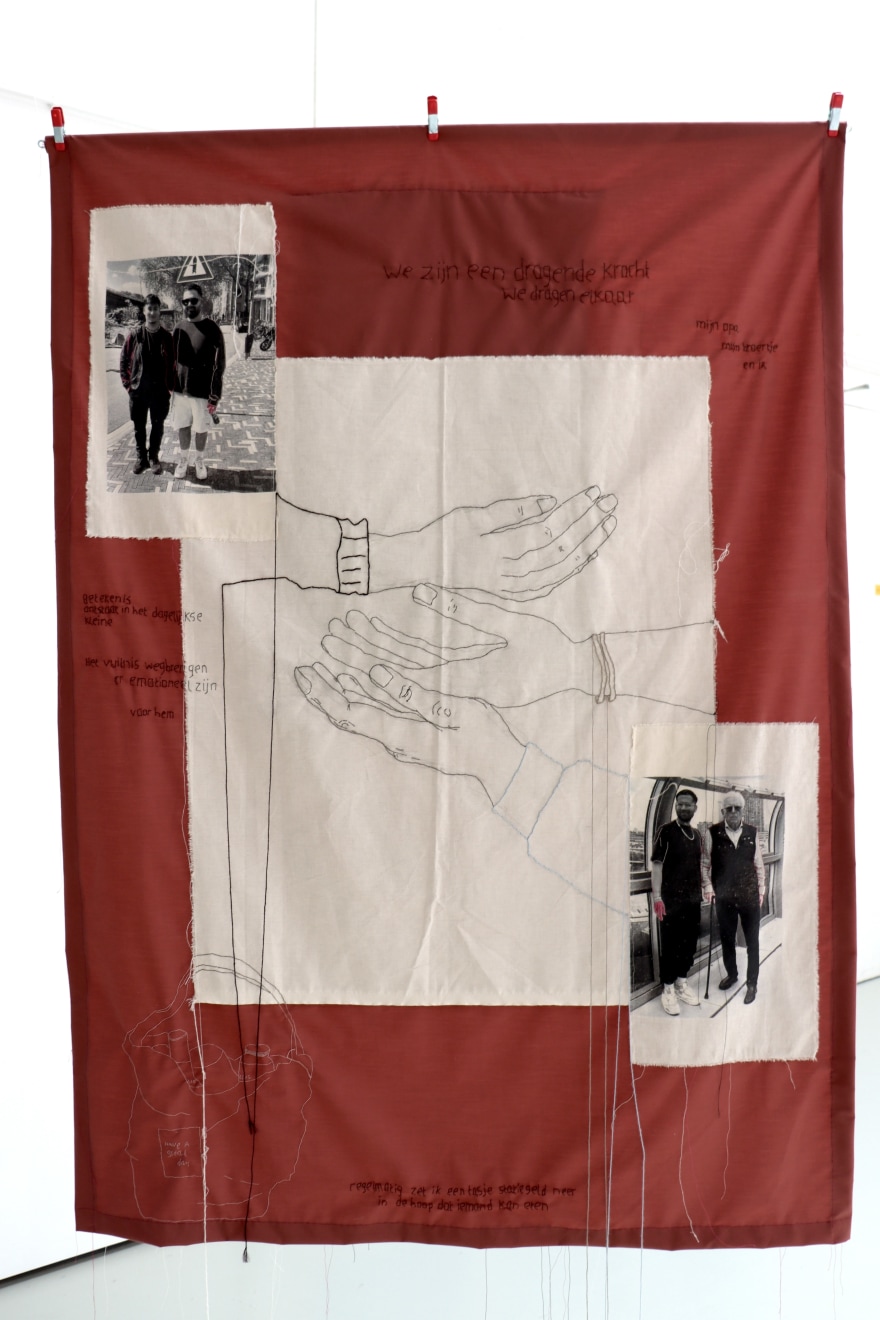
Dieuwke Oosterbosch | ArtEZ 2025 | Gifting Fabric Sem 08_06_25, 2025
We Do Care; Gifting Fabrics by Dieuwke Oosterbosch (ArtEZ Arnhem) is an ongoing project in which she explores the act of giving as a way to create connection. In personal one-on-one conversations, Oosterbosch asks participants a simple question: “If you could give something to someone or to a place, what would you give?”
The answers form the starting point for her hand-embroidered gifting fabrics, which the recipient is allowed to keep. Normally, this work is not for sale to individuals, but for this presentation is available—though only to institutions. “It’s something that our times really need,” says Vána. “The academy in Arnhem is known for its engagement and Dieuwke manages to maintain a human scale in her work.”
On Friday 29 August, Alderman for Art & Culture Touria Meliani will be presenting the Best of Graduate Awards. Đặng-Vu Đặng will also be performing with his edible self-portraits during the event. The ceremony starts at 5:00 p.m.
