08 august 2025, Wouter van den Eijkel
The studio of... Tomáš Libertíny
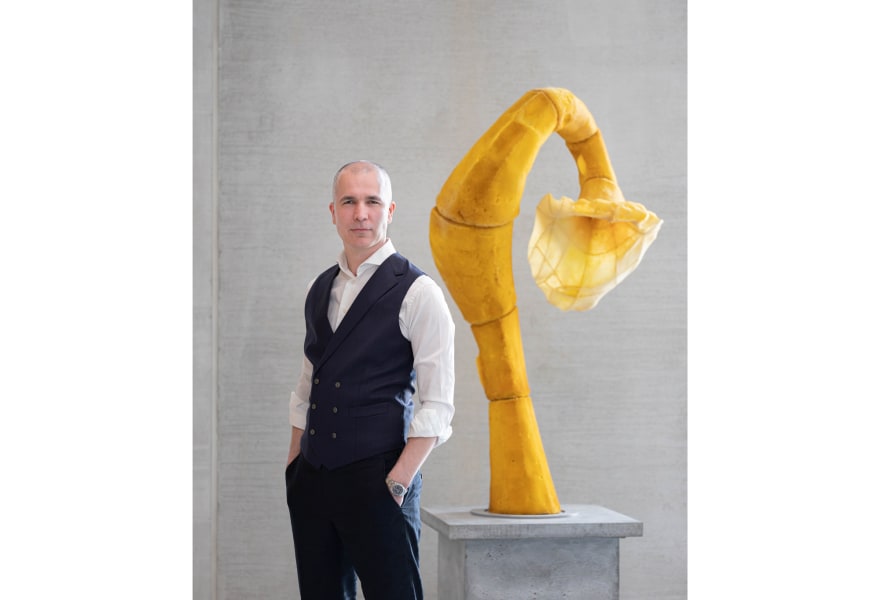
During the summer, lots of galleries close their doors to enjoy a well-earned holiday. But museums stay open, so this coming month, we’ll be focusing on artists with museum exhibitions. In this edition of The Studio of: Tomáš Libertíny.
This Slovakian artist is building a unique body of work consisting of sculptures made from beeswax. He collaborates with various bee colonies for his creations. In addition to a studio in the centre of Rotterdam, he also has two apiaries, one in Overschie and one in Slovakia.
Work by Tomáš Libertíny is currently on display at Museum Kranenburgh. The exhibition is titled For Eternity, a reference to the stability of beeswax. We spoke to him about his studios, working methods, personal growth he experienced working with bees and the exhibition in Bergen.
In addition, work by Libertíny can be seen until the end of August in the group exhibition We are nature at Singer Laren. Work by Libertíny is also on display at the Depot @ Lakeside Collection “Harvest” Exhibition until the end of October. Tomáš Libertíny is represented by Galerie Ron Mandos.
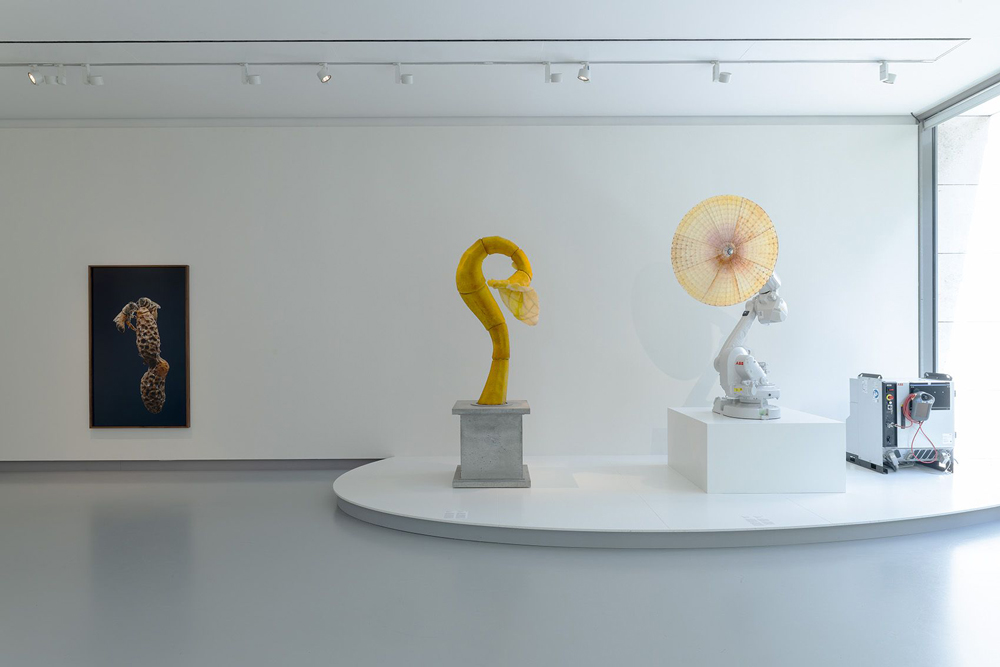
Tomáš Libertíny, For Eternity, Museum Kranenburgh. Photo © Michel Claus
As I understand it, you work at multiple locations.
Yes, I have a large studio in the former post office in Rotterdam close to the central railway station. I’ve had that space for nearly 18 years. People know me for my work with bees, but I also paint and do photography. This studio consists of several rooms, allowing me to do all those things and also experiment with new materials.
Initially, I worked with beekeepers in the Netherlands. I asked them if they wanted to help me with my work. They were a kind of friendly favors. To increase production, I started a beekeeping business in Slovakia seven years ago. With the wax I first received, I could only produce two sculptures per year. That year I spoke with Ali Keles of the Lakeside Collection, and he asked me why I hadn’t started an apiary here in Rotterdam. Together with him, I started a second bee farm six years ago in Overschie, near the airport. We have a full-time beekeeper so that the bees are happy and the collaboration goes well.
It sounds like the perfect studio setup.
Yes, it’s a wonderful space. Unfortunately, the lease is ending soon, so I’ll have to find another location. I don’t really want to leave, but I’ve heard that the building is being considered for redevelopment. I’m grateful for the opportunity to have worked in the city centre for so long. It will be an exciting challenge to find and set up a new studio.
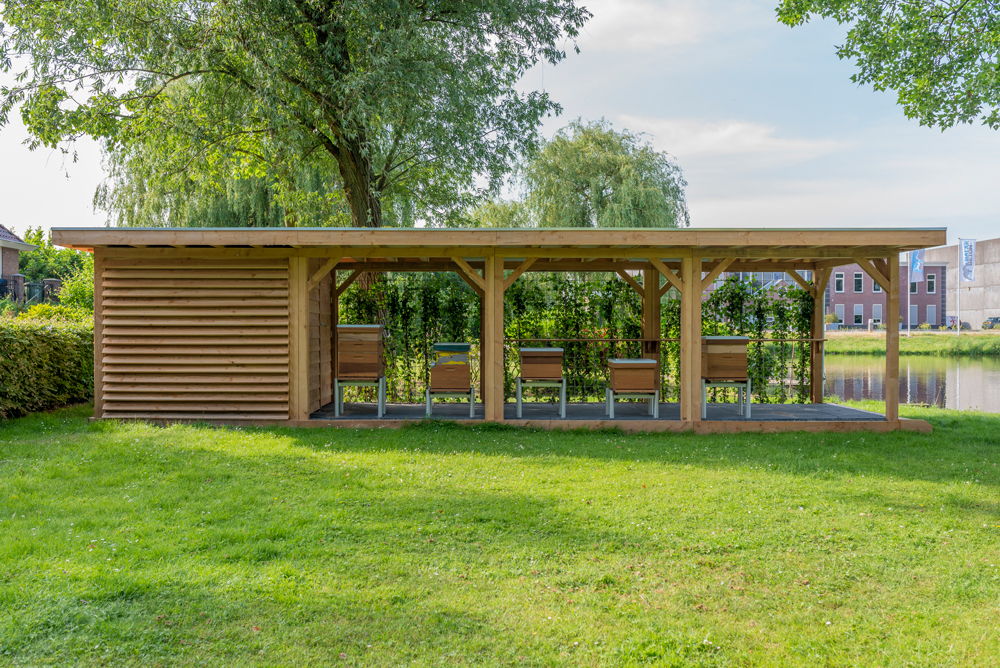
Lakeside Bee Farm. Photo © Studio Libertiny
How did you end up working with bees and beeswax?
Reading Dostoyevsky’s The Brothers Karamazov played a key role in this. I love reading and when I was in my early 20s, I came across lots of references to the book in other literature. I felt that I was ignorant for not having read it. So, I read it. It starts with an introduction in which Dostoyevsky pleads with the reader to stick with the story until the end because only then would it be possible to understand why he chose the youngest brother, Alyosha, as the hero. Alyosha is not only the youngest, but also the least remarkable, a bit dull and the most sensitive. That sensitivity allowed him to recognise danger more easily, making him adaptable and resilient.
For my work, I wanted to choose a similar type of hero—something that never gets attention, like beeswax. It has always been used to preserve fragile things. In Egypt, for example, tombs have been opened in which honey has been found that still edible because it was sealed airtight with beeswax. Beeswax was also used to create moulds for bronze sculptures, but never as the subject itself. Yet it is incredibly stable—as long as it isn’t exposed to major temperature fluctuations.
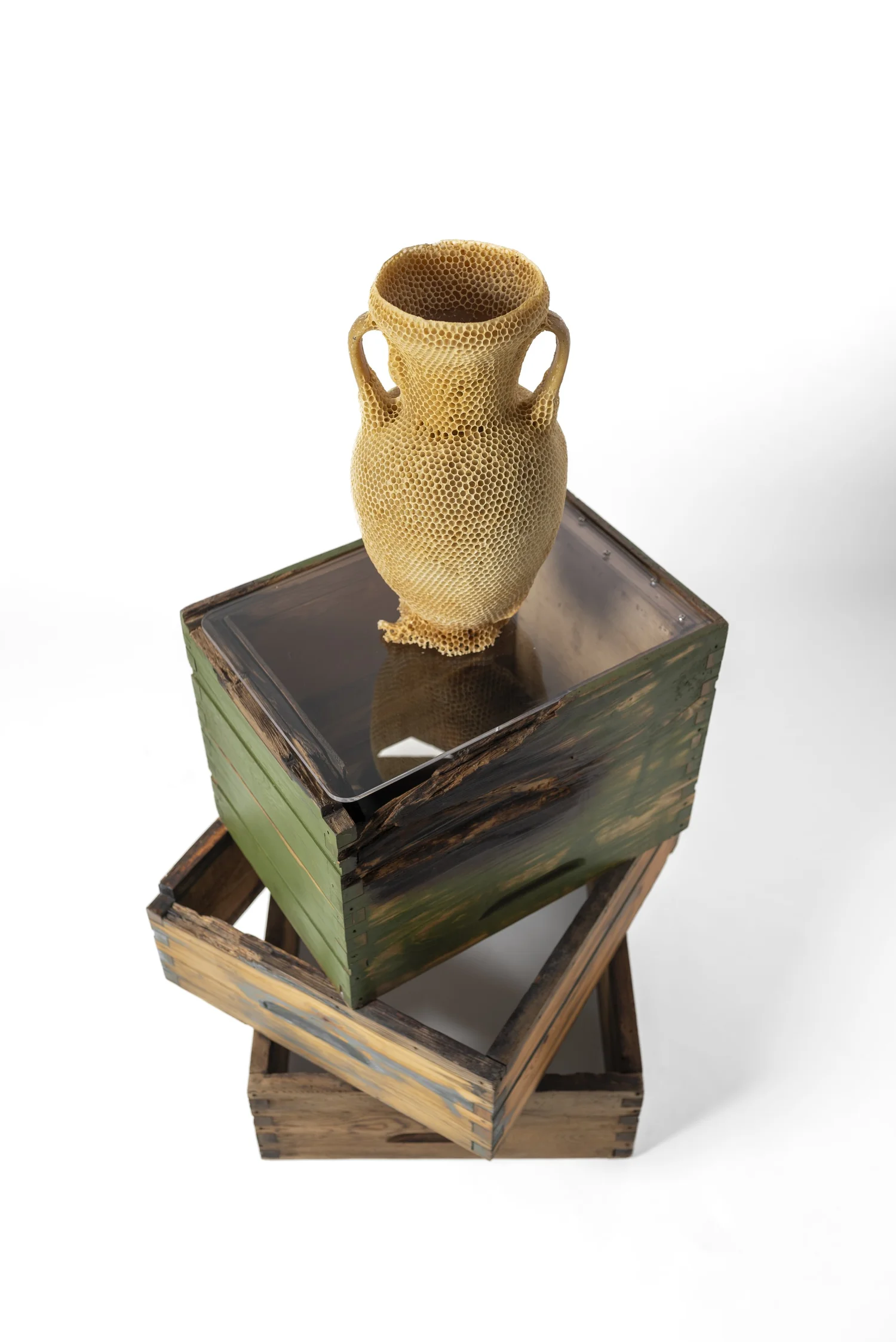
Tomáš Libertíny, The Honeycomb Amphora I. Year: 2020. Dimensions: 47 x 42 x 147 cm. Materials: natural beeswax, museum glass, wood, re-used beehives. Photo © Titia Hahne
You are educated as a painter, sculptor and designer and graduated from the Design Academy, all fields in which control is important. Isn’t it hard to work with bees, which simply do their own thing?
Absolutely. Control is a recurring theme in my life. I’m the son of an architect and science historian, two fields with little room for interpretation. My instinct was to control my environment, from relationships to friendships, and definitely my work. When I started studying, I leaned toward conceptual design because design is more socially responsible. Design serves society, while contemporary art is often a mirror of the maker.
Working with bees turned out to be a godsend. I discovered it by chance, but grew more quickly as a person because of it than I would have otherwise. Letting go was both a selfish act—because it helped me personally—and a collective one, because I became part of nature again and had to embrace cooperation with the bees. It shaped me into the person I am today.
How would you describe your collaboration with the bees?
I sometimes describe it as being a conductor of an orchestra. I don’t play any instruments personally, but coordinate the music. That requires a deep understanding of the beehive, which involves a lot of research. You might also compare my method to that of bonsai masters. Shaping a bonsai tree takes a long time and they merely guide the process. If a branch grows out of proportion, they prune it. I only intervene when necessary, trimming the honeycomb only if the sculpture becomes disproportionate. I simply steer the bees in a certain direction. I open the hive only when needed. With the sculpture of Nefertiti, for example, I trimmed down an overly large nose.
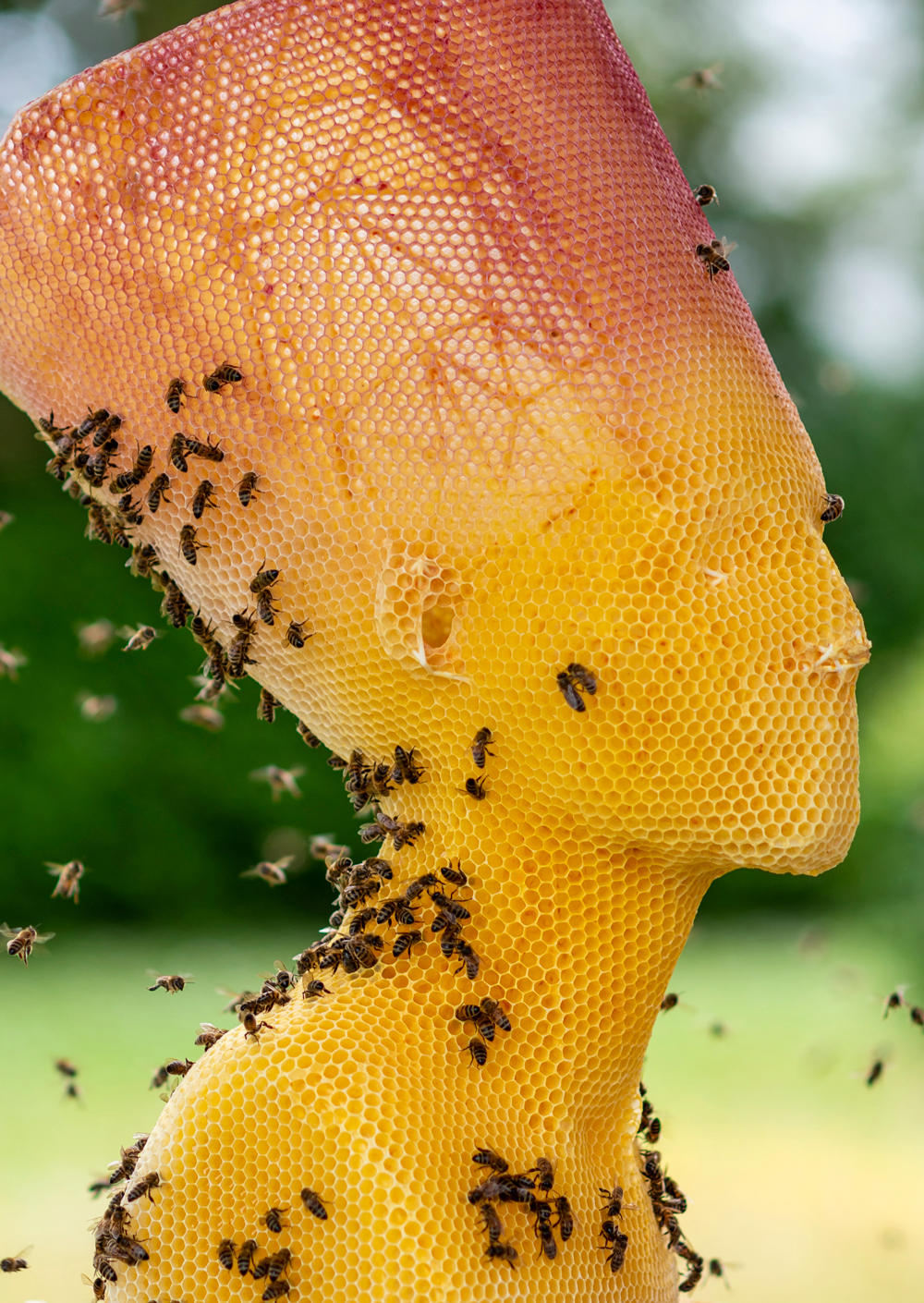
Tomáš Libertíny, Eternity (a.k.a. Nefertiti) Year: 2022. Materials: beeswax, composite, wood, glass, ,metal. Dimensions: 240 x 360 x 500 mm (head). Collection AkzoNobel Art Foudantion. Photo © Studio Libertiny
You just mentioned your version of the famous bust of Nefertiti. It’s one of your best-known works and is part of the Kranenburgh exhibition. How does a sculpture like that come into being?
I get that question a lot and honestly, it’s both a blessing and a curse, really. Nobody ever asks a painter how they paint a painting. At the same time, it's what draws people to my work—after all, without sounding arrogant, my method is unique.
I noticed that when bees search for a new home, they temporarily settle between the branches of a bush or tree. These branches form a kind of network between which the bees build honeycombs. I mimicked that network structure for the Nefertiti sculpture. It was the first 3D-printed framework I created. It was commissioned by the Kunsthal and had to be perfect since the original is so iconic. It’s a tribute to the original bust. At the same time, because Nefertiti was a queen, it is a tribute to the queen of the beehive and thus to Mother Nature.
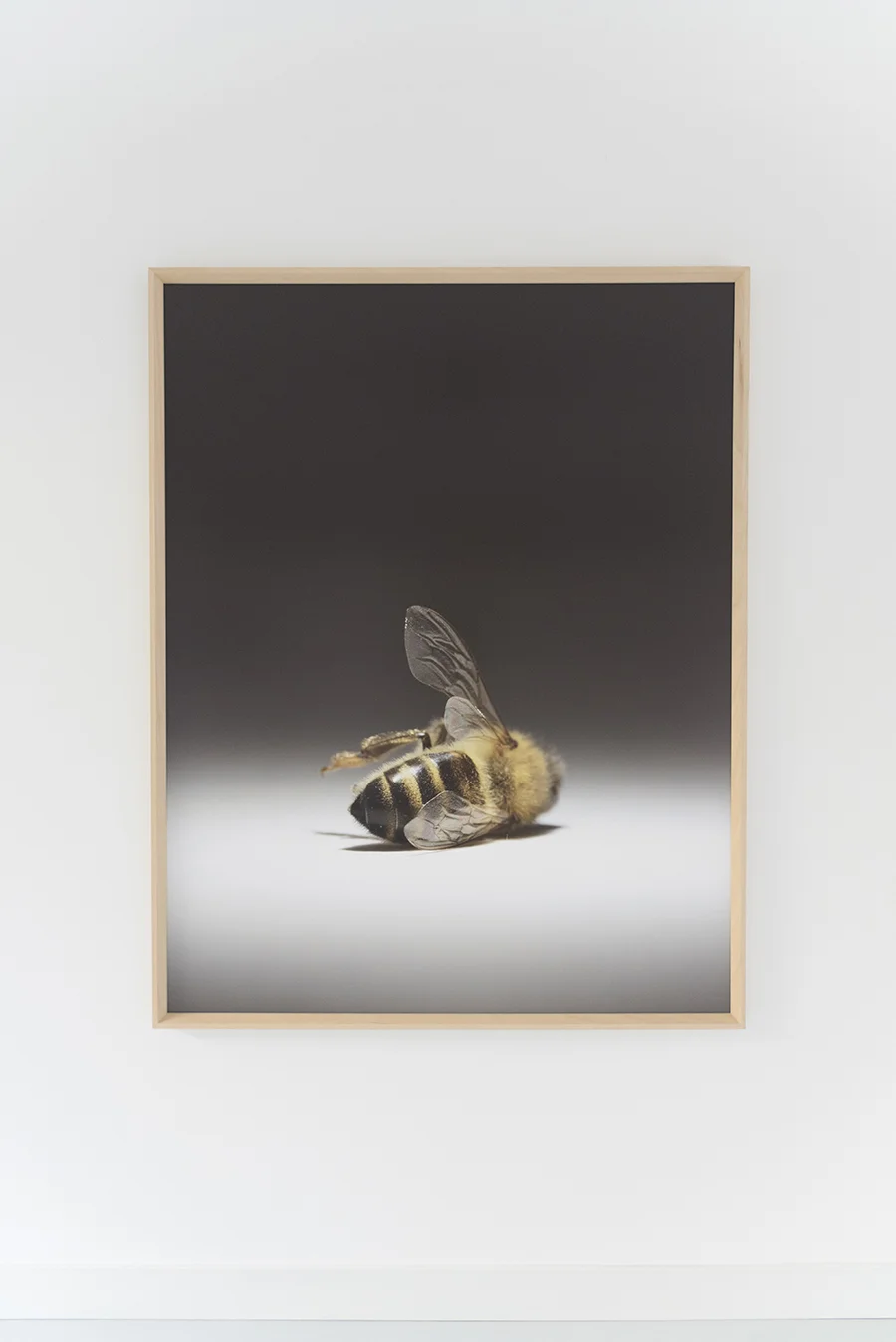
Tomáš Libertíny, Martyr. Year: 2017. Materials: Digital print on Canson Platine Fibre Rag,310grams, framed and mounted on 2mm Dibond. Dimensions: 165 x 128 cm. Edition: 3 + 2 APs signed. Photo: Studio Libertiny
The exhibition opens with the photographic work Martyr, which depicts a dead bee, its face turned away. The photo is large, measuring around 160 x 130 cm. Like the Nefertiti bust, Martyr references a famous artwork: The Death of Marat by Jacques-Louis David (1793).
I love painting, especially historical works. There are several versions of The Death of Marat. It’s not a portrait in the traditional sense, but more like a news or police photo. Many versions exist because Marat was a well-known revolutionary. A year after the murder, David painted two versions and was the only one who didn’t depict the killer.
In the painting, there’s hardly any blood. Marat’s arm hangs down from the tub, eyes closed, holding his final words. The French revolutionary Jean-Paul Marat (1743–1793) had a skin condition that forced him to bathe often—the bath was effectively his office.
It’s not a bloodbath, because that would distract from the main theme: sacrifice for the community. Bees do the same—for their colony and for all of us. In my picture, you don’t see the bee’s face. This one bee represents all bees. The bee is not damaged—just like David’s painting, my photo looks peaceful. I don’t wag my finger or try to induce guilt.
Last question: is there a bee-related project you’d still like to carry out?
I’d love to one day reverse the process and invite the bees to design architecture. Usually, I create the sculptural form and they fill it in, but it could work the other way around. I’d love for them to design a pavilion—on their scale, of course. I’d then scan it using a CT scanner and print it out, allowing us to build it larger in other materials. The honeycomb uses minimal material to achieve maximum strength. This would be my Sagrada Família.
My dream is to have it placed in the Serpentine Pavilion—but that’s temporary. I’d prefer a permanent structure. I envision a serene, sacred space, a place for contemplation that celebrates the restoration of our connection to nature.
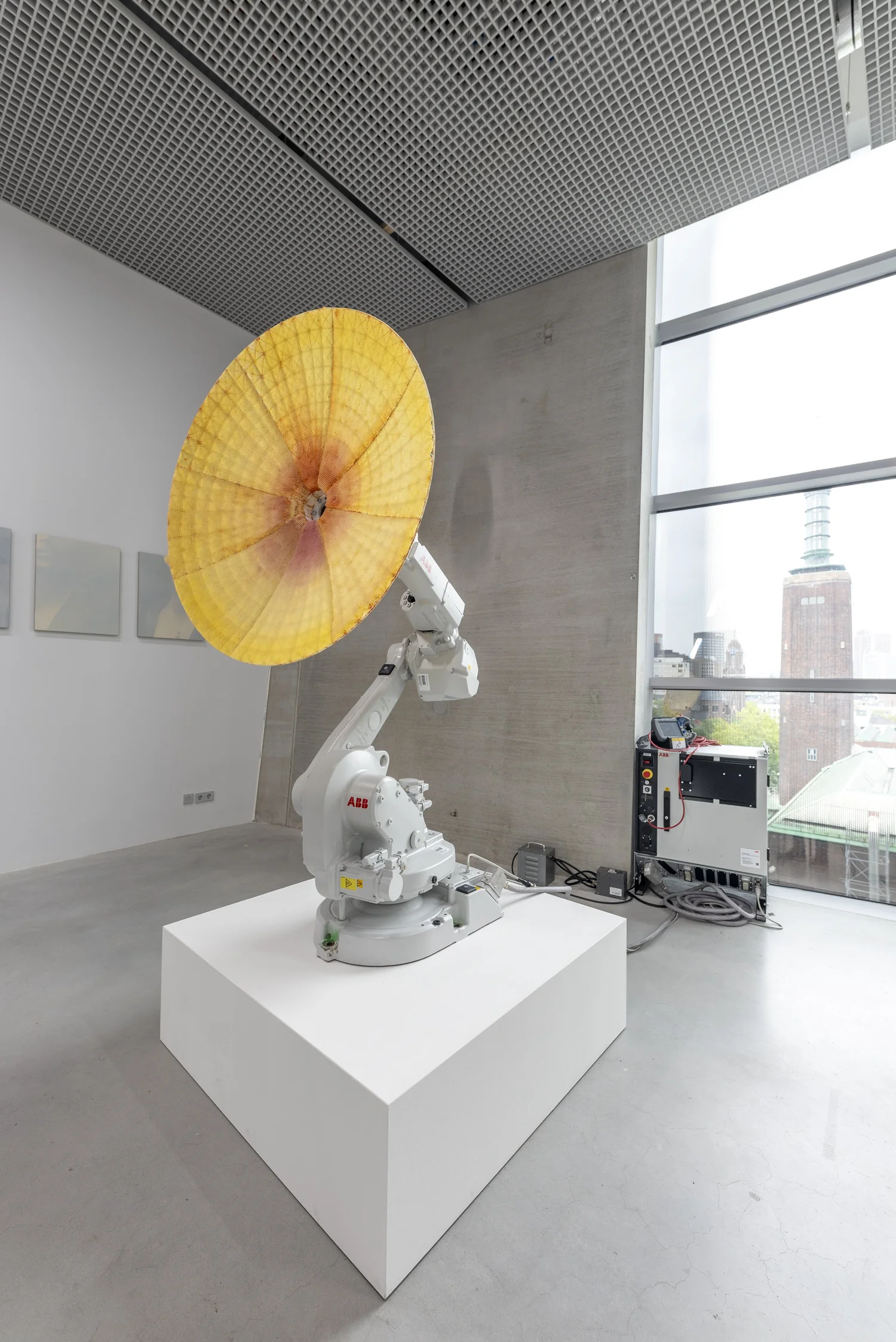
Tomáš Libertíny, S.O.S. (Bee Satellite) Year: 2024. Dimensions: ø 100 cm (dish), installation varies in size (kinetic). Technique: made by bees. Materials: natural beeswax, metal, PA. Photo: Studio Libertiny
