14 may 2025, Yves Joris
Why cauliflowers appear in the work of Mathieu V. Staelens
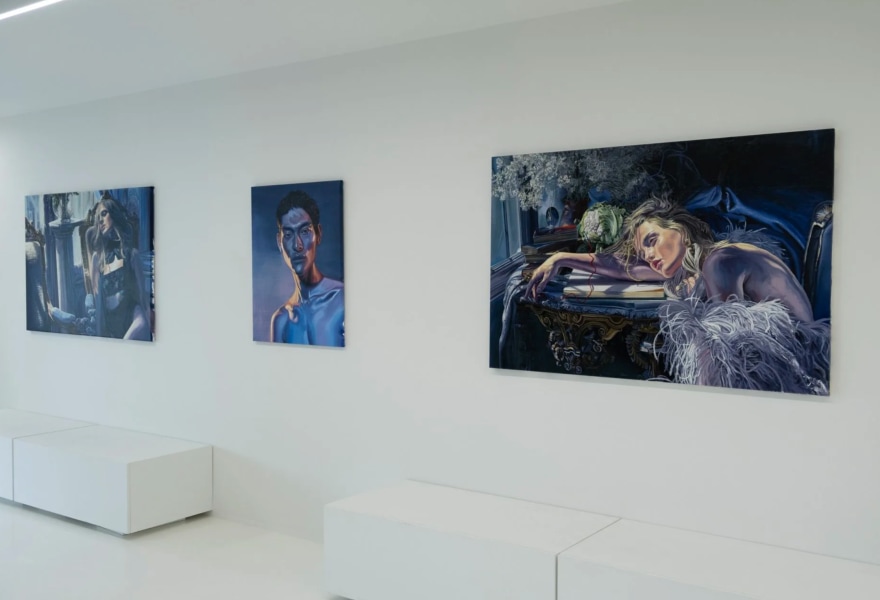
Mathieu V. Staelens’ art is not a superficial aesthetic nor visual bravado meant to seduce or impress. It is an open wound, a mirror without varnish. In his latest exhibition Inner Struggle is relatable, Perfection is not at Art Partout, the artist offers us a visual language that vacillates between vulnerability and awareness.
This is not art to casually stroll past, but work that invites us to stop and to keep feeling. What follows is not a classical review, but a philosophical musing on art, an attempt to approach this inner struggle in words without pinning it down.
The cauliflower as an oracle of the unconscious
That a cauliflower would emerge as a leitmotif in Staelens’ oeuvre may at first seem like an ironic pun. But anyone who delves into the deeper meaning of this motif quickly realises that it is a loaded symbol. The cauliflower, Staelens writes, has something cloud-like about it, something fragile and detached. He compares it to a resting skull. It evokes the womb — a sense of safety, protection and perhaps also the origin of inner conflict.
In the same personal exhibition text, the artist refers to a surprising literary discovery. The cauliflower symbolises “the pure emotion over one’s own existence”. The cauliflower is not a visual joke. In this work, it becomes an icon of introspection, vulnerability and connection. That Staelens turns to such an image points to a longing to touch something universal through the everyday.

Mathieu V. Staelens, Catalyst to Cultivate Loyalty to your higher Self (Post-woke Clarity), 2025, Art Partout
The struggle behind the struggle
The exhibition title Inner Struggle is relatable, Perfection is not captures the essence of the project in an almost poetic way. We all recognise this struggle. We know what it feels like to be torn, to fall short, to doubt. But perfection? That’s an abstraction — almost inhuman and unrelatable. And therefore a form of violence against the vulnerable within ourselves.
Staelens’ canvases visualise this inner struggle, not as dramatic spectacle, but as a slow erosion of self-image. The figures in his paintings do not appear broken, but stripped of their pretence. They exist in a transitional state between insight and acceptance, between disorientation and regained balance. We recognise the outlines of the human brain, of vegetal structures, of breathing landscapes. The paintings become almost like MRI scans of the inner world. Not as diagnosis, but as recognition of what lives within.
Post-woke and the ethics of inner work
Staelens introduces the concept of ‘Post-Woke’ in his work. According to him, this does not reject the core values of the Woke movement, but embraces the original call for awareness, justice and unmasking of power. But he is critical of how the movement has at times become a caricature of itself: in hollow dogmas, rigid moral stances and a lack of nuance.
The Post-Woke individual is someone who is not only aware of injustice, but also of their own inner contradictions, who does not project the moral struggle outward, but first engages with it internally. For, as Staelens aptly puts it, “The distance to the other is directly proportional to the distance to ourselves.” Herein lies a deep ethic, harking back to Socrates’ ‘Know thyself’, but also to the mystical tradition in which self-knowledge is a prerequisite for a loving connection with the world.

Mathieu V. Staelens, The Transposition of Tolerance for your Unique Authenticity (Post-woke Clar, 2025, Art Partout
Painting transformation
Staelens’ painting does not belong to either the expressive or abstract art style, but balances between the two. There is figuration, but it dissolves. Recognisable forms such as brains, cauliflowers and bodies blend into a visual language that expresses transformation. The brushwork is bold, but never gratuitous. There is a certain sobriety, a restraint that speaks of internal exploration.
The colours are often earthy and organic, without cold detachment or technological sterility. Everything breathes closeness and embodiment. The paintings are like skin — sometimes wounded, sometimes healed. As a viewer, you not only feel what is depicted, but also the process of hesitation, repetition and letting go.
From self-denial to self-acceptance
Staelens’ work does not offer a diagnosis or solution. What it does offer is opportunity — for doubt, for pain, as well as for gentleness and healing. The movement in his work is from self-denial to self-acceptance. Not through a heroic myth of victory, but through a slow and often painful analysis of the ego.
In this context, the cauliflower develops into an inner guide. It is not a cliché of growth or blossoming, but a form of quiet presence. It teaches us that vulnerability is not weakness, but a gateway to truth. That introspection is not a luxury, but a necessary condition for authenticity.

Mathieu V. Staelens, Shimmer and Sparkle Protect every little Secret (Post-woke Clarity), 2024, Art Partout
The value of imperfection
Staelens poses an important question: What if we stop striving for perfection and instead strive for realness? What if we no longer hide our inner struggle, but share it? What if we no longer define ourselves by our achievements, but by our willingness to feel, to listen, to transform?
In a world that increasingly threatens to become impersonal, this exhibition offers a counter-voice. A slow, honest, human voice. Staelens invites us not only to look at his work, but also to look at ourselves anew. Not with judgment, but with openness.
The inner struggle is relatable. Perfection is not. And perhaps therein lies the greatest comfort: that we are not alone in our search.

Mathieu V. Staelens, Inner Struggle is Relatable, Perfection is not, Art Partout
