13 march 2025, Yves Joris
The gallery of... Danny Weckx
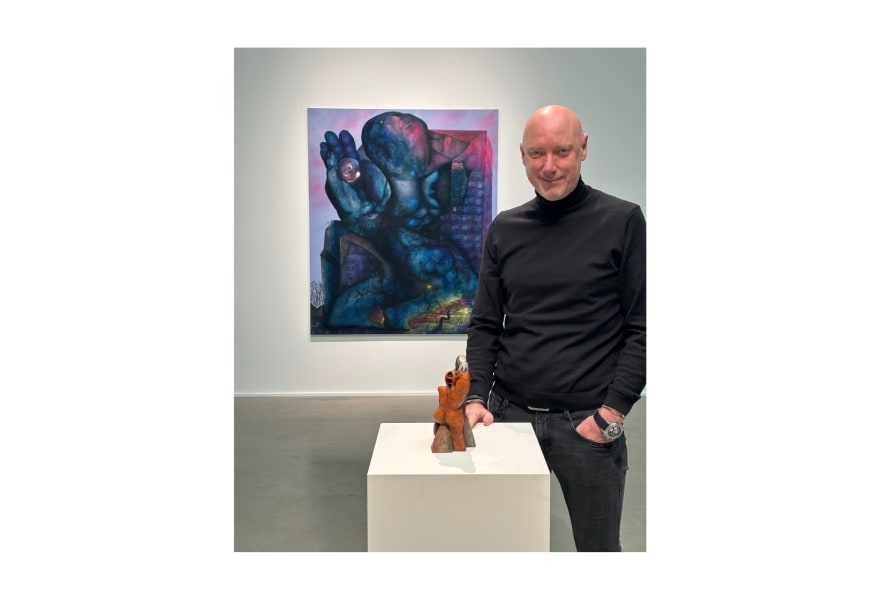
In the world of art galleries and contemporary art, there are always those who think differently, take a unique approach and bring a fresh perspective to the art market. Danny Weckx is one such individual. As the founder of Uitstalling Art Gallery & Kube, he has not followed traditional paths, but has carved out his own. With a background in industry and marketing, but a deep-rooted passion for art, he has quickly built a gallery that focuses not only on Belgian artists, but also on international talent.
What began as a personal search for art soon evolved into an ambitious project, both at home and abroad. Uitstalling is not just a gallery, but a space where art receives the time and attention it deserves. Here, it’s not just about selling art, but about creating a platform for artists and fostering a deeper dialogue about art.
I arrive just in time to admire the work of Polish artist Szaweł Płóciennik, which is being carefully packed to be sent back to Poland, while the work for the new exhibition impatiently waits in a corner to be unpacked and displayed.
Weckx takes the time during our interview to discuss his vision of art, the challenges of running a gallery and interaction between Belgian and international artists. We also take a look at the role of art criticism, the importance of strong presentation and how art is increasingly finding a place within businesses and enterprises.
Can you tell us a bit about yourself and how you ended up in the art world?
I might be a bit of an outsider in the art world. My background is in industry and marketing. Art wasn’t a big part of my upbringing; my parents were mostly focused on their work. In Limburg, there was also less opportunity for culture compared to places like Antwerp or Ghent. My interest in art really began during my travels, especially in South Africa, where I saw art on every street corner in public spaces. That fascinated me and inspired me to start collecting art, which eventually led to the creation of Uitstalling.

The Little Death (exhibition 2023) in Uitstalling Villa
When did you start Uitstalling?
In 2019. We’ve been active for around six years now. At first, it was more of a passion project, a place to showcase art that moved me. But when I do something, I want to do it well. I often saw exhibitions where the art seemed to be just thrown against the wall. I wanted to do things differently. Art needs space and artists deserve a respectful presentation. Uitstalling quickly grew into a full-fledged gallery with international ambitions.
You focus not only on Belgian artists, but also on international ones. Why?
That was a conscious strategy in the beginning. I didn’t want to be just another gallery showing local artists, no matter how talented they are. I wanted to stand out and bring international names to Belgium. Over the years, my scope has expanded and I’ve started collaborating with Belgian artists as well. But the market in Limburg remains small. Many artists move to Brussels or Antwerp, where there are more collectors. That’s why I chose to operate internationally as well.
Are there specific themes among the artists you work with?
Yes, a common thread in our programme is social engagement. Many of the artists we work with address themes such as inequality, identity and feminism. In Poland, for example, you can see how the political situation influences art. But ultimately, these themes are universal. An artist like Zanele Muholi, a visual activist, creates work that is relevant worldwide. Her work is exhibited at MoMA, but we have also shown her here. Later, she went to Paris, where over 80,000 visitors admired her work. I’m always looking for artists who have something to say, not just those who focus on aesthetics.

Rum Runner (exhibition 2024-2025), Uitstalling Gallery
You now have galleries in Poznań, Warsaw and are active in South Africa. What’s the next step?
We’re looking at Zurich. My wife is from there and I spend a lot of time in the city. It would be a logical expansion. Zurich has a strong art scene and many collectors. I think it could be an interesting place for our artists.
You also work to integrate art into businesses. How does that work?
Many entrepreneurs don’t know how to incorporate art into their corporate environments. So, I organise events for business owners and architects to introduce them to art. Art can strengthen a company and contribute to its identity. Moreover, art offers tax benefits, but many businesses are unaware of this. I help them integrate art into their spaces and advise them on possible acquisitions. The goal is to merge art and entrepreneurship naturally.
Running a gallery is economically challenging. How do you manage that?
I didn’t get into this to get rich, but out of a passion for art. People can immediately sense that on entering. Running a gallery as a pure business model is difficult, that’s true. Many gallery owners start from passion, but those who want to sell art as entrepreneurs face different challenges. You have to find a balance between commerce and artistic freedom. I don’t want to compromise on quality, but at the same time, the gallery needs to remain financially viable.

Uitstalling Gallery (Le Charbonnage)
How do you view art criticism in Belgium?
A lot of art criticism is written for a small intellectual elite. I think that’s a shame. I believe in strong writing and good exhibition catalogues, but they should remain accessible. Art should be understandable, also in terms of language. You don’t have to use complex terms to take art seriously. Art is emotion and you should be able to feel and understand it.
What can we expect next?
On 14 March, we’re opening our new exhibition 'Nothing Really Ends', a tribute to the recently deceased artist Ado Hamelryck. Art never stops. That’s also the essence of what we do here: giving art a permanent home, without any boundaries.
