13 january 2025, Yves Joris
The beauty of chaos
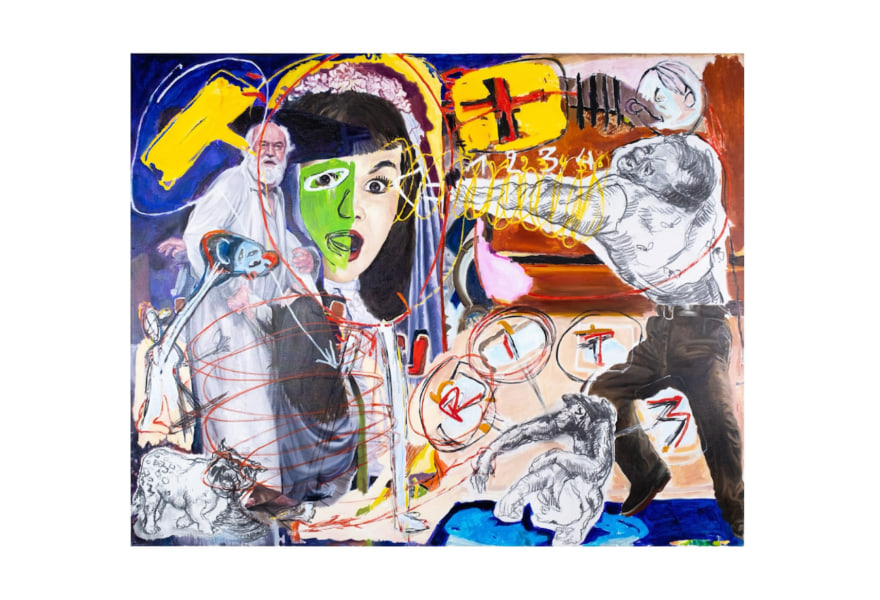
In Karl Mechnig's work, a visual complexity emerges that stimulates both reason and emotion. The 'Hola' exhibition, which opened on 11 January at Art Gallery De Wael 15, offers a labyrinth of images in which echoes of baroque opulence, playful directness of pop art and layered nature of contemporary visual culture converge. The influence of Martial Raysse, who defined pop art with his bright colours and ironic commentary, is evident, but Mechnig's approach extends beyond this. His paintings are not meant as critique, but embody a search for the poetry of the intangible. The work invites a contemplative gaze, revealing chaos as a form of beauty.
Can you encapsulate an artist's oeuvre in a single piece? Of course not, but I’ll do it anyway. "RITM", a recent work from 2024, has the honour of representing the 'Hola' exhibition. And does so magnificently.
The echo of Raysse: colour and context
Martial Raysse’s work immediately comes to mind. The bright green hue on the face of a female figure recalls his iconic portraits, in which fluorescent colours disrupt the conventional depiction of human skin. Fortunately, Mechnig resists the temptation of mere imitation. He seems to be using the green as a (limited) reference, but primarily as part of a broader visual language in which colour symbolises both alienation and expressiveness.
At first glance, the painting appears to be a collision of fragments: a priestly figure with a serene gaze, a grotesque hand gesture oscillating between violence and dance and animalistic forms that are barely distinguishable from human facial features. Across this composition winds a wildly twisting red line, a visual tornado that heightens the tension. Mechnig invites the viewer to distil meaning from this visual abundance: the artist demonstrates how the search for clarity itself can be an aesthetic experience.

Karl Mechnig, 'T licht, 2024, Art Gallery De Wael 15
Text as visual element
What gives Mechnig’s work its distinctive signature is his use of text as a visual element. Words appear not as explanatory titles or captions, but as autonomous visual signs. The word 'RITM', prominently featured in the piece, seems to have no direct meaning, but acts as a sort of visual disruptor, a fragment that is as much a part of the composition as the colours and shapes around it. The spelling, with the missing ‘e’ (or is the dissident letter lurking just outside the canvas?) adds to the work's layers. It raises questions about rhythm and disruption, about what is missing and what the viewer must fill in. Perhaps the deliberate omission of the ‘e’ hints at a conscious disturbance of language, a form of visual noise that makes the composition more dynamic. Mechnig is touching on the realm of concrete poetry in which words shed their semantic weight to become images. The letters dance across the canvas, elusive in their message, but all the more powerful in their aesthetics.
The use of text can also be interpreted as a playful reference to Mechnig’s past as a comic book dealer. The cartoonish flair of the letters and rhythmic repetition of symbols evoke the language of American comics in which image and word are in constant dialogue. Yet Mechnig avoids nostalgia; he transforms these elements into a contemporary commentary on the visual overload of our time.

Karl Mechnig, Powergirl and wonderwoman, 2023, Art Gallery De Wael 15
The baroque and the contemporary: a paradoxical symbiosis
In Mechnig's work, the dynamism of the baroque and the aesthetics of pop art initially seem opposed. With its dramatic diagonals, rich textures and mythological themes, the baroque seemingly contrasts with the flat, ironic visual language of pop art. And yet Mechnig manages to bring these two worlds together in a paradoxical symbiosis.
Just as Rubens divided the human figure into flowing, almost musical movements, Mechnig fragments the composition into jagged, overlapping layers. But whereas Rubens sought theatrical pathos, Mechnig seems to embrace doubt. His priestly figure exudes no authority, but a bewildered sense of being lost, trapped in the tangle of images surrounding him. The baroque dynamism is not used to tell a story, but to highlight the fragmentation of modern imagery.
The humour that runs through the work elevates the paintings beyond the superficial play of pop art. The playful colours, grotesque gestures and cartoonish text fragments suggest not mere irony, but a deeper sense of wonder about the absurdity of existence. It is this subtle smile, hidden amidst the chaos, that gives the work its depth.

Karl Mechnig, sinema pathé, 2020, Art Gallery De Wael 15
More than the sum of its parts
'Hola' is more than a collection of paintings; it is an invitation to pause and reflect on the role of images in today’s frantic art scene. Whereas pop art often falls into the trap of superficiality, Mechnig creates a complex visual language in which confusion and beauty go hand in hand.
His work balances seriousness and playfulness, wonder and critique. The echoes of Martial Raysse and Rubens are not references to flaunt, but building blocks for a contemporary visual narrative that confronts us with our own viewing habits.
The exhibition does not feel like a closed-off whole, but rather an invitation to look further. Mechnig challenges the viewer to embrace the game of associations, to face the chaos rather than avoid it. Because within the multitude of images, the clash of styles and fragmentation of meaning lies a deeper truth: art does not need to provide answers. It may —no, it must—continue to ask questions.
