11 january 2025, Wouter van den Eijkel
Way in the middle of the air — Steffani Jemison on tumbling, flying and freedom
The second solo exhibition by Steffani Jemison at Annet Gelink is called 'Way in the middle of the air'. The main focus is on the stories of two tumblers, i.e. professional trampoline jumpers. You don’t see them, you only hear their voices. The ease with which Jemison makes you reflect on a fundamental and abstract subject like freedom is astonishing.
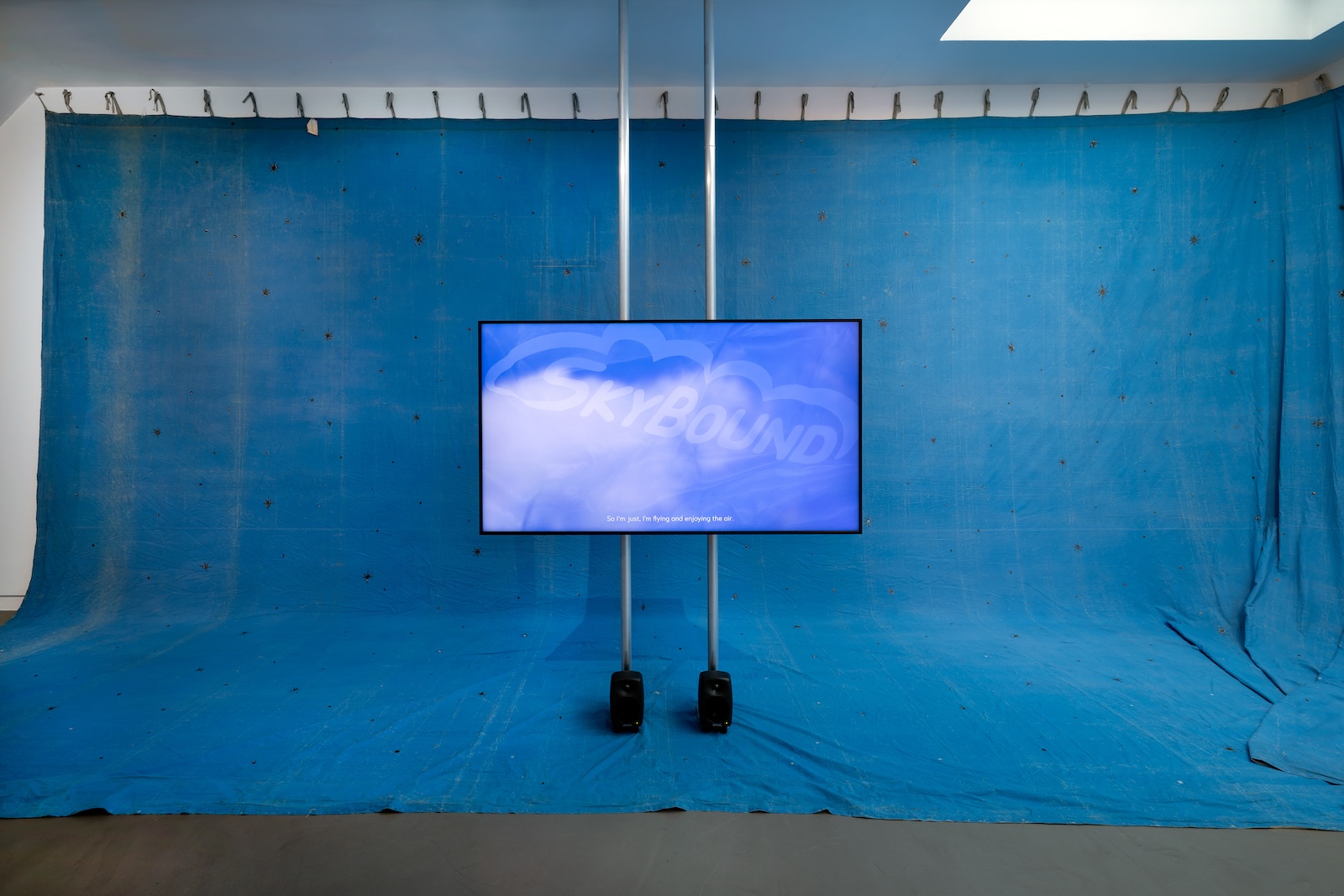
Video art has a reputation for being challenging. It often has its own rhythm, editing that can be difficult to appreciate and a logic that doesn’t align with daily life. Although Jemison takes liberties with reality in Bound, her video work is highly viewer-friendly—even though the subject addressed is multifaceted and abstract. Visually, not much happens in Bound. You see the sky—sometimes cloudy, sometimes with a chemtrail—and the camera tilts occasionally, showing the Chicago skyline for a few minutes, always filmed through the transparent fabric of a SkyBound trampoline.
A man and a woman speak. They are tumblers, professional trampoline jumpers from the Jesse White Tumblers, a predominantly African-American troupe from Chicago. Jemison spent weeks with the group, became friends with some members and asked them to collaborate on this project. As you listen, you notice that the speakers are at ease and the texts are unscripted, with all text improvised.

Steffani Jemison, Bound, 2024 HD video, colour, sound, 20:22 min. Courtesy the Artist and Annet Gelink Gallery, Amsterdam
Both talk about what they would do if they could fly instead of briefly floating. The male narrator begins his story prosaically by putting on his shoes, but within a few sentences, he’s flying above Chicago. With the exception of a few children, no one sees him: “I am just flying, so no one looks for it.” He spends considerable time describing his flying technique: “swoop, swoop and glide.” The female narrator keeps it shorter, simply stating where she would fly.
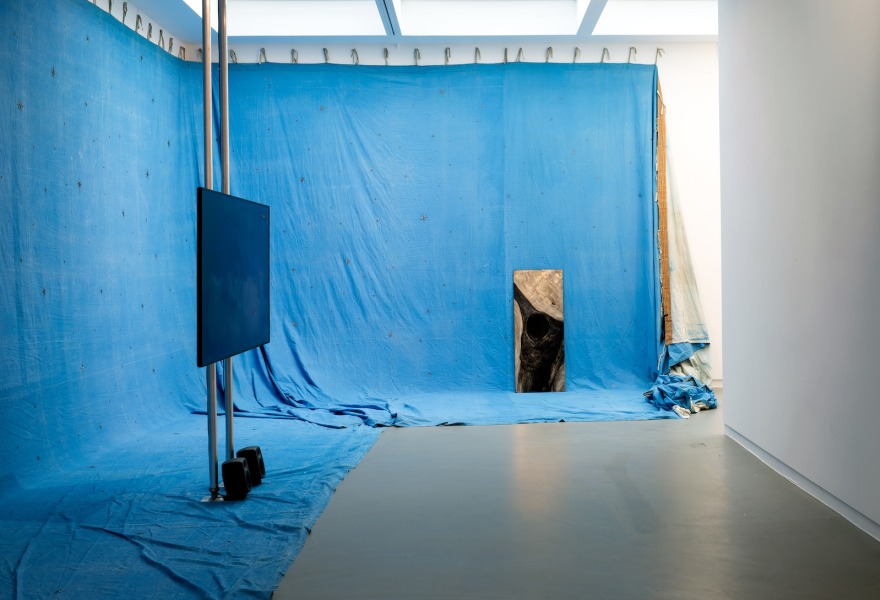
Due to the lack of a visual narrative, your attention automatically shifts to listening. In this sense, Bound resembles a podcast or radio interview, but without an interviewer. The stories are relatively simple and easy to follow. The installation is supported by a massive, light blue theatre curtain depicting a starry sky. In the gallery, the viewer is nearly surrounded by the curtain. This reinforces the idea that you’re watching a play, while also contributing to what’s
called the ‘suspension of disbelief’: you simply keep listening.
What stayed with me afterward was mainly the difference in explanation between the speakers. During the 20 minutes of the film, the man talks for around 15 minutes, while the woman talks much less. Both interpret what they would do with the hypothetical ability to fly and this radical form of freedom in their own unique way. The meaning of freedom, particularly for members of the African-American community, is the underlying theme of the exhibition. Jemison explores this subject in various ways. The interpretation above is descriptive, but those familiar with Jemison’s work know that Bound has multiple layers of meaning.
Steffani Jemison (California, U.S., 1981) lives and works in Brooklyn, New York. She only pursued an art education after studying literary studies, and this is clearly noticeable. Jemison does not work from a specific medium; her work originates from language, metaphors, stories and customs. The human body—as a nexus of social and cultural conventions and power dynamics—also plays a significant role.
One story that frequently appears in Jemison’s work is the Greek myth of Icarus. In Bound, the comparison between the tumblers and Daedalus’ son, who flew and fell, is also quickly made. The tumblers’ activity can be seen as a metaphor for flying or escaping and then falling again.
Another reference to flying, escaping and freedom lies in the exhibition’s title. Way in the Middle of the Air refers to the African-American spiritual Ezekiel Saw the Wheel, which sings about the prophet’s revelation of a flying chariot. In 1950, science fiction author Ray Bradbury borrowed the phrase Way in the Middle of the Air for a short story about African-Americans secretly building rockets to escape to Mars.
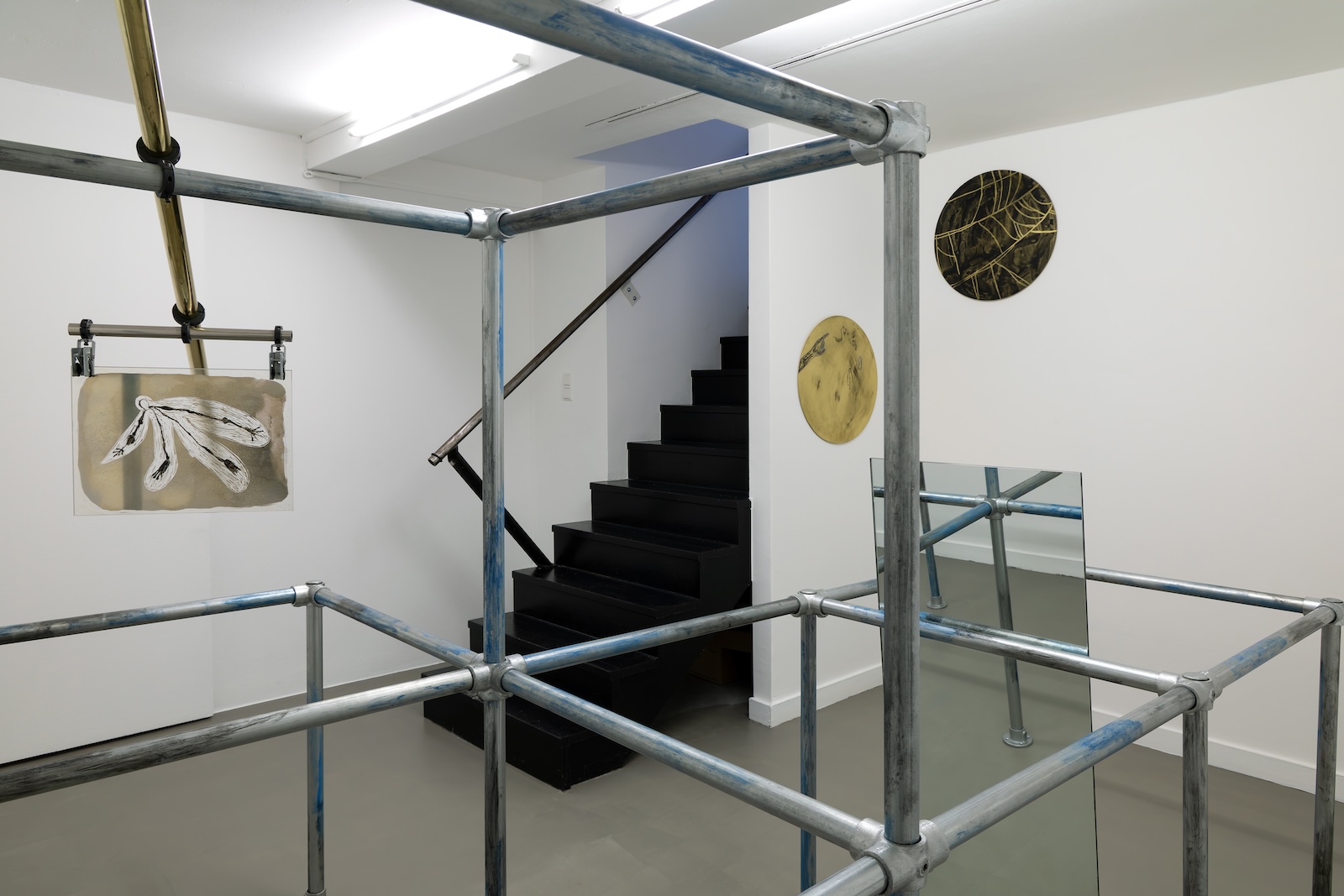
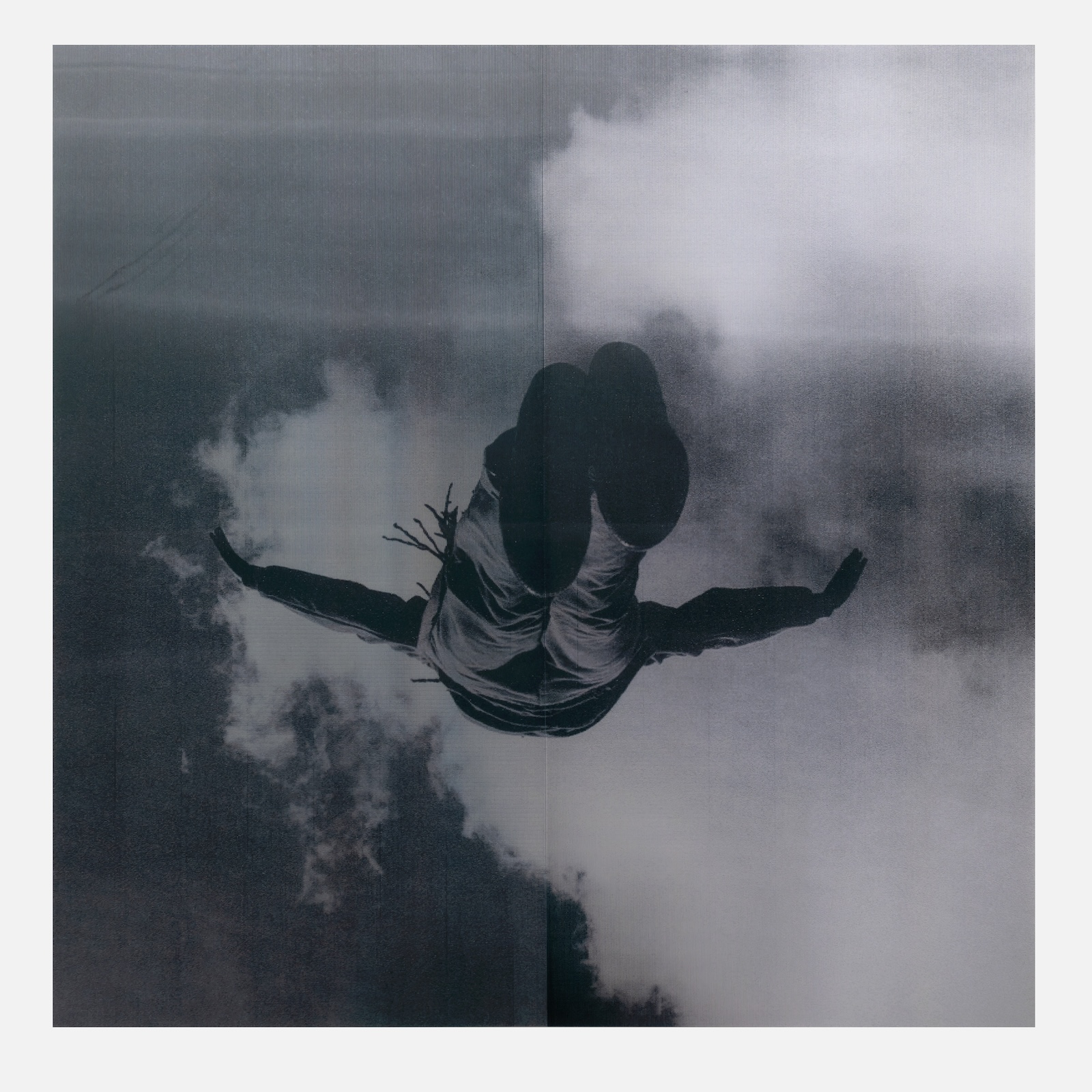
What’s remarkable about Bound, the large hologram print of a tumbler—this tumbler floats forever—and the other brass etchings on display at Annet Gelink, is that Jemison resists the temptation to use her work to make a judgment about the social disadvantage, racism or poverty faced by the African-American community. By avoiding moral judgments, her work remains accessible, open and rich in ideas.
In essence, Jemison’s work brings together ideas and customs around a theme. In 'Way in the Middle of the Air', she combines the spiritual and science fiction about flying and escaping with the acrobatics of the tumblers into a poetic work about the meaning of freedom—and consequently, about limited freedom and imprisonment.
But even if most references and metaphors escape the viewer, Bound stands on its own. The stories of the man and woman are universal enough to make you reflect on the fundamental topic of freedom. What would I do if I could fly? What would I do with this freedom? What does freedom mean to me? Would I need 15 minutes to explain it or would I be done quickly? Would I fly as inconspicuously as the man or take out my Superman suit?