25 october 2024, Yves Joris
From petrified wings to soft weights, Leen Van Tichelen and the art of balance
As an artist, Leen Van Tichelen moves through a landscape where matter and psyche almost imperceptibly touch. Her work, often created with recycled materials and tangible structures, intimately explores the tension between freedom and limitation, between weight and lightness. Within the walls of Settantotto Art Gallery, she presents her exhibition A CONATIVE INTERACTION, a body of work that not only invites us to look, but also to feel—to experience the weight of both the physical and the mental. What follows is a reflection on the fascinating journey through the human condition to which Van Tichelen exposes us.
It has been a long time since I visited an exhibition that I had no preconceived notions about. What should I understand by ‘conative interaction’? And what does ‘conative’ mean anyway? Conative is a term used in psychology to refer to the motivation and striving of a person to achieve goals. It refers to the willpower, desire or effort that someone exerts to perform certain actions and accomplish goals. Conative processes are about how people direct their energy and resources toward completing tasks, overcoming obstacles and making decisions aimed at achieving their goals. Unlike cognitive (thinking processes) and affective (emotional processes) dimensions of human behaviour, the conative dimension focuses on will, motivation and intention. With this knowledge in mind, I allowed myself to be guided by the artist.

Leen Van Tichelen, BLACK BRAIN 12, 2015, Settantotto Art Gallery
In Van Tichelen’s world, nothing is what it seems. Matter carries stories and objects become bearers of deeper meanings. Her work reveals a delicate balance between the hard and the soft, between what we can see and what resides invisibly within us. Take, for example, her much-discussed series BLACK BRAIN. This collection of 27 drawings is inspired by brain scans, but whereas medical science shows us hard facts, Van Tichelen offers us a glimpse into the fragility of the human mind. Each work raises the question of how structures within us influence how we act, feel and think. In these drawings, we do not merely see anatomy; the lines and shapes suggest a dark inner world full of tension and movement. The contrast between black and white, sharp and soft, reflects the psychological burdens we carry. The work seems to whisper: how much can we bear before we break?
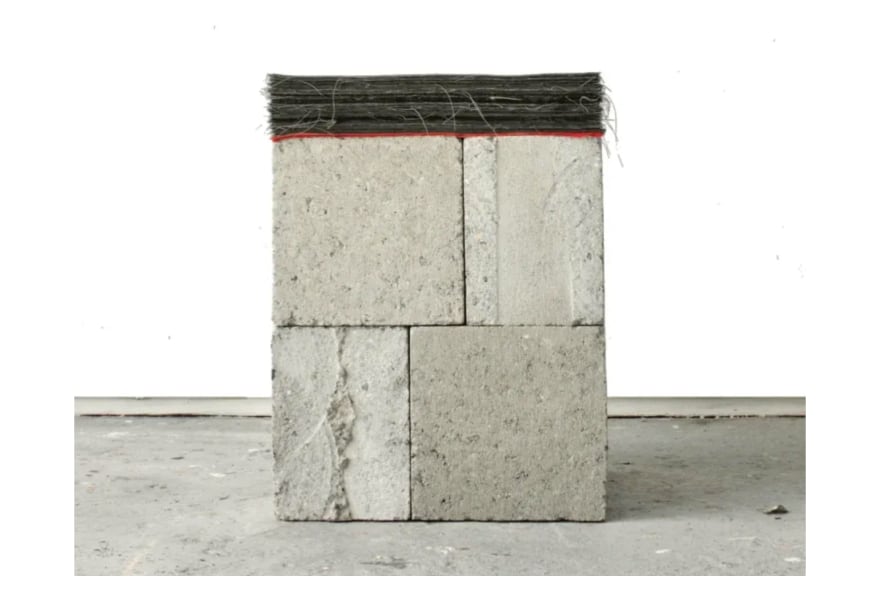
This sense of burden becomes literally tangible in her installations. In the BALLAST series, the idea of physical weight is made tangible through large structures filled with straw, balanced by heavy stones. These stones—found in her garden and at construction sites—are not just raw materials, but symbols of the weight of emotional burdens. "It's about how much you can carry, both physically and emotionally," she says. This theme, the confrontation between strength and fragility, forms a central theme in her work.

Leen Van Tichelen, 80 pieces of 10 birds falling down in four different ways. B1, Settantotto Art Gallery
A recurring theme in Van Tichelen’s work is the duality of freedom and limitation. This is beautifully depicted in her work with wings and masking tape, where both elements take on different meanings. Masking tape, typically used to mark off areas, takes on a much broader symbolic significance in her work. It is a means to create boundaries, to fix something in place, yet also a material that leaves room for interpretation. "Tape blocks off something; it creates a boundary where nothing can pass," she explains.
In her winged works, we find a counterbalance to this limitation. The wings symbolise the human urge for freedom—our constant desire to break free from the barriers surrounding us, both physically and mentally. In the series Ten birds falling down in four different ways, this tension between control and freedom is masterfully made visible. Van Tichelen uses one form, that of a falling bird, to create an endless number of variations. "I am fascinated by how many possibilities there are to create so many new movements with one shape," she explains.
The repetition in these works resembles a meditative exercise: the same form again and again, but always slightly different. It suggests that within limitations lies immense freedom, provided we take the time to explore it. Just as the masking tape marks a boundary, it also opens up the possibility to redefine boundaries, to transform the physical into the mental.

Leen Van Tichelen, BLACK BRAIN 09, 2015, Settantotto Art Gallery
Between weight and lightness
A striking aspect of Leen Van Tichelen’s work is her refined handling of materials. She consciously chooses rough, recycled materials like paper, concrete and wood, each telling its own story. Although her sculptures are often heavy and robust, they also have a surprising lightness about them. This tension between weight and lightness is an essential feature of her work. Concrete plays a central role in this: a material that reminds us of steadfastness and brute force of industry. Yet Van Tichelen gives it a fluid and almost soft appearance.
In her installations, she combines concrete with other materials, such as pigments and coatings, giving the work an unexpected softness and movement. She explains, "I want my work to claim space, but without being overwhelming. It should breathe in and absorb the space." This play with contrasts—between heavy and light, between solid and fluid—makes a deep impression on the viewer. It is as if the objects in her work not only take up space, but also become part of a broader dialogue about the human experience.
Her choice of materials is always careful and has significance. For example, she uses a type of kraft paper used to protect floors during renovation work as the basis for many of her drawings. This paper serves as a metaphor for protection and vulnerability, for the temporary and the permanent. Just like the concrete in her sculptures, each element in Van Tichelen’s work carries a layer of both physical and mental significance.
A spatial conversation that challenges the senses
The exhibition at Settantotto is more than a visual presentation of objects; it is a sensory experience, a spatial conversation between the artist, the material and the viewer. Van Tichelen’s works invite you not only to look with your eyes, but to be physically present, to feel the weight and the movement. Her art speaks to our deepest experiences of control and release, of strength and vulnerability. She says, "The work must speak and I hope the audience is willing to listen, not only with their eyes, but with their entire body."
The artist compels us to pause, to reflect on our own burdens, our own limitations, but also our possibilities. Her work offers no answers, but raises questions—questions about what we can bear, about how we relate to the material and mental world around us. In the subtlety of her structures, we find a profound dialogue that lingers long after we leave the space.
With this intimate yet impressive exhibition, Van Tichelen shows that the boundary between freedom and limitation is not fixed, but constantly shifting. Her work is an invitation to self-examination, to question the burdens we carry and the space we occupy.
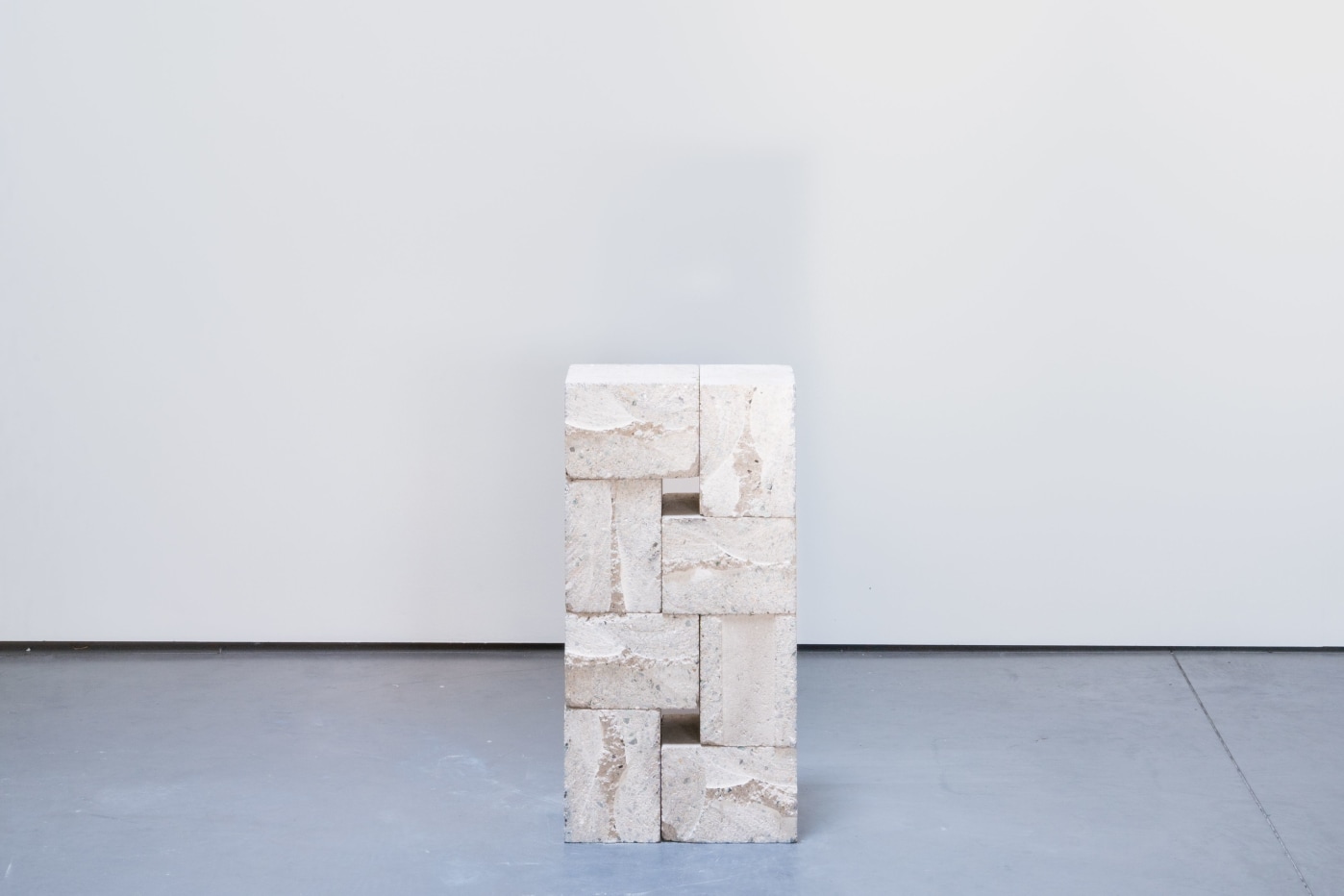
Leen Van Tichelen, STACK II, 2024, Settantotto Art Gallery. Photo: Liesbet De Waele
