11 october 2024, Yves Joris
Disentangling into shapes and stories
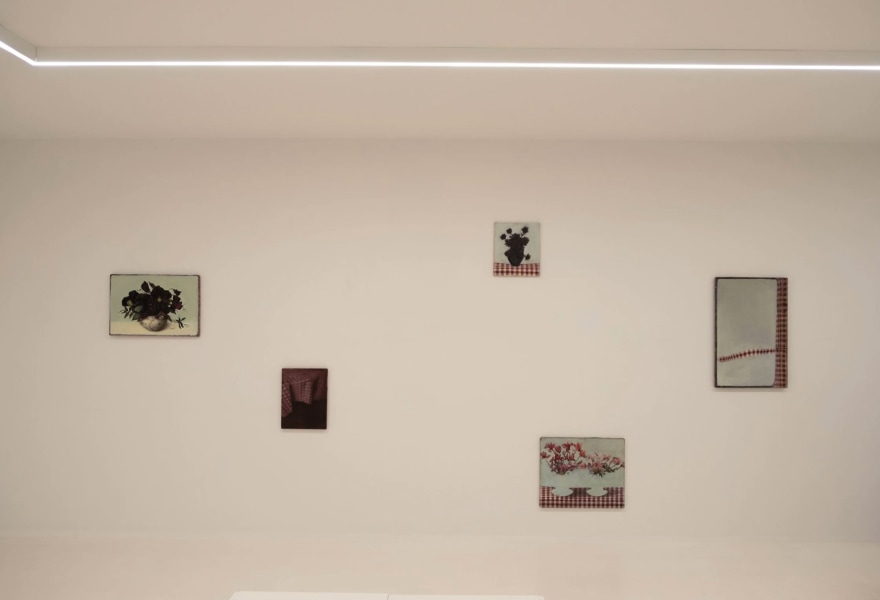
Gallery owner Gert Junes approaches me on a bicycle. Like me, he is enjoying the warm autumn sun. The sun casts shadows on the windows of Gallery Art Partout, blending seamlessly into the works of Diederik Boyen. The new exhibition ont-BINDING evokes a feeling as fleeting as it is elusive, as if you are stepping into a dream landscape where each work displays a fragment of a vanished reality. Boyen, who has enjoyed years of success with his layered and melancholic paintings, goes further here than ever before. The exhibition takes the viewer on a journey of decay and reconstruction, a process that seems to unfold not only in the works of art, but also in the space itself.
The premise behind ont-BINDING is not merely an aesthetic one. To me, it is a deeper investigation into the boundaries of reality. Boyen, known for his portraits with dark, melancholic undertones, has embarked on a new path in which he reuses old canvases, placing them in a completely new context. He cuts and manipulates the old textures, leaving the original patina of the canvas partially intact and using it as the foundation for his creations. The result is an intriguing interaction between abstraction and realism in which time itself appears to be captured as a visible element on the canvas.
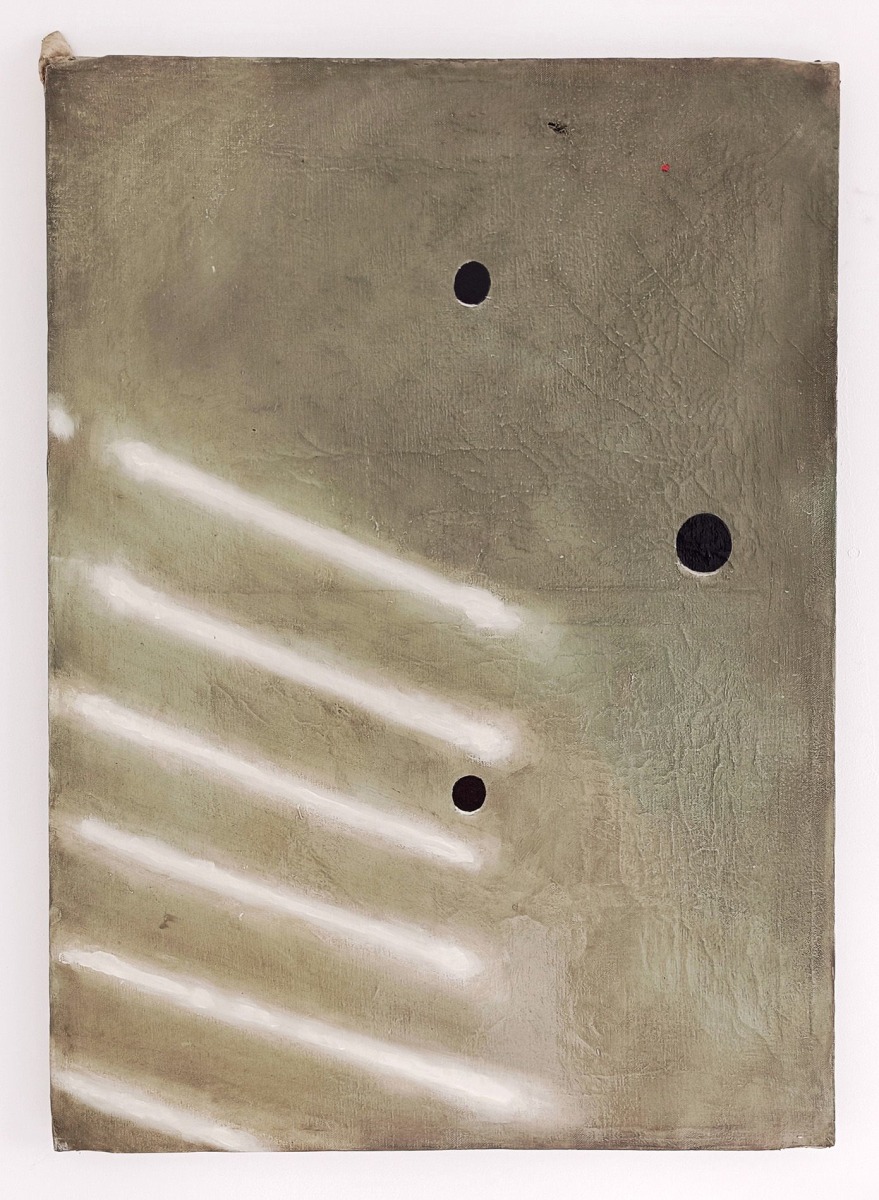
Diederik Boyen, Zwarte Gaten, 2024, Art Partout
De Spons Er Over
One work that immediately strikes me for its simplicity and power is De Spons Er Over (Subject Closed). Here, Boyen shows us not only a painting, but a philosophical statement. A simple pink sponge placed in an empty space raises more questions than it answers. The Dutch expression ‘to sponge over something’ means to declare a subject closed, taking on a double meaning here. On the one hand, it refers to the process of forgetting, of erasing a past that no longer seems relevant. But with this painting, Boyen emphasises the opposite: can the past ever truly be erased? The sponge seems almost randomly placed in the space, but the precise shadows and light play make it clear that it is anything but a coincidental composition.

Diederik Boyen, De Spons Er Over, 2024, Art Partout
What Boyen does here is nothing less than engaging in dialogue with art history. It is almost impossible not to think of Robert Rauschenberg’s famous work Erased de Kooning Drawing, in which the erasure of a masterpiece itself became a work of art. But, for Boyen, it is not the physical act of erasure that is central, but the symbolic act. The sponge makes us ask whether we can ever truly forget what lies behind us or whether the remnants of the past always linger in the shadows.
The void surrounding the sponge further emphasises this. Whereas Rauschenberg directly erased an image, Boyen’s sponge makes us pause and consider whether anything can be erased at all. The void that follows the sponge is not complete: something always remains, be it in the form of a memory, shadow or vague imprint.

Diederik Boyen, De Kerktoren, 2024, Art Partout
Under the steeple, in the footsteps of Luc Tuymans
The work De Kerktoren (The Steeple) shows us a very different kind of alienation, but with the same underlying theme. We see a road winding through a deserted landscape along whitewashed walls that seem almost ghostly. These walls immediately bring to mind Luc Tuymans’ Vlaams Dorp (Flemish Village). The significant difference between the two works is that in Boyen’s, the church tower is hidden from our view. Does the winding path lead to a church tower shrouded in misty silence? Has Boyen painted over the church tower that was once prominent in a previous figurative life, leaving us with only the title of the work in which it lives on?
Boyen’s subtle use of colour plays a crucial role here. The shades of green and grey dominating the landscape give the work a silent, almost suffocating feel, as if you are looking at a scene that is not taking place in our world, but a timeless, elusive moment between reality and dream. The house that appears on the right seems to be melting away, as if reality is literally dissolving. This fading of solid forms and structures seamlessly aligns with the overarching theme of ont-BINDING: the dismantling of our known world, the crumbling of what once seemed certain.
De Kerktoren balances between figuration and abstraction in a way that is characteristic of Boyen’s more recent work. The image starts off recognisably, almost traditionally, but the longer you look at it, the more the image disintegrates before your eyes. The paint, which seems to drip and flow, tells the story of a world that can no longer hold itself together. It is as if the artist is inviting us to observe the unravelling of reality, to surrender to the inevitable decay.

Diederik Boyen, Toile Cirée 02, 2024, Art Partout
Painting as sculpture
Junes calls Boyen’s exploration of the boundary between painting and sculpture one of the most remarkable aspects of his work. His earlier paintings were masterpieces of technical control, full of melancholic portraits in which every brushstroke was carefully considered. But in ont-BINDING, we see an artist who has left behind the limitations of the flat surface. By working on old canvases that already have their own history, a new, layered dimension emerges. These are no longer just paintings constructed with paint, but physical objects in their own right, works of art that appeal not only to the eye but also to the touch.
The manipulation of the canvas—cutting, folding and recomposing—raises questions about the materiality of art. When does a painting become a sculpture? Where does one end and the other begin? It is these questions that make Boyen’s work so intriguing. It is this tactility that makes Boyen’s work so tangible, almost physically palpable. Each work bears the marks of its past, from the canvases that were once something completely different. But Boyen adds something new: his own interpretation, a new layer of meaning that arises from the process of destruction and creation.
ont-BINDING is more than a collection of paintings. It is a journey through time and space, a story about decay and rebuilding. The artist explores not only the material side of art, but also the symbolic significance of what it means to break something down and build it back up again. Each work seems steeped in history, not only that of the canvas itself, but also of broader art history and the human experience. On leaving the exhibition, the feeling lingers of a world in constant change, where nothing is ever truly permanent. Boyen’s paintings make us reflect on the fragility of our reality, on the question of whether we can ever truly let go of what lies behind us, and what remains when everything has been erased. ont-BINDING is an invitation to participate in this process, to surrender to the decay and reconstruction of what we know and to realise that in art—just like in life—nothing can ever be completely erased.

Diederik Boyen, 'ont-BINDING', Art Partout
