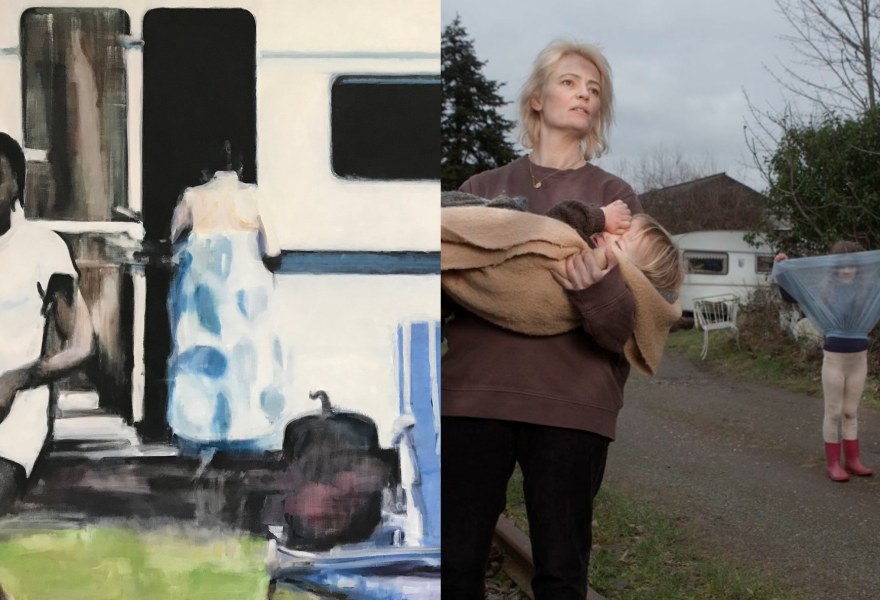
Miloushka Bokma presents the series "Sense of the Damaged", which is connected to a video piece of the same name that was recently on view at Eye as part of Cinedans. Drawing inspiration from press photographs of refugees, this series probes the complex phenomenon of modern desensitization — the ways in which a continuous stream of intense news reports, often accompanied by poignant images, gradually diminishes our sensitivity to the harrowing reality. These realities, steeped in sorrow and loss, paradoxically highlight the resilience of humanity, sometimes yielding images of an almost surreal quality. Bokma's work explores the subtle nuances of her subjects' body language and facial expressions, revealing how they relate to their environment. She is interested in the layers that are not immediately visible. Often, careful planning precedes the shooting process, but she also embraces a certain degree of chance. As a viewer, you are immediately invested in the narrative: what has happened here, or what is about to happen? And how does it relate to the image it was inspired by?
Bokma studied at the Utrecht School of the Arts and has exhibited her work at the Houston Center for Photography, the Gallery of Photography Dublin, the Fries Museum, SOHO Century Plaza in Shanghai, and during the 7th Cairo Video Festival.
Andrea Rádai, Black White Colour I, diptych, 2021, O-68
Andrea Rádai's oil paintings emanate a captivating tension, often fueled by narratives that are incomplete and emotionally charged. Rádai's inspiration primarily comes from a vast array of found material, ranging from film clips and news segments to photographs and personal stories. She describes herself as a voyeur, but not in a non-committal way. Rádai emphasises, "The gaze is not a neutral tool of registration, but one which brings up many questions of moral obligation. There is power in looking, just as there is power in being able to avert one’s eyes.” The artist typically invents an extensive backstory to what she observes. The resulting painting is positioned somewhere between the original image and the specific feeling that Rádai wanted to add to it, effectively creating a completely new context. She encourages viewers to use their imagination and opts for a slow medium in an era that is dominated by the rapid consumption of imagery. Her work occasionally spotlights specific themes, as is the case in her exploration of the Duinmeijer family vacation photos. They were the victim of a horrific family drama: the murder of their (black) son Kerwin by a skinhead in 1983. Rádai was deeply affected by his story and used the vacation photos, among other things, to expose the complexity of power dynamics and socio-economic disparities.
Rádai completed her education at the Hungarian University of Fine Arts in Budapest, followed by a degree at the Minerva Art Academy in Groningen and the École Nationale Supérieure des Beaux-Arts in Paris.